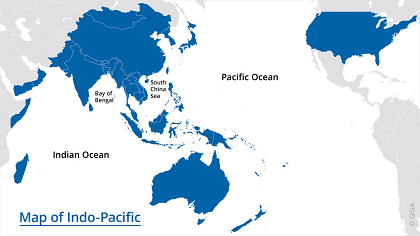
GIGA_map_of_Indo-Pacific_Kontur_resize Courtesy: Science Po
28 July 2022

India’s blue economy and the Indo-Pacific’s future

The Indo-Pacific region envisages the Indian and Pacific Oceans as a continuum and stands on two central pillars – maritime security and economic development. The public discussions, however, are focused on maritime security, strategy and geopolitics, while economic development has received less attention. This imbalance can be corrected by creating an awareness on how to harness the potential of the region's Blue Economy and its vast resources and opportunities.

ISRO satellite Courtesy: ISRO
26 May 2022

India’s EO satellites in the Indo-Pacific

The Quad has agreed to launch a satellite-based maritime security initiative to curb illegal fishing by China. India is a global leader in satellite launches, especially in Earth Observation (EO) satellites. The Indo-Pacific nations are looking at the Indian model because it is applicable, economical, and sustainable.

FILE - In this April 12, 2018, file photo released by Xinhua News Agency, Chinese President Xi Jinping, left, speaks after he reviewed the Chinese People's Liberation Army (PLA) Navy fleet in the South China Sea. From Asia to Africa, London to Berlin, Chinese envoys have set off diplomatic firestorms with a combative defense whenever their country is accused of not acting quickly enough to stem the spread of the coronavirus pandemic. (Li Gang/Xinhua via AP, File) Courtesy: The Japan Times
31 March 2022

China’s military modernisation

China's 2022 defence budget reflects the seriousness of the Communist Party aims to fully modernise the People’s Liberation Army by 2027. Given the on-going border competition, it is crucial for India too, to optimise budgetary resources, intensify restructuring and enhance indigenous defence production, thereby improve power projection capability.

TDB_car_151021 Courtesy: TDB
24 February 2022

Enhancing Regional Financial Intermediation in the Indo-Pacific

Financial intermediaries are critical lubricants for business, growth and development. The Indo-Pacific countries are industrializing, but smaller nations lag behind economically. The Quad countries can aid the advancement of the financial architecture in the Indo-Pacific by helping to develop an ecosystem, modelled on the examples of Japan and India.

quad fm photo mea Courtesy: Ministry Of External Affairs
24 February 2022

The Quad converges beyond China

The Quad Foreign Ministers’ Meeting, held in Melbourne on February 11, revealed an ambitious plan for economic and developmental affairs, beyond the security concerns posed by China. Despite differing approaches towards Myanmar and Ukraine, the Quad countries are strengthening their cooperation while maintaining strategic autonomy.

amb saurabh kumar Courtesy: Ministry of External Affairs, Government of India
3 February 2022

India’s Indo-Pacific vision

Saurabh Kumar, Secretary (East), Ministry of External Affairs, Government of India, delivered the keynote address at the panel discussion on India in the Indo-Pacific: Pursuing Prosperity and Security, organised by Gateway House and the U.S. Embassy, New Delhi, on 1 February 2022. He outlined India's vision for a free and inclusive Indo-Pacific, and the initiatives undertaken to further cooperation among nations in the region.

Europe - IP Courtesy: Club of Three
18 November 2021

Indo-Pacific through the European prism

The EU's Indo-Pacific strategy, released in September, set the tone for a renewed focus on the region. Europe's Asia connect is rich, strong and multi-layered, laying the foundation for an advantageous position for the EU in the Indo-Pacific. This can be achieved if the EU is more candid with itself, more assertive with China, and more cooperative with India.

bcim corridor Courtesy: Institute of Peace and Conflict Studies
9 November 2021

Physical connectivity in the Bay of Bengal

China is a clear winner in the physical connectivity stakes in the Bay of Bengal, and there's a reason a why: Its projects are connected to one another, from rail to road to port. While India also has some successful cross-border road and rail infrastructure projects, they are often an extension of an existing railway line or highway, not specific to the connectivity needs of the region. India can win by focussing instead on building infrastructure to maximise the vast maritime potential of the Bay of Bengal, especially the Andaman and Nicobar Islands that give India access to critical sea channels and trade routes.

The Bay of Bengal: The next battle Courtesy: Shutterstock
28 October 2021

Bay of Bengal: Building tech connectivity

The Bay of Bengal is a natural bridge between South and South-East Asia, which New Delhi seeks to optimise. But progress on India's Act East policy has been slow, creating a space for China's Belt and Road Initiative to step into. While India cannot match China’s cheque-book diplomacy, it can use its start-up industry to pursue a combination of physical, technological and financial projects to improve regional connectivity.