Quad amidst a geopolitical flux Courtesy: Twitter | @narendramodi
23 September 2021

Quad amidst a geopolitical flux

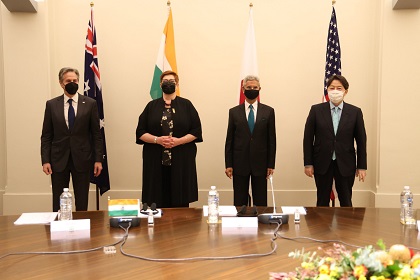
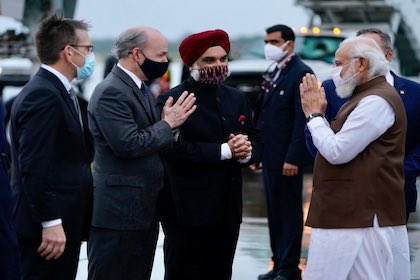
On September 24, the Quad leaders will attend the first in-person summit of the grouping in Washington DC. There is much to discuss for the four leaders, given recent developments: the Taliban takeover of Afghanistan, the Australia-UK-US (AUKUS) security partnership and the EU's new Indo-Pacific strategy. The Quad also needs to focus on long term goals like institutionalising itself and devising a strategy to counter the China challenge.

2019-06-14T000000Z_1951021920_RC-2 Courtesy: SCO, Russia (2020)
22 July 2021

China’s quad?

A potential anti-Quad formation of China, Russia, Iran and Pakistan is in the making, and can pose risks to the Quadrilateral Security Dialogue. However, a close analysis of China's bilateral relationship with each country shows that this is a flawed grouping, formed on limited common interests and rivalries.

Source: Shutterstock Courtesy: Shutterstock
3 June 2021

The Quad hits its stride

As China’s global competitive edge is sharpening across the military, economic, diplomatic, and technological domains, it is clear that the extent to which the Quad countries (Australia, India, Japan, and the United States) can collaborate across all four domains will be an important factor in determining whether China’s hegemonic designs on the Indo-Pacific will succeed.

India, IOR and blue economy Courtesy: Common Wealth
25 February 2021

India, IOR and the blue economy

The Indian Ocean Region (IOR) presents a unique opportunity to develop a Blue Economy, with security, sustainability and business profitability as its three pillars. An IOR Defence Ministers' Conclave held on 4 February provided a platform to discuss regional cooperation, linking development with defence, and emphasized India's pivotal position within the IOR.

Quad image_ Courtesy: Shutterstock
10 December 2020

To formalize the Quad – or not

Should the Quad be formalized? It has evolved from a crisis response group in 2004 to a strategic partnership today between the four member-countries – India, the U.S., Australia and Japan. There are benefits and challenges to the institutionalisation of the Quad which require timely analysis, especially as the group has renewed vigour this year with the COVID-19 pandemic and China’s aggression in the Indo-Pacific region.

shutterstock_1091235845 Courtesy: Shutterstock
15 October 2020

UN: Necessary but reformed

The UN turned 75 this year but instead of grand celebrations, the world witnessed an empty UNGA with world leaders addressing it via video screening because of the pandemic. The UN is under unprecedented stress and being shown up for its inability to tackle the challenges of today like the pandemics, climate change, terrorism or global peace and security. The institution's key governing structures, especially the UN Security Council, are inadequate and demand reform. India must now use gritty resolve to ensure its place in these governing structures.