Indo-Pacific: New Geostrategic Reality
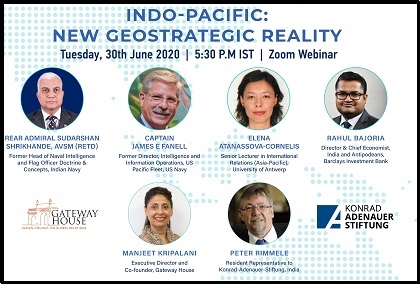
On 30th June, 2020 Gateway House in association with Konrad-Adeneur-Stiftung (KAS) co-hosted a webinar on Indo-Pacific: New Geo strategic reality.

 Courtesy: Gateway House
On 30th June, 2020 Gateway House in association with Konrad-Adeneur-Stiftung (KAS) co-hosted a webinar on Indo-Pacific: New Geo strategic reality.
 Courtesy: Shutterstock/Gateway House
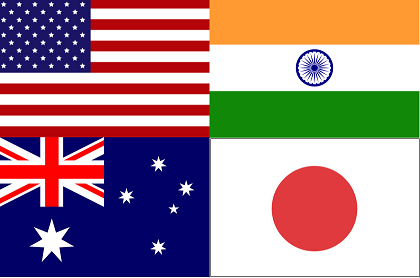
China’s escalating actions in the wake of the COVID-19 catastrophe is a calculated strategic diversion and risk. In the Indo-Pacific, tensions between China and the U.S., Australia, India and others are building momentum. As a geopolitical partnership, the relevance of the Quad is now proven. There are clear ways to empower it immediately, and make it a resilient grouping.
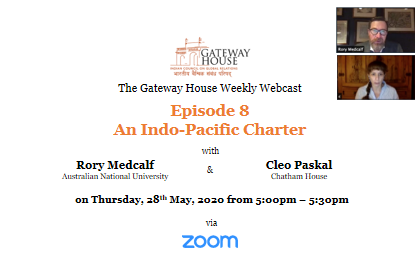
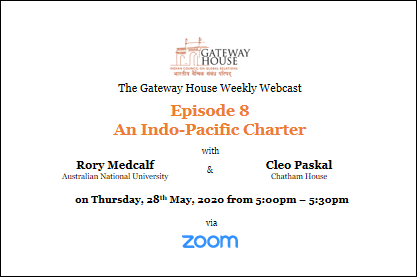
Manjeet Kriplani, Executive Director, Gateway House, in discussion with Prof. Rory Medcalf, Head, National Security College, Australian National University, and author of Indo-Pacific Empire: China, America and the Contest for the World's Pivotal Region; and Cleo Paskal, Associate Fellow, Energy, Environment and Resources, and Asia-Pacific, Chatham House; on the possibility of an Indo-Pacific Charter for the region.
 Courtesy: Gateway House
Manjeet Kripalani, Executive Director, Gateway House, in discussion with Prof. Rory Medcalf, Head, National Security College, Australian National University, and author of Indo-Pacific Empire: China, America and the Contest for the World's Pivotal Region; and Cleo Paskal, Associate Fellow, Energy, Environment and Resources, and Asia-Pacific, Chatham House; on the possibility of an Indo-Pacific Charter for the region.
 Courtesy: Shutterstock
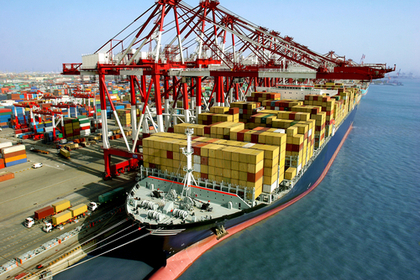
Globalisation has resulted in the interdependence of nations through the largely unimpeded transmission of investment capital and information, and integrated business operations. The leading beneficiaries have been the global 1%, and China. While it is too late and not possible to roll back an interconnected world order, globalization as we know it will recede, as will China’s standing in the world.
 Courtesy: Shutterstock
Recent investments by Facebook, Silver Lake, Vista Equity Partners, General Atlantic, KKR, Mubadala, ADIA, TPG, L Catterton and Intel Capital could well be the infusion of capital and expertise Jio needs to compete with Alibaba and Amazon. The infographic compares the number of services offered by these companies across different technology domains
 Courtesy: Shutterstock
Under the ‘Artemis Accords’ the U.S. is planning an international coalition to extract natural resources from the Moon. China is concurrently planning an Earth-Moon Special Economic Zone. India’s antiquated endorsement of the 1979 Moon Agreement is shackling its true potential for economics-driven space exploration. India must immediately do away with Cold-War era, vintage whims of global commons.
 Courtesy: Gateway House
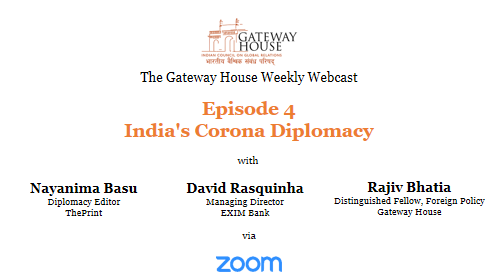
In this webcast, we discuss India's Diplomacy during the COVID-19 pandemic with David Rasquinha, Managing Director, Exim Bank, Amb. Rajiv Bhatia, Distinguished Fellow, Foreign Policy Studies Programme, Gateway House and Nayanima Basu, ThePrint.
 Courtesy: Gateway House
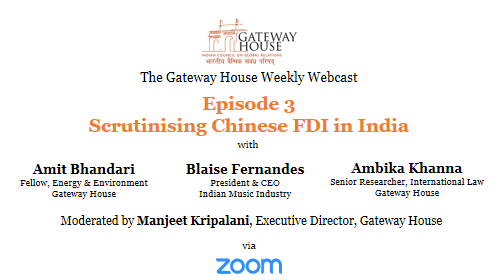
Amit Bhandari, Energy & Environment Fellow, Gateway House; Blaise Fernandes, President, Indian Music Industry Association; Ambika Khanna, Senior Researcher, International Law Programme, Gateway House discuss the reaction to China’s increased investment in HDFC, the depth and motive for China's investments in India, and the new FDI rules put in place by the government to protect strategic investments in the country.
 Courtesy: Foreign Affairs
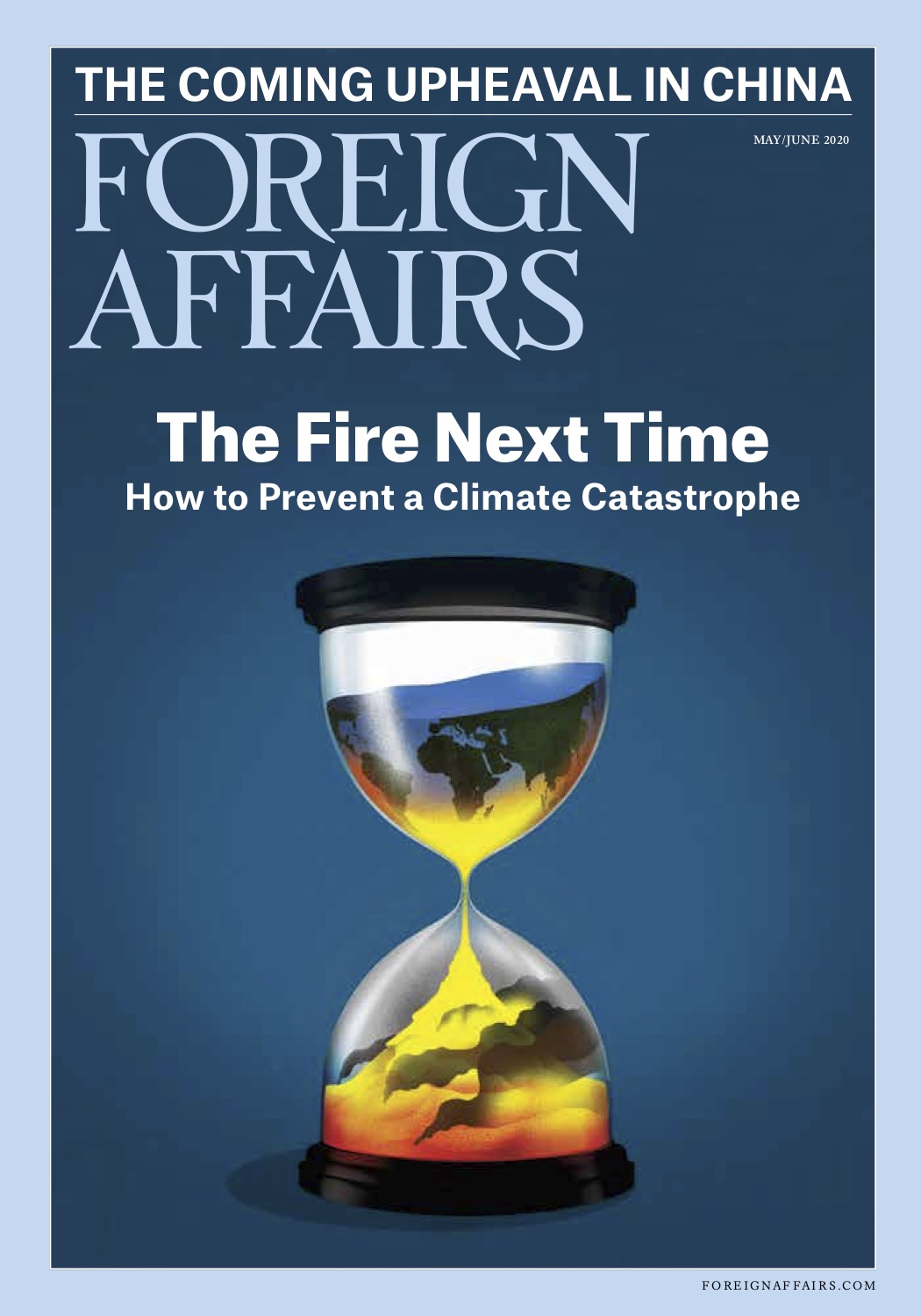
The U.S.-China relationship, which has wavered between cooperation and competition, has, over the past few years, veered more sharply towards confrontation – possibly because of China’s own more assertive stance. Now, Beijing’s confidence is under test, not only by these fractious relations, but also COVID-19 and an economic slowdown. Will these factors reveal its weaknesses?