Gateway House launches first Quad Economy and Technology Task Force
The Task Force led by Gateway House will study economic and technological cooperation between the four like-minded democracies in the Indo-Pacific.

 Courtesy: Gateway House
The Task Force led by Gateway House will study economic and technological cooperation between the four like-minded democracies in the Indo-Pacific.
 Courtesy: Shutterstock
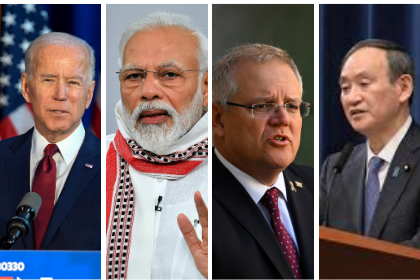
In its recent itineration, the Quad (or the Quadrilateral Security Dialogue) has been toiling since 2017, through deliberations among mid-level and senior officials, to develop a common vision for the challenges facing the Indo-Pacific region, challenges caused by China's menacing rise and aggressive behaviour.
 Courtesy: Shutterstock
As 2021 opens, the post-COVID world can expect some changes in the geopolitics of Asia. It will involve altering equations in the Indo-Pacific among major, middle and small powers. These will fluctuate with characteristic familiarity, creating instability, tensions and strife, but not leading to military conflict – barring an unforeseen accident. Post-COVID, the world will be uncertain and complex.
 Courtesy: Shutterstock
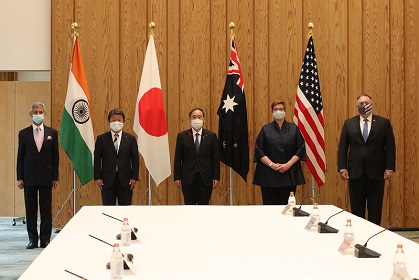
Should the Quad be formalized? It has evolved from a crisis response group in 2004 to a strategic partnership today between the four member-countries – India, the U.S., Australia and Japan. There are benefits and challenges to the institutionalisation of the Quad which require timely analysis, especially as the group has renewed vigour this year with the COVID-19 pandemic and China’s aggression in the Indo-Pacific region.
 Courtesy: US Navy/Twitter
Australia's much-awaited inclusion at the Malabar Exercise-2020 reflects a hard reset in India's foreign policy that was traditionally accommodative to Chinese concerns on the militarisation of the Quad. In the backdrop of the on-going stand-off with China at the Ladakh border, the Indian Navy has maintained a high operational tempo and deployed the highest numbers of frontline assets during this edition of the Malabar Exercise. India must build on this strategic vision and work towards including France at the next edition of Malabar in 2021.
 Courtesy: Shutterstock
On 21 October, Gateway House and the Institute of Chinese Studies, Delhi jointly hosted a webcast with Ambassador (Lt. Gen.) Karl Eikenberry, Sinologist, Deputy Chairman, NATO Military Committee; former Director of the U.S.-Asia Security Initiative at the Shorenstein Asia-Pacific Research Center, Stanford University on the Growing Sino-American Military Rivalry
 Courtesy: Shutterstock/Gateway House
Now that the India-U.S. 2+2 meeting has ended, Indian officials are preparing for a hectic season of summiteering in November, from the SCO to the BRICS and the G20. All will give India global attention, and help the country prepare its positioning at home and abroad.
 Courtesy: Wikimedia Commons
The Space20 is the newest sub-forum of the G20 initiated by Saudi Arabia, with the support of the United Nations Office of Outer Space Affairs. India, on its way to the G20 presidency in 2022, should set a comprehensive Space20 agenda for the democratization of outer space, whereby it can share its space growth story with the developing world and achieve its goal to become a global knowledge epicenter.
 Courtesy: Shutterstock
The UN turned 75 this year but instead of grand celebrations, the world witnessed an empty UNGA with world leaders addressing it via video screening because of the pandemic. The UN is under unprecedented stress and being shown up for its inability to tackle the challenges of today like the pandemics, climate change, terrorism or global peace and security. The institution's key governing structures, especially the UN Security Council, are inadequate and demand reform. India must now use gritty resolve to ensure its place in these governing structures.
 Courtesy: Shutterstock
Ambassador Rajiv Bhatia, Distinguished Fellow, Foreign Policy Studies Programme, Gateway House delivered the opening remarks at the 2020 Asia Economic and Entrepreneurship Summit, in the lead-up to the session, - The Future of Asia Pacific Economic Cooperation in a Sustainable VUCA World – What to Expect? What Next? The Summit was jointly organised by the KSI Strategic Institute for Asia Pacific (KSI), The Pacific Basin Economic Council (PBEC) and China Daily Asia Pacific (CD), Kuala Lumpur, 8 September 2020.