Screenshot 2025-10-13 103335 Courtesy: Körber-Stiftung
13 October 2025

Bandung at 70: Multilateralism in a New Era of Multi-Alignment

The world is facing multiple crises which are shaking the foundations of multilateralism. The West’s structures are faltering, and the need for effective and equitable cooperation is greater than ever. Seventy years after the 1955 Bandung Conference, its principles of sovereignty, territorial integrity, cooperation and solidarity remain vital. This report revisits Bandung’s relevance for today’s reform efforts, urging renewed Global South–Europe collaboration for a sustainable global future.

Report Courtesy: Körber-Stiftung
17 April 2025

Momentum for Middle Powers: Emerging Middle Powers Report

The world is undergoing profound transformations that are not being driven only by the United States, China or Russia. Small and medium-sized States are carving out a legitimate place for themselves in the emerging new order. This second edition of our annual Emerging Middle Powers Report is a reminder that the signs of the times are showing a new momentum for middle powers.

EmmaLouiseDiscussion Courtesy: Getty Images
21 March 2024

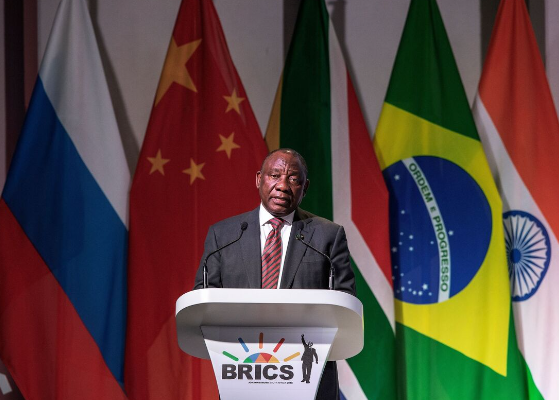
‘BRICS wants to challenge the G7′

With South African presidential elections slated for late May, South African opposition politician and Shadow Minister for International Relations and Cooperation, Emma Louise Powell shares her views on the future trajectory of BRICS, the credibility of the African Union (AU) on the continent, South Africa’s relations with China, and her country’s stance on key global issues.

Report Photo Courtesy: Körber-Stiftung
18 March 2024

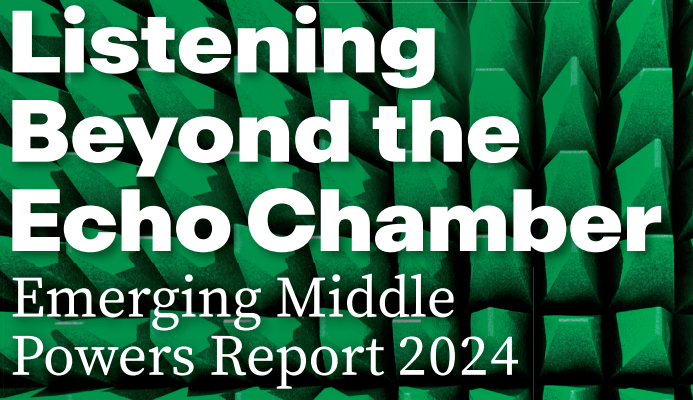
Listening Beyond the Echo Chamber: Emerging Middle Powers Report

Divergent global reactions to major crises such as those sparked by the war in Ukraine and NATO’s Afghanistan withdrawal have widened the chasm between Western countries and emerging middle powers. This survey, conducted among nearly 1,000 experts from India, Brazil, South Africa and Germany, examines key foreign policy priorities in these countries, and reveals that despite differences, dialogue is possible.

Russian_BRICS_Chairship Courtesy: Official Internet Resources of the President of Russia
4 March 2024

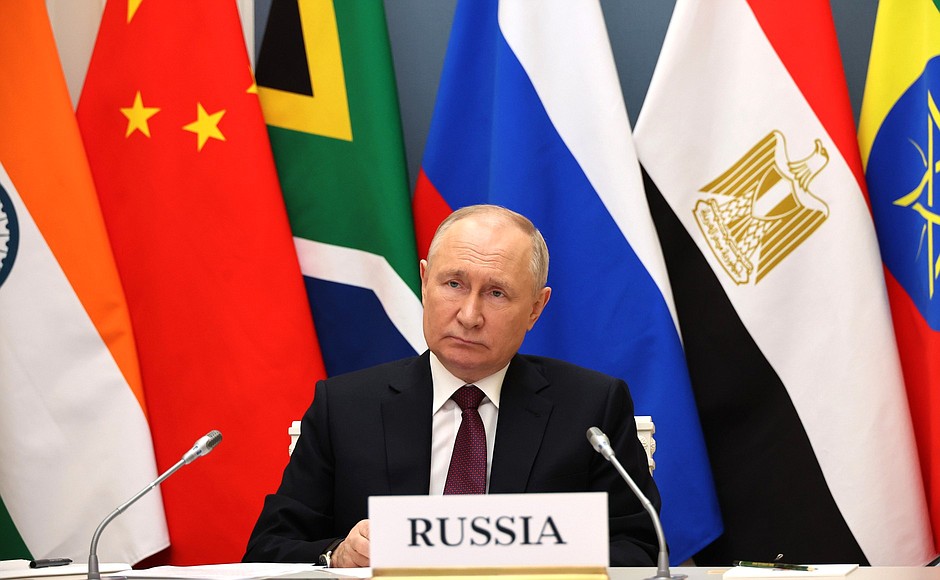
BRICS under Russian chairship

Russia took charge of BRICS in January 2024 at a point of inflection in geopolitics and expanding influence for the bloc. As chair, Moscow aims to bolster cooperation along the lines of the BRICS’ three pillars to shift power away from the West and explore ways to engage potential members. Though China seems onboard, for India, neither of these pursuits must proceed too aggressively.

BRICS India website Courtesy:
24 August 2023

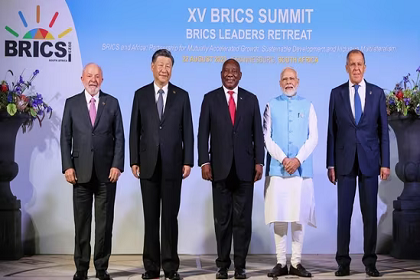
The BRICS Imperative

The BRICS Summit in Johannesburg has drawn international attention to the grouping’s past record of achievements and failures, its strained internal dynamics, and new challenges. As BRICS heads into its 18th year, its success and way forward will depend on the members’ ability to tackle the principal challenge of retaining its internal solidarity while balancing expansion and its impact and influence in the world.

task force cover 420 Courtesy: Gateway House
16 February 2023

G20 Energy Transitions and Climate Finance Task Force Report

Significant progress has been made globally in adopting green energy. Technological advances, easier availability of capital and regulatory measures have helped. But progress is likely to slow due to the shocks caused by Covid-19 and the Ukraine crisis. How to continue the green transition whilst ensuring that lower-income countries have access to affordable energy? This Task Force offers recommendations for India’s G20 Presidency.

african continent Courtesy: Toppr
25 January 2023

Time for Compact with Africa 2.0

While India must do justice to its diverse responsibilities as steward to the G20, it has a special duty and priority: to advance the Africa agenda while serving as a powerful bridge between the developed and developing parts of the world.

T20 policy brief on digital transformation Courtesy: T20 Italy 2021
23 September 2021

T20 Policy Brief on Digital Transformation

Public digital infrastructure encourages competition, innovation and inclusion. Through India Stack and Modular Open Source Identity Platform (MOSIP), the Indian experience offers developing countries a path to leapfrog the development phase for digital platforms. Open-source systems offer countries an opportunity to establish low-cost public identity, financial and data exchange systems. This policy brief explains how the G20's support of such platforms will accelerate adoption, allowing developing countries to advance digital usage.

BigTech Report (1) Courtesy: Gateway House
1 July 2021

Regulating Big Tech: A Balancing Act

Big Tech is powerful and its profits are growing - by 105% over the last year. It dominates economies. This raises concerns about data protection and privacy, anti-trust, fintech and the specific role of intermediaries. India is leading the way on fintech, but is behind several countries and institutions on digital rules. It is important to establish laws and rules to govern technology – whether domestic or through multilateral bodies – with the aim to strike the right balance between innovation and regulation.