Enticing post-COVID Japan to India
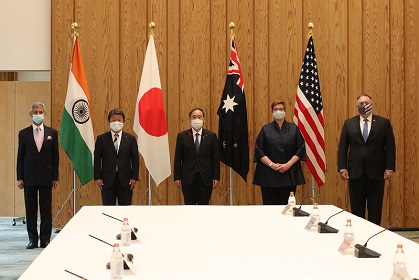
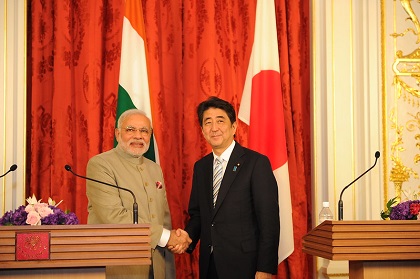
Japan has determined $ 2.2 billion for rehabilitation of industries exiting China. Prime Minister Modi’s new stimulus package, close to 10% of GDP, could be the impetus Japan needs to refocus FDI to India
Courtesy: MEA/Flickr
Japan has determined $ 2.2 billion for rehabilitation of industries exiting China. Prime Minister Modi’s new stimulus package, close to 10% of GDP, could be the impetus Japan needs to refocus FDI to India
Courtesy: Shutterstock
India will host four prestigious international conferences, such as the India-Africa Forum Summit and the subsidiary SCO Summit in the course of the next three years. These are historic opportunities for the country to show global leadership and fulfil a diplomatic agenda that involves handling strategic competition and advancing partnerships
Courtesy: MEA/Flickr
There have been mixed reactions to India’s not signing on to the Regional Comprehensive Economic Partnership. India is often criticised for abstaining from trade agreements and being a protectionist nation, but in fact, the reverse is true. The country’s trade to GDP ratio of 43% is higher than China’s 38% and the U.S.’ 27%. This shows how important trade is for India, particularly if it wants to reach the 2024 goal of being a $5- trillion economy.
Courtesy: TICAD7/Flickr
The Seventh Tokyo International Conference on African Development was a departure from earlier editions of it. Japan, which is changing tack as a competitor to China in Africa, held back from publicising the number of heads of state present to prevent any comparisons with other such forums and made no further commitments on Overseas Development Assistance. The accent, instead, was on increasing Japanese private sector engagement
Courtesy: Shutterstock
The foreign ministers of the Quad countries meet for the first time in New York today even as the Indo-Pacific has turned into a keenly contested geopolitical arena. Some countries are offering to play a mediatory role while other triangular equations are also undergoing change. An analysis of some of the relationships at work here
Courtesy: Shutterstock
India and Japan have emerged close strategic partners, particularly in the current decade. They are cooperating for the economic development of India’s landlocked North East Region through connectivity building and infrastructure projects. The Modi government’s Act East policy has been a major impetus in the flow of Japanese assistance. Such cooperation also comes in direct response to China’s BRI
Courtesy: Shutterstock
India is the second largest emitter of methane in the world. But methane-cracking has enormous economic potential. It can help India become a high-technology manufacturing powerhouse by producing a steady supply of methane-derived, advanced carbon materials and hydrogen-energized transportation
Courtesy: Shutterstock
On 15 July, the Indian space programme will achieve a feat with the Chandrayaan-2 mission. Two challenges lie ahead: the speedy construction of Chandrayaan-3 and the development of a public-private ecosystem of space capabilities
Courtesy: MEA/Flickr
The 2019 G20 Summit in Osaka on June 28-29, is the 14th meeting of the Group of 20 leaders. The G20 is the world’s most influential economic multilateral forum. It is the agenda-setting forum that develops and guides rules of global economic governance. Under the Japanese Presidency, this summit will be the first to discuss and establish the rules for the worldwide governance of data, including current hot-button issues like data localisation and data sovereignty. India has both a preparatory and a contributory role to play in the G20 this year. For in 2022, it will be the President of the G20. India must identify its agenda early on; its a weighty responsibility but also an opportunity to set the global economic agenda.
Courtesy: IEEE Spectrum
The Basic Exchange and Cooperation Agreement for Geospatial Cooperation (BECA), the last of the India-U.S. foundational agreements, will enable India to avail of U.S. expertise on geospatial intelligence and to sharpen the accuracy of weapons and automated hardware systems used for military purposes. But the over-emphasis on imaging in the agreement overlooks the likelihood of a clash between the telecom and meteorological technologies, which can hurt India’s crucial capabilities in space-based weather forecasting and disaster management