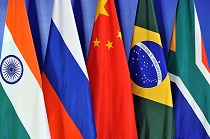
Indian foreign policy has not yet addressed the ramifications of Chinese economic dominance in BRICS. Nor have we matched China’s engagement within the group to ensure that the BRICS vision of a new international order for emerging economies actually works in their favour.
At the 5th BRICS Summit that begins in South Africa today, the heads of state of Brazil, Russia, India, China and South Africa are expected to ratify the creation of the BRICS Bank. After discussion and study for over a year by the respective governments, the bank will be launched with seed money estimated at between $50 billion to $100 billion, and most likely an equal share of voting rights for the management of the bank. What remains
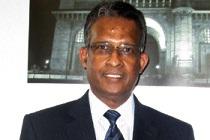
With India backing the United Nations resolution against Sri Lanka, New Delhi-Colombo relations appear to be in a tense phase. Gateway House interviews Prasad Kariyawasam, the High Commissioner of Sri Lanka to India, to discuss the implications of the UNHRC vote and the future of India-Sri Lanka relations.
New Delhi has taken some opportunistic actions, such as its vote against Sri Lanka in the UN Human Rights Council, to pacify internal political demands. But these extract a price in the international arena. Should we anticipate a further decline in India’s regional and international credibility?
The establishment of a BRICS Development Bank will be among the prime topics of discussion at the BRICS Summit on March 26. Gateway House’s Akshay Mathur interviews former Indian Ambassador and Foreign Secretary, Shyam Saran, on the prospects and viability of alternate financial architectures.
The recent allegations of corruption against the sale of AgustaWestland helicopters has renewed serious concerns on foreign defence acquisition in India. The larger question is this: to what extent does corruption really affect national security? Aakash Brahmachari blogs.
India’s relations with Islamic nations, many of which are members of the Organisation of Islamic Cooperation (OIC), have become even more prolific over the last decade. While India does not visualise becoming a member of a religious international body, many reasons militate against our formally joining the OIC.
The steps taken by the Indian government to enable private sector involvement in ASEAN have been hesitant. After the recent ASEAN summit in New Delhi, it is time for greater coordination of Indian private industry with government-to-government interaction, which will benefit all members, including India.
The year 2012 has been a busy one for foreign policy: from escalating disputes in the South China Sea to alternate financial instruments from the emerging world. India’s foreign policy too has its shown strengths and weaknesses. We present our top foreign policy Hotspots, Sweet spots and Blind spots for 2012.
New Delhi has actively worked with Beijing to address its massive bilateral trade deficit. However, it has another option. India can seek greater economic integration with ASEAN and substitute its imports from China with that of ASEAN. The India-ASEAN Summit on December 20 would be a good place to start.