Presentation at India-ASEAN Partnership@25
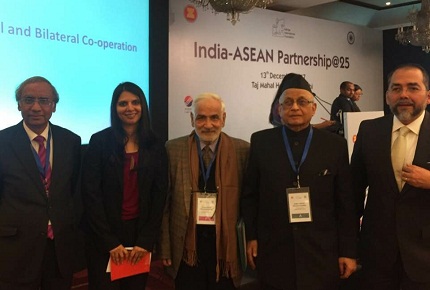
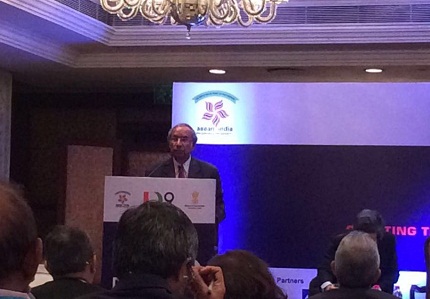
Ambassador Rajiv Bhatia, Distinguished Fellow, Gateway House gave a presentation on ‘Regional and Bilateral Co-operation’ at the Conference on India-ASEAN Partnership@25, New Delhi
Courtesy:
Ambassador Rajiv Bhatia, Distinguished Fellow, Gateway House gave a presentation on ‘Regional and Bilateral Co-operation’ at the Conference on India-ASEAN Partnership@25, New Delhi
Courtesy: Arjun Chawla
This speech was delivered by Rajiv Bhatia, Distinguished Fellow, Foreign Policy Studies, Gateway House, at the Delhi Dialogue 9, for the session on Regional Geopolitics: Great Power Politics in Asia -Pacific in Delhi on 4 July
Courtesy: Flickr / MEA India
India’s East Asia policy has been a bedrock of the country’s foreign policy, and the Modi government has deepened ties with ASEAN and extra-ASEAN powers in a significant way. As India turns 70, it is worth assessing the few key bilaterals that will now become more important for regional security and prosperity.
Courtesy: ustr.gov
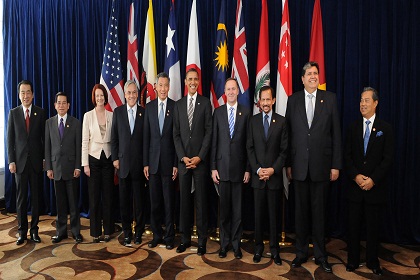
The Trans-Pacific Partnership has dropped strong Intellectual Property Rights regulations on India’s doorstep. The implications of these regulations could affect India’s own policies, as well as her global aspirations towards the potential Regional Comprehensive Economic Partnership.
Courtesy: PTI
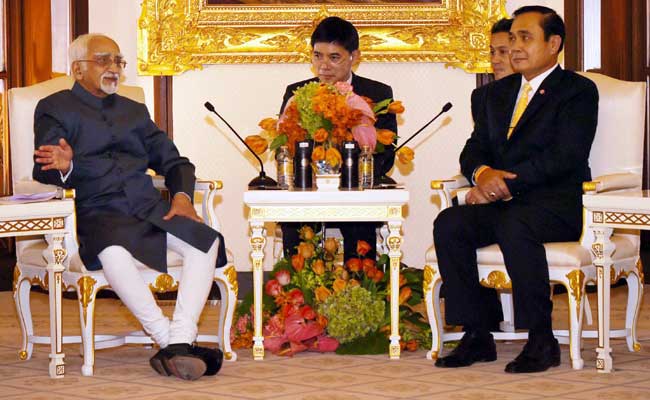
Vice President Ansari’s recent visits to Brunei and Thailand provided further clarity to the Act East Policy while advancing its implementation. He effectively showcased that the rationale for a strong India-ASEAN strategic partnership is sharper than before.
Courtesy: Wikipedia
Although it is too soon to comprehensively analyse the Trans-Pacific Partnership agreement of October 5, it is worth assessing what is known. Here are the facts, the controversies, the assessments, and the implications for countries that are not part of the agreement, especially India.
Courtesy: Wikipedia
The Trans-Pacific Partnership might soon be concluded if the U.S. Congress fast-tracks it, as recently announced, while the Regional Comprehensive Economic Partnership Agreement remains on slow-track. But the TPP, although ambitious, follows an outdated template, and it is the dynamic RCEP that can be a model for a new global rules-based framework
Courtesy: file photo/Xinhua, Wikipedia
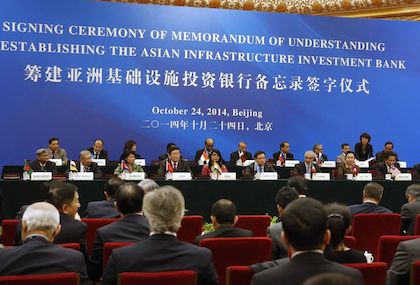
The AIIB is a step along a path that started with the Asian financial crisis, which defined ASEAN’s views about the U.S.’s commitment to the region. Although the bank may signal the rise of China, it is also a coming together of Chinese and ASEAN goals—ASEAN’s focus on infrastructure for growth requires another source of finance, and this forecasts its strong relationship with the AIIB
Courtesy: Prime Minister's Office
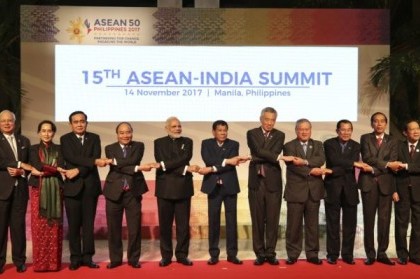
The India-ASEAN Free Trade Agreement in services and trade will allow India to leverage its competitive offerings in IT, finance, among other fields. But the pact has proved elusive so far due to the open squabbling between ministries. The deal now looks set to come through only after the new government takes over
Courtesy: Systemman, Erin A. Kirk-Cuomo/Wikimedia Commons
The U.S. government shutdown and President Obama’s absence gave China immense diplomatic and political space at the APEC and East Asia Summit meetings. China’s declaration of a “de-Americanised” world may be premature but the crumbling old order is doing little to dispel this notion