debnath shaw Courtesy: Gateway House
5 July 2012

“Russia still dominates Central Asia”

Though some countries like Russia gained a strong foothold in Central Asia and the Caucasus post-1991, India has been a late-comer. Gateway House interviews former Ambassador to Azerbaijan Debnath Shaw to discuss India’s energy interests in the region, the Shanghai Cooperation Organization and the TAPI pipeline.

indo us strategic dialogue Courtesy: U.S. State Department
12 June 2012

India-U.S.: More equal partners

The setting for the third Indo-U.S. Strategic Dialogue is promising: a global shift of economic weight to Asia, U.S. military exhaustion and indebtedness to China and other factors call for a greater convergence in Indo-U.S. interests than ever before. It is essential then, to take bold decisions at the dialogue.

Courtesy: Government of Tonga
29 May 2012

India-Tonga: Old friends, new engagements

After the passing of Tonga's revered King, Tupou V, all eyes are on the new establishment for signs of change in Tonga's foreign policy. How will India, an old friend to the Pacific island-nation, fit into this increasingly important region? Can it build on traditional ties with Tonga?

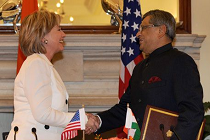
hillary clinton articles Courtesy: Ministry of External Affairs, India
18 May 2012

Hillary Clinton’s ‘Pivotal’ Moment

U.S. Secretary of State Hillary Clinton's recent visit to China, India, and Bangladesh is keeping with the U.S. pivot to Asia. The choice of countries has strategic significance for the U.S., where India is flagged as balancing the rise of China, and Bangladesh as a strategic base in the Bay of Bengal.

wisner interview Courtesy: Gateway House
2 April 2012

India-U.S.-Iran Impasse?

Given the immediacy of rising tensions around Iran’s nuclear programme, what can India and the U.S. do to resolve the issue? Gateway House’s Manjeet Kripalani talks to Ambassador Frank Wisner about the possibilities of a strike against Iran and its effects on the India-U.S. relationship.

Courtesy: PMO
3 January 2012

India-Japan: An Asian Partnership

India and Japan have designed their collaborations over the years to be a win-win for both sides. Now, they are willing to collaborate on long-term initiatives, based on intrinsic factors of inter-dependent competencies – rather than on the defence of an extrinsic threat of a common enemy.

anna hazare 2 Courtesy: nazeah/Wikimediacommons - Ramesh Lalwani/Flickr
30 December 2011

2011’s Top Foreign Policy Cheers and Jeers

The year 2011 saw various events - the Arab Spring, anti- corruption protests, Europe's sovereign debt crisis - transform countries and reshape the world order. Gateway House takes a look at what these events mean for India, and presents India's top foreign policy cheers and jeers for the year.

manipur Courtesy: Manipur Police/WikimediaCommons
22 December 2011

Look to Manipur before looking East

What have economic blockades in India's North East achieved? For one, they choked off the supply chain of an already isolated region. With Myanmar showing signs of warming towards India, New Delhi must establish ties with its eastern neighbour, but first, it needs to fix Manipur’s broken socio-political landscape.

Trans Pacific Partnership (TPP)
13 December 2011

Trans Pacific Partnership (TPP)

Amidst myriad country groupings that already exist – BRICS, IBSA, APEC, SCO and many others – a new initiative in the Pacific is looking to integrate more powerful countries to form a multilateral free trade agreement – the Trans Pacific Partnership. How important is this towards the reshaping of trade and power?