Turkey: Europe’s new gas hub?
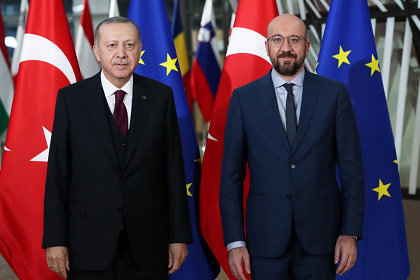
The Ukraine crisis has sent the EU scrambling for new gas supplies, generating fresh interest in gas pipelines from Central Asia and West Asia via Turkey. Practical difficulties make most of these new projects unviable.

 Courtesy: Reuters
The Ukraine crisis has sent the EU scrambling for new gas supplies, generating fresh interest in gas pipelines from Central Asia and West Asia via Turkey. Practical difficulties make most of these new projects unviable.
 Courtesy: ANI
India hosted a summit with five Central Asian states on January 27, marking 30 years of diplomatic relations with the region, and an important step forward to pursue greater connectivity between India and Central Asia. New Delhi's engagement holds promise for ambitious bilateral agendas including security in Afghanistan, the revival of dormant projects, and potential collaboration in renewable energy, space and information technology.
 Courtesy: vicepresidentofindia.nic.in
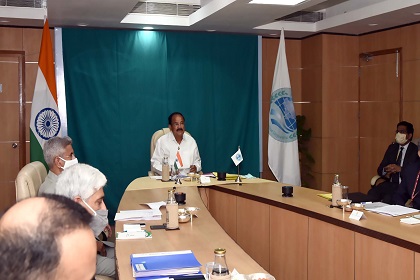
India hosted the SCO summit on 30 November. Fueling its diplomatic drive is the region’s strategic importance and an enhancced focus on Central Asia with its strong civilizational, cultural and emotional bonds with India. Despite the daunting regional challenges, old and new, a seat at the SCO table strengthens India's hand in shaping the grouping’s - and region’s - future.
 Courtesy: Gateway House
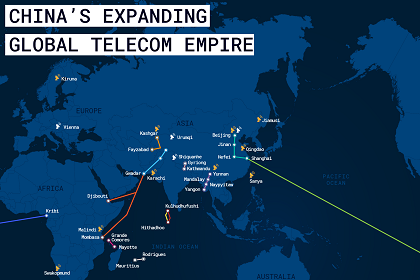
This version of the Gateway House Map on China’s Expanding Global Telecom Empire identifies some more telecommunication assets -- optic-fibre and satellite ground stations -- that Beijing is working on in South and Central America, Africa, Myanmar, the Indian Ocean Region and mainland China besides the existing ones, such as the Pakistan East Africa Cable Express (PEACE). It shows the direction China’s investment is taking, its diplomatic overtures and the larger geopolitical implications of its growing telecom empire
 Courtesy:
India must quickly recognise the evolving changes, challenges, and opportunities in Central Asia to avoid being relegated to the periphery of Eurasian trade AND geopolitics. It is now up to Prime Minister Modi to manage a rebalancing in Central Asia through diplomacy and cooperation rather than competition
 Courtesy: Prime Minister's Office, India
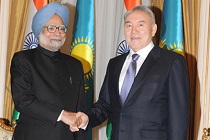
The current political, strategic and economic scenarios, both regionally and internationally, present immense potential for India and Kazakhstan to enhance their engagement, qualitatively and quantitatively. Why must New Delhi and Astana forge stronger and deeper relations with each other?
 Courtesy: Ministry of External Affairs, India
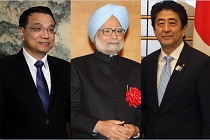
While the recent India-Japan Joint Statement contains significant breakthroughs, the China-Pakistan Joint Statement reveals the absence of warmth between India and China. With the current flurry of bilateral exchanges, India is fine-tuning its approach to emerging regional realities, as are others.
Though some countries like Russia gained a strong foothold in Central Asia and the Caucasus post-1991, India has been a late-comer. Gateway House interviews former Ambassador to Azerbaijan Debnath Shaw to discuss India’s energy interests in the region, the Shanghai Cooperation Organization and the TAPI pipeline.
 Courtesy: PMO
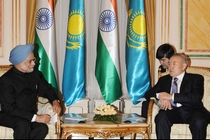
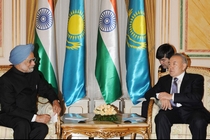
Indian Prime Minister Manmohan Singh met with Kazakh President Nazarbayev to strengthen ties and announced a Joint Action plan for 2011-14. Should the countries enhance their “arms-length transactional” relationship, a deeper alliance can be forged to include untapped sectors with immense potential
 Courtesy:
The India-Kazakhstan relationship is in need of a massive overhaul. Manmohan Singh’s visit to Astana is full of possibilities that can transform the relationship from a short-sighted association into a broad-based, strategic, long-term one focusing on energy, security, trade and technology.