Book review: A riveting retelling of a tragedy
In ‘The Blood Telegram’ Gary Bass jolts us into recalling one of the most horrific genocides of the last century that occurred during the creation of Bangladesh

 Courtesy: Knopf
In ‘The Blood Telegram’ Gary Bass jolts us into recalling one of the most horrific genocides of the last century that occurred during the creation of Bangladesh
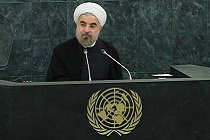 Courtesy: Office of the President of Iran
In recent days, both the U.S. and Iran have intimated that they seek a broad improvement in relations, signalling a welcome thaw in bilateral ties. What does this mean for Tehran and Washington, and more importantly, how will this development play out in the West Asian region?
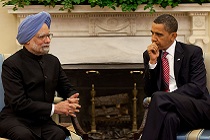 Courtesy: Pete Souza/Wikimedia Commons
Since 2009, distraction and dysfunction in India and the U.S. resulted in low enthusiasm vis-à-vis bilateral ties. Indian Prime Minister Manmohan Singh, who met U.S. President Barack Obama, prior to the UNGA, had one last chance to salvage India-U.S. ties before the country goes to elections in 2014. Did he succeed?
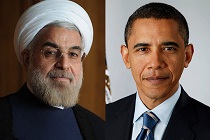 Courtesy: WikimediaCommons
The positive advances made by newly-elected Iranian President Hassan Rouhani and U.S. President Barack Obama at the 68th UN General Assembly indicates a strong potential for a thaw in Tehran-Washington relations. However, it will take sincere efforts from both sides to turn this into concrete reality. Can India help?
 Courtesy: Pete Souza/WikimediaCommons
This daily column includes Gateway House’s Badi Soch – big thought – of the day’s foreign policy events. This Badi Soch analyses the open letter in The New York Times from Russian President Vladimir Putin to American citizens, arguing against a military strike in Syria.
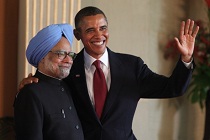 Courtesy: U.S. Embassy New Delhi
Since 2009, distraction and dysfunction in both India and the U.S. have dissipated the enthusiasm for greater bilateral ties. However, Indian Prime Minister Manmohan Singh has one last chance to salvage India-U.S. ties during his visit to the country this month, and he must utilise it appropriately
 Courtesy: Asitimes/ Flickr
Indian and Chinese companies routinely bid against each other in their quest to secure oilfields and other resource pools resulting in rising prices. However, a preferable recourse would be for the nations, along with ASEAN, to collaborate as there is enough for all
 Courtesy: Ministry of External Affairs, India
Although the office of the U.S. vice president seldom plays a role in defining the country’s foreign policy, the recently concluded visit of Vice President Joe Biden to India – the first such visit in nearly three decades – has thrown open several questions, answers to which hold upshots for India and her neighbours. Chintamani Mahapatra blogs
 Courtesy: Ministry of External Affairs
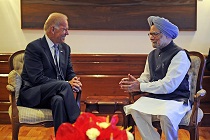
Policy-making in India remains haphazard, and in the name of ‘strategic autonomy’ New Delhi is scuttling its own rise. Biden’s visit underlines India’s importance in the U.S.’ strategic calculus. India must now decide what role it sees for the U.S. in its foreign policy matrix and for itself in the global order
 Courtesy: Ministry of External Affairs, India
U.S. Vice President Joe Biden’s visit to India this week comes at a time when the India-U.S. bilateral relationship has gone seemingly adrift. Can this visit, which comes just months ahead of the Indian general elections, rejuvenate the relationship which is rooted in long-term common strategic interests?