TDB_car_151021 Courtesy: TDB
24 February 2022

Enhancing Regional Financial Intermediation in the Indo-Pacific

Financial intermediaries are critical lubricants for business, growth and development. The Indo-Pacific countries are industrializing, but smaller nations lag behind economically. The Quad countries can aid the advancement of the financial architecture in the Indo-Pacific by helping to develop an ecosystem, modelled on the examples of Japan and India.
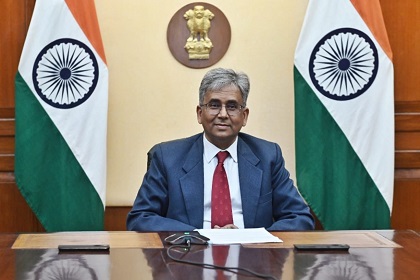
amb saurabh kumar Courtesy: Ministry of External Affairs, Government of India
3 February 2022

India’s Indo-Pacific vision

Saurabh Kumar, Secretary (East), Ministry of External Affairs, Government of India, delivered the keynote address at the panel discussion on India in the Indo-Pacific: Pursuing Prosperity and Security, organised by Gateway House and the U.S. Embassy, New Delhi, on 1 February 2022. He outlined India's vision for a free and inclusive Indo-Pacific, and the initiatives undertaken to further cooperation among nations in the region.

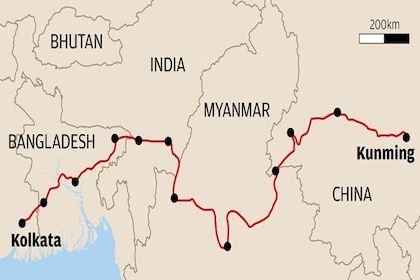
bcim corridor Courtesy: Institute of Peace and Conflict Studies
9 November 2021

Physical connectivity in the Bay of Bengal

China is a clear winner in the physical connectivity stakes in the Bay of Bengal, and there's a reason a why: Its projects are connected to one another, from rail to road to port. While India also has some successful cross-border road and rail infrastructure projects, they are often an extension of an existing railway line or highway, not specific to the connectivity needs of the region. India can win by focussing instead on building infrastructure to maximise the vast maritime potential of the Bay of Bengal, especially the Andaman and Nicobar Islands that give India access to critical sea channels and trade routes.

Countering China's Maritime Greyzone activities Courtesy:
22 July 2021

Countering China’s Maritime Grey Zone Activities

On 15 July, Gateway House co-hosted a webcast with Konrad-Adenauer-Stiftung (KAS) on 'Countering China’s Maritime Grey Zone Activities'. The panel discussed the potential strategies that smaller nations in the region can adopt to overcome the challenges of Chinese maritime grey zone activities, and the role of regional maritime powers in capability-building of maritime law enforcement agencies.

Securing India's energy needs Courtesy: Shutterstock
8 July 2021

Securing India’s energy needs

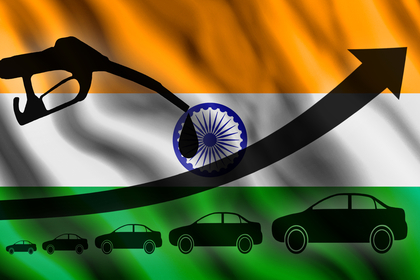
India’s oil consumption and imports are likely to resume their upward trajectory as the economy opens up, after a temporary drop due to the pandemic. To secure its energy needs, the country should shift course from investing in oil and gas assets of emerging economies to those of developed nations. The oil-rich Organisation for Economic Co-operation and Development (OECD) countries, such as Canada, Norway, and the U.S. can be given special consideration.

49012249412_d8b02bb141_c Courtesy: MEA/Flickr
7 November 2019

Goodbye, RCEP

There have been mixed reactions to India’s not signing on to the Regional Comprehensive Economic Partnership. India is often criticised for abstaining from trade agreements and being a protectionist nation, but in fact, the reverse is true. The country’s trade to GDP ratio of 43% is higher than China’s 38% and the U.S.’ 27%. This shows how important trade is for India, particularly if it wants to reach the 2024 goal of being a $5- trillion economy.

32015837878_7c9f57e917_o Courtesy: MEA/Flickr
29 November 2018

ASEAN-India Connectivity

The following remarks were given by Ambassador Rajiv Bhatia, Distinguished Fellow, Foreign Policy Studies, Gateway House as a speaker at the ASEAN-India Business Summit on November 27, 2018.

Modi Asean Courtesy:
12 May 2016

India’s Act East Policy so far and beyond

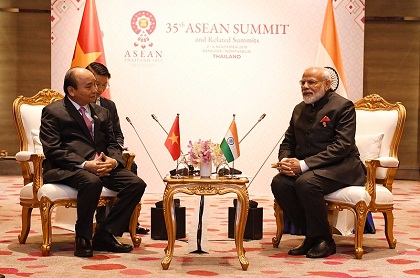
In two years, the Modi government’s Act East Policy has gone well beyond the focus on economic ties of its predecessor, the Look East Policy. It has made progress on many wider fronts, including connectivity and defence collaboration. India must now build on this success and further consolidate relations and trade links with ASEAN and beyond

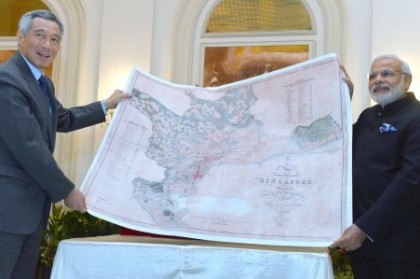
The Prime Minister, Shri Narendra Modi presenting a reproduction of a map of the island of Singapore dating back to 1849 to the Prime Minister of Singapore, Mr. Lee Hsien Loong, in Istana, Singapore on November 24, 2015. Courtesy: Wikimedia
19 April 2016

Defining & deepening India-Singapore partnership

India and Singapore elevated their ever deepening relationship to a strategic partnership last year. The two countries laid out an ambitious roadmap for expansion and diversification of bilateral ties. What drives this multi-layered bilateral relationship?