QUAD (1) Courtesy: Times Now
13 June 2025

India-U.S. Trade Agreement nearing reality

India and the U.S. are now on the verge of establishing a comprehensive trade agreement, overcoming a long history of bilateral trade challenges. This is a pivotal moment that could lead to mutual benefits and a deeper partnership. It will also illumine the path for other modern trade agreements that India is currently negotiating with multiple countries.

IMEC map with source Courtesy: Gateway House
11 June 2025

IMEC: more than just a corridor

The proposed IMEC corridor connecting India to Europe through the Gulf can be transformative, helping to reduce risks to the global movement of goods and data. It’s early days yet, and there are gaps to be filled in terms of missing infrastructure and overcoming a diplomatic rift.

Myanmar article Courtesy: X /@antonioguterres
28 May 2025

Quid pro quo for Myanmar’s humanitarian corridor

A proposed humanitarian corridor from Bangladesh to Myanmar’s suffering Rakhine state is the need of the hour. But Chief Advisor Yunus has linked it with repatriation of the Rohingya refugees in Bangladesh, mixing up unrelated issues. This is a classic ploy to distract the public from his own shortcomings, and his single-minded focus to extend and legitimise his regime.

India Today (1) Courtesy: India Today
26 May 2025

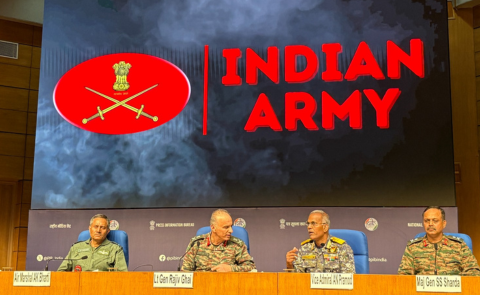
India’s evolving defence doctrine

The Pahalgam attack has changed India’s strategic calculus. With Operation Sindoor, the country is moving towards a more assertive posture, consolidating its strategy around an evolving doctrine of Proactive Deterrence underpinned by Calibrated Coercive Capability. A strategic practitioner’s viewpoint is below.

Website articles  (17) Courtesy: Nayanima Basu
19 May 2025

India’s three-pronged war strategy

Operation Sindoor has established a “new normal” in India-Pakistan relations. It has also given the world a glimpse into the Narendra Modi government’s future strategy in countering terrorism supported by the Pakistani Army and ISI, and how New Delhi will manage the Kashmir dispute.

Getty (1) Courtesy: Gateway House
15 May 2025

The New Geopolitics and South Asia’s Trade Architecture – What Next?

Geopolitics is increasingly intertwined with the economic destiny of South Asia. Even before the U.S. tariffs were rolled out, growing polycrises had hit the global economy, which has been struggling since the pandemic. South Asia seems a relatively bright spark of regional trade and growth. This paper analyses South Asia’s trade architecture in the backdrop of a sluggish world economy in the 2020s, and makes recommendations for closer regional economic integration.

Website articles  (12) Courtesy: Gateway House
15 May 2025

U.S., global emperor of sanctions

Over two centuries, the U.S. has amassed vast economic powers across the globe during and after the two World Wars , and sanctions slowly became an effective tool it used to achieve its foreign policy goals, becoming the global emperor of sanctions.

Pahalgam-attack-1024x679 Courtesy: Khyber News
24 April 2025

Post Pahalgam, India’s choices

The horrific attack on April 22 on tourists in Kashmir has exposed its stark and violent reality. Kashmir remains tumultuous even after the abrogation of Article 370 in 2019. Before confronting Pakistan, India must first address its internal challenges and deliver on its election promises to achieve enduring progress.

Kurdistan Courtesy: Reuters
22 April 2025

The new Kurdish reality in West Asia

Kurdish independence has been an unresolved problem in West Asia for over a century, but a solution may be in sight. Two recent developments highlight this: the unilateral ceasefire declaration by the Kurdistan Workers Party and the signing of a Memorandum of Understanding between Syria’s transitional government and the Syrian Democratic Forces. These may be key to resolving the Kurdish issue.

Report Courtesy: Körber-Stiftung
17 April 2025

Momentum for Middle Powers: Emerging Middle Powers Report

The world is undergoing profound transformations that are not being driven only by the United States, China or Russia. Small and medium-sized States are carving out a legitimate place for themselves in the emerging new order. This second edition of our annual Emerging Middle Powers Report is a reminder that the signs of the times are showing a new momentum for middle powers.