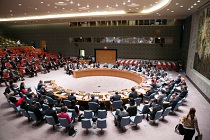
UNSC Syria UNSC Courtesy: United Nations
4 October 2013

Decoding the UNSC Resolution on Syria

The recent UNSC Resolution, which mandates the complete destruction of Syria’s chemical weapons, demonstrates that after more than a year, a degree of international agreement on the Syrian issue has been possible. In the evolving situation, Russia will now emerge as a major player
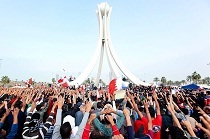
Bahrain Activist/WikimediaCommons Courtesy:
8 February 2013

India navigates the Arab Uprisings

The Arab uprisings show no sign of closure, and have become amorphous. While New Delhi has so far been immunised from the political and religious dimensions of the uprisings, the rise of political Islam, Islamic governance, and continuing instability will impact India.

Www.Oic-Oci.Org Courtesy:
23 January 2013

India and the OIC: To join or not to join?

India’s relations with Islamic nations, many of which are members of the Organisation of Islamic Cooperation (OIC), have become even more prolific over the last decade. While India does not visualise becoming a member of a religious international body, many reasons militate against our formally joining the OIC.

obama second term_0 Courtesy: U.S. Navy
10 November 2012

The second term

U.S. President Barack Obama will certainly have the benefit of continuity in his second term, but he has a range of impending crises to address immediately - be it to avert the so-called fiscal cliff before the end of the year when automatic cuts kick in or plan for the military drawdown from Afghanistan.

Courtesy: FREEDOM HOUSE2/FLICKR
24 August 2012

Syria: What next?

With the Free Syrian Army being supplied aid by the West and the Gulf Cooperation Council countries, the endgame for the Syrian regime has begun. Does Assad's exit guarantee the replacement of autocracy with democracy? What implications will it have on regional politics?

morsi_0 Courtesy: gr33ndata/Flickr
9 August 2012

Islamism and democracy

The involvement of Islamists in democratic movements is usually dismissed as a mere ruse to attain political power. However, evidence suggests that people in Muslim-majority democracies support Islamist groups which challenge a dishonest government, rather than those who seek to establish Islamic autocracy.

tightrope india us Courtesy: The White House
13 June 2012

Iran tests India’s policy

Apart from bilateral ties, also at play at the India-U.S. Strategic dialogue is the difficult triangulation in India’s relations with the U.S. and Iran. It does not serve India to get enmeshed in the U.S-Iran confrontation. Instead, the relationship must develop on the basis of realpolitik and mutual interest.

ambassador abhyankar interview Courtesy: Gateway House
8 June 2012

“We are not in the business of ‘civilizing’ nations”

Over the past year, there has been a drastic change in the political scenario in Syria, which is now engulfed with violent sectarian conflict. Gateway House speaks to former Indian Ambassador to Syria, Rajendra Abhyankar, about the changing political scenario and the implications of the ongoing conflict in Syria.

5825395379_5d725a53f4_z Courtesy: Flickr/freeedomania
21 April 2012

UN: a return to ‘mandated colonialism’

By forcing regime change in Libya, and attempting the same in Syria, and by promiscuously arming disparate groups of Wahabbis and Salafists to achieve this aim, NATO is creating more room for instability in the region. What Syria needs is engagement, not isolation; it needs dialogue and not the arming of rebels.

IMG_4820 Courtesy: Gateway House
20 April 2012

Deciphering today’s Middle East

What are the implications for India if Iran is attacked? How effective has the response been by gulf nations to their own protests? Ambassador Talmiz Ahmad, India’s former Ambassador to Saudi Arabia, discusses the dynamics of West Asia with Gateway House’s Alisha Pinto and Azadeh Pourzand.