

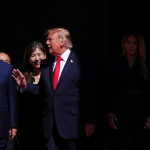

President Xi Jinping of China paid a state visit to the U.S. on September 23-25, 2026. The invitation for this visit came from U.S. President Donald Trump, and it was accepted by Xi in May when the former visited China. Trump announced the date of Xi’s visit immediately after it was accepted, in contrast to the Chinese practice of announcing such visits a week prior to the actual dates. Almost certainly, China did not like being upended in that manner.
Trump laid out the red carpet and received the Chinese President on the tarmac with his wife, Melania, at the Joint Base Andrews Naval Air Facility, Washington, D.C. This is a rare honour given to a foreign dignitary after 64 years. The last time was when President John F. Kennedy received the British Prime Minister Harold Macmillan. With this gesture, the U.S. lost the edge over China during this visit. It appears that President Trump relies on his personal friendship with Xi, but that is not the way China does business. The visit did not result in a joint statement, which is indicative of the fact that there were major differences between both countries during discussions. This is also borne out by the fact that the respective statements issued by China and the U.S. have been divergent. Here are some insights.
The eight deliverables and understandings issued by the Chinese Foreign Ministry,[1] and the White House Fact Sheet,[2] had only a few points in common. Points 3, 5, and 7 of the Chinese readout mentioned Iran, bilateral trade, and artificial intelligence (AI). While the leaders may have discussed Russia, North Korea and Iran, it is only on Iran that China and the U.S. seem to be clear that Iran should keep its promise of not developing nuclear weapons and that no country should be allowed to collect tolls in the Strait of Hormuz.
On bilateral trade, both sides seem to be at variance. China says that the Boards of Trade discussions have arrived at an understanding to reduce tariffs of $30 billion for both countries. However, the U.S. wants more favourable tariff treatment for $30 billion worth of non-sensitive goods. If the U.S. version is to be believed, the effect on tariffs will not be $30 billion but approximately $7 billion (U.S. tariffs on China are at 22 per cent).
The items that are being considered for this reduction reveal a vast divergence. The U.S. is concerned about the export of its agricultural products, whereas the items for import from China are toys, small appliances, holiday decorations, and children’s car seats. The trade truce that was agreed upon in Busan in October last year, which was to end on October 10 this year, has been extended by two months. This is another indication that there has been no meeting of minds on the trade issue. Consequently, on September 30, both countries released a list of items amounting to $30 billion each that will qualify for taxes at most favoured nation rates.
The third issue is AI. Both the U.S. and China decided to establish a dialogue on artificial intelligence and a crisis response mechanism. The only difference between both versions is the term used for AI. The U.S. version calls it Super Intelligence, the name used by Trump for AI.
An additional point in the Chinese statement is that both the countries’ militaries will sign a Memorandum of Understanding on crisis communication and prevention of crises, and the search for remains of U.S. soldiers in China[3] will continue. With these points, the commonality of both the readouts ended.
The U.S. version, in addition to the details mentioned above, indicated its concerns. Psychotropic substances, which have been a problem for the U.S. because it resulted in the death of approximately 70,000 Americans in 2025, find mention as the first point. The ingredients to make fentanyl, one such psychotropic substance, originate from China.
On rare earths also, the U.S. is clearly dissatisfied with the restricted exports from China and indicated that the supply mutually agreed to have not been forthcoming.
There was a staleness to the meeting, as the remarks of both the leaders during the state banquet concentrated on the past rather than the present.
On Taiwan, a clear red line for China, the statements from both sides are at variance. Xi mentioned that he hoped that the U.S. would adhere to the correct position of opposing “Taiwan independence” and handle the Taiwan question with caution[4] but Trump brushed aside a question on the subject that they did not talk much about.
The media in China was full of Xi’s visit and projected him and China as winners and as equal to Trump and the U.S., respectively. The aim of the U.S., in contrast, appears to “kick the can down the road” on contentious issues till the midterm elections are over in November this year.
Ever since Trump’s visit to China in May 2026, two dimensions have been highlighted. One is China and the U.S. becoming a G2. Nothing can be further from the truth. The contradictions between the two countries will indicate that this formulation is unlikely to fructify.
It has been noticed by all; even S. Jaishankar, India’s foreign minister, remarked on it in a speech[5] in the U.S. in September. The nature of the partnership pronounced by China as a “constructive relationship of strategic stability” seems to have been accepted by the U.S. This differs from the idea of a G2, in which the U.S. and China would work together on global issues. The new formulation is limited to the bilateral relationship between the two countries and is again a framing set by Beijing, and accepted by Washington.
What does all this indicate? Both the visits, one by Trump to China and the other by Xi to the U.S., appear to favour China. They also clearly signify the inability of the U.S. to prevail over China on issues that are important to the former. While it may not show the decline of the U.S. as yet, it certainly denotes the growing stature of China.
It takes two to tango, and this dance is guided by China.
Lt Gen S L Narasimhan is the Distinguished Fellow for China and National Security Studies at Gateway House.
This article was exclusively written for Gateway House: Indian Council on Global Relations. You can read more exclusive content here.
For permission to republish, please contact outreach@gatewayhouse.in.
Support our work here.
© Copyright 2026 Gateway House: Indian Council on Global Relations. All rights reserved. Any unauthorised copying or reproduction is strictly prohibited.
References:
[1] Ministry of Foreign Affairs of the People’s Republic of China. “China and the United States Reach Eight Deliverables and Understandings.” September 26, 2026. https://www.fmprc.gov.cn/eng/xw/zyxw/202609/t20260926_12031663.html.
[2] The White House. “Fact Sheet: President Donald J. Trump Advances a Fair and Reciprocal Relationship with China While Hosting Historic State Visit.” September 25, 2026. https://www.whitehouse.gov/fact-sheets/2026/09/fact-sheet-president-donald-j-trump-advances-a-fair-and-reciprocal-relationship-with-china-while-hosting-historic-state-visit/.
[3] These are the remains of US soldiers who lost their lives while flying over the area called “the hump” over the Himalayas to logistically support the Allied Forces.
[4] https://www.mfa.gov.cn/eng/xw/zyxw/202609/t20260925_12031181.html
[5] Asia Society Policy Institute, Sept 28, 2026.