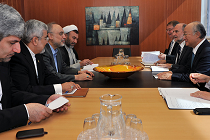
iran talks Courtesy: IAEA Imagebank/Flickr
8 June 2012

All to play for in Moscow

Ahead of nuclear talks between Iran and the P5+1 in Moscow, the West seems confident that sanctions will induce Iran to settle on its uranium enrichment. But rather than arriving at a negotiated settlement by applying the principle of reciprocity, the West may look to anaesthetize oil markets.
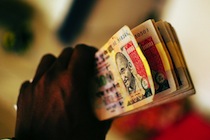
Can BRICS swaps save the rupee copy Courtesy: Flickr/t3rmin4t0r
1 June 2012

The case for BRICS swaps

Banks around the globe would be wise to take a second look at what now could be the most significant agreement in international finance since the Euro: the BRICS currency swap. Though certain geopolitical risks are involved, could this free India from unpredictable currency fluctuations?

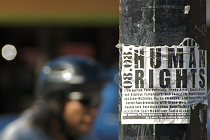
human rights Courtesy: Flickr/tao_zhyn
1 June 2012

Rethinking human rights

The failure of Western military interventions to bring peace raises questions about the effectiveness of human rights and calls for its redefinition. Instead of stigmatizing non-Western democracies that do not necessarily support intervention, the West should initiate an inclusive dialogue with these countries.

Courtesy: PIAZZA del POPOLO/Flickr
24 May 2012

EU austerity: room to wiggle

Momentous developments are taking place in Europe. In elections in Greece, France and Germany, Europeans expressed dissent against austerity policies adopted by their government to combat the economic crisis in Europe. How will these results affect the future of European policy-making?

616px-Swedish_flag_with_blue_sky_behind_ausschnitt Courtesy: Wikimedia Commons/Tage Olsin, Hofres
15 May 2012

Why is Sweden number one?

Few people know that Sweden was severely affected by the 2008 global economic crisis. However, the Swedish government adopted prudent fiscal and monetary policies to overcome the situation. The author discusses the factors that helped Sweden to acquit itself so creditably in the most challenging of circumstances.

5825395379_5d725a53f4_z Courtesy: Flickr/freeedomania
21 April 2012

UN: a return to ‘mandated colonialism’

By forcing regime change in Libya, and attempting the same in Syria, and by promiscuously arming disparate groups of Wahabbis and Salafists to achieve this aim, NATO is creating more room for instability in the region. What Syria needs is engagement, not isolation; it needs dialogue and not the arming of rebels.

Courtesy: IAEA Imagebank
9 April 2012

Iran: An opportunity for BRICS

The scope for any process on nuclear talks with Iran to founder on distrust, misunderstanding and political in-fighting in both Tehran and Washington remains formidable. Equally disturbing are the wider political realities. Can the upcoming talks in Istanbul launch a process that can, over time, lead to agreement?

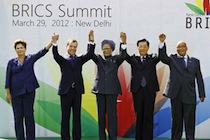
Brics_Summit_-_2012 copy Courtesy: Saurabh Das/AP Photo
30 March 2012

BRICS: Moving in the right direction?

The 4th BRICS Summit in New Delhi has brought a new dimension to emerging markets. The author explains why the summit was perhaps the most significant of the BRICS meetings so far – and one that should have the developed world really worried about their eroding position at the top of the global heap.

Courtesy: PMO
13 March 2012

India-Brazil: pioneers of a new development agenda

India and Brazil have declared inclusive development an imperative and have engineered creative solutions to meet their developmental challenges. But both also face many obstacles to equitable development. Can the upcoming BRICS Summit in New Delhi help drive a new development agenda?

Beware copy Courtesy: upton/Flickr
9 March 2012

Beware of cheap lending from China

While India’s mega-companies are only experiencing the beginning of Beijing’s accommodating bank policy, Brazil and Russia seem to have grown accustomed to Chinese money. Before they meet in New Delhi for the 2012 BRICS summit, it’s important to remember that China’s loans come with strings attached.