amb saurabh kumar Courtesy: Ministry of External Affairs, Government of India
3 February 2022

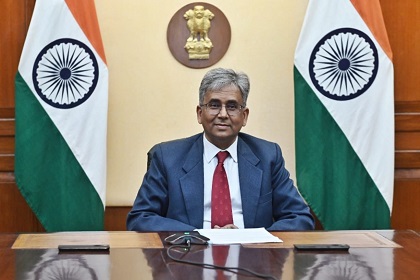
India’s Indo-Pacific vision

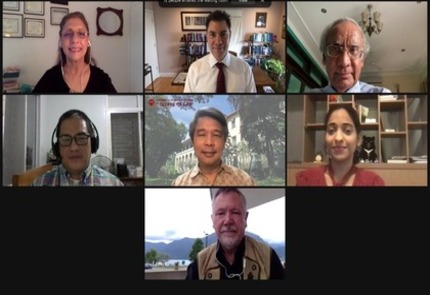
Saurabh Kumar, Secretary (East), Ministry of External Affairs, Government of India, delivered the keynote address at the panel discussion on India in the Indo-Pacific: Pursuing Prosperity and Security, organised by Gateway House and the U.S. Embassy, New Delhi, on 1 February 2022. He outlined India's vision for a free and inclusive Indo-Pacific, and the initiatives undertaken to further cooperation among nations in the region.
Beautiful,National,State,Flags,Of,Myanmar,And,India,Together,At Courtesy: Shutterstock
23 December 2021

India’s delicate mission in Myanmar

Foreign Secretary Harsh Vardhan Shringla is on a crucial visit to Nyapitaw, meeting with the military government and opposition for the first time since the military coup this year. This is part of New Delhi's diplomatic agenda for Myanmar, which includes border management and striking a balance between strengthening democracy and supporting the military, amid dynamic regional geopolitics.

Countering China's Maritime Greyzone activities Courtesy:
22 July 2021

Countering China’s Maritime Grey Zone Activities

On 15 July, Gateway House co-hosted a webcast with Konrad-Adenauer-Stiftung (KAS) on 'Countering China’s Maritime Grey Zone Activities'. The panel discussed the potential strategies that smaller nations in the region can adopt to overcome the challenges of Chinese maritime grey zone activities, and the role of regional maritime powers in capability-building of maritime law enforcement agencies.

hundred days after the myanmar coup Courtesy: Reuters
13 May 2021

Hundred days after the Myanmar coup

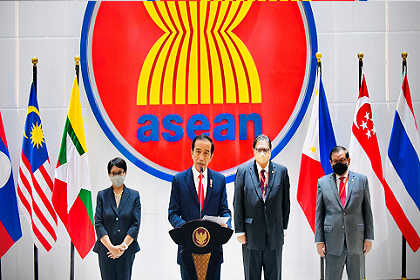
Since the military coup in Myanmar on February 1, violence and protests have broken out across the country and are continuing. Supported by India and Japan, ASEAN has played a key role, by calling the emergency summit in Jakarta. It has bridged internal gaps and helped navigate the international community to a reconciliation of the crisis. India must continue support to such efforts, which aim for immediate and long-term peace.

learning from bangladesh Courtesy: Shutterstock
25 March 2021

Learning from Bangladesh

This month marks the beginning of triple celebrations in Bangladesh, including the 50th anniversary of its independence, for which Prime Minister Modi will be traveling to Dhaka as the guest of honour. There is much to celebrate: A country that began as a case study for development is now on top of the global GDP charts. The springboard was achieved through a thriving textiles industry, women's workforce participation, micro finance, liberal investment policies. There is much to learn from this neighbour.

50636637062_a0e491ec59_c Courtesy: MEA/Flickr
26 November 2020

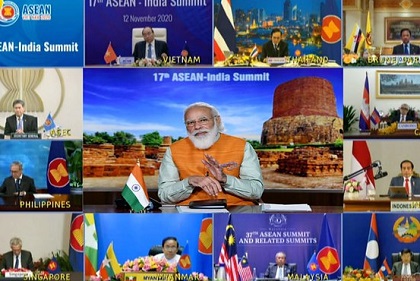
The ASEAN- India Summit: A new direction emerges

The recently concluded ASEAN and EAS Summit saw Prime Minister Modi highlighting the Indo-Pacific region. That’s because a cohesive, responsive and prosperous ASEAN is seen as vital to India's Indo-Pacific Vision and to Security And Growth for All in the Region (SAGAR). India’s decision to opt out of RCEP, even when all ASEAN member countries are signatories to that agreement, will mark a shift in how India enhances bilateral engagements with ASEAN nations with greater strategic intent.

shutterstock_1091235845 Courtesy: Shutterstock
15 October 2020

UN: Necessary but reformed

The UN turned 75 this year but instead of grand celebrations, the world witnessed an empty UNGA with world leaders addressing it via video screening because of the pandemic. The UN is under unprecedented stress and being shown up for its inability to tackle the challenges of today like the pandemics, climate change, terrorism or global peace and security. The institution's key governing structures, especially the UN Security Council, are inadequate and demand reform. India must now use gritty resolve to ensure its place in these governing structures.