Website articles  (56) Courtesy: Gateway House
19 March 2026

BRICS CBDCs can lead to financial multipolarity

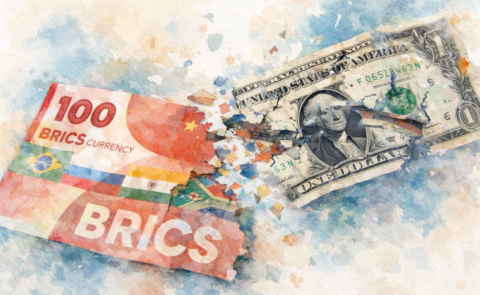
India’s proposal to link the digital currencies of the BRICS nations could alter how emerging economies settle trade deals. It is necessary to examine the reasoning behind such a move, its effort to reducing dollar dependence, and the benefits that accrue to India.
Website articles  (43) Courtesy: Reuters
25 February 2026

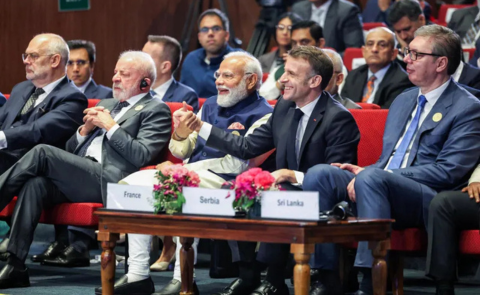
Macron, Modi, Lula: the emerging troika

A new troika is on the rise: India, France and Brazil, led by Modi, Macron and Lula. They were present at the AI Impact Summit in New Delhi on February 20, representing the three largest democracies in Latin America, Asia, and Europe. Can their mutual understanding and global influence bring prosperity and resilience to their economies and strengthen their cooperation in addressing global challenges?

News on Air (4) Courtesy: DD News
29 January 2026

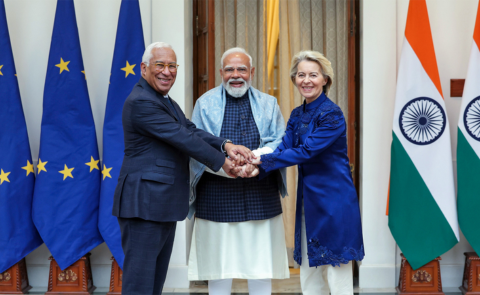
The European pivot to India

By signing the EU-India Free Trade Agreement on January 27, the ties that bind India and the European collective have been re-energised. They are now set to reach new heights, while overcoming past hesitations and divergences.

News on Air Courtesy: News on Air
8 January 2026

2026: India’s foreign policy challenges

In the shifting sands of contemporary geopolitics, terms such as ‘fluid multipolarity’, ‘multiplexity’, ‘tripolarity’, and ‘bipolarity with multipolar characteristics’ are replacing the old dogmas and orders. But what is driving the world today? How does India plan to protect its vital interests in the current age of ongoing polycrisis? The road ahead is challenging, marked by risks and uncertainty.

Themba HadebeAP Courtesy: Themba Hadebe/AP
27 November 2025

Johannesburg G20 summit: advancing amidst anxiety

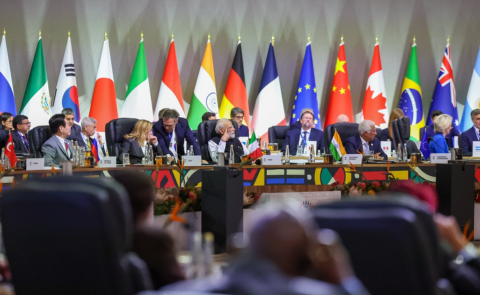
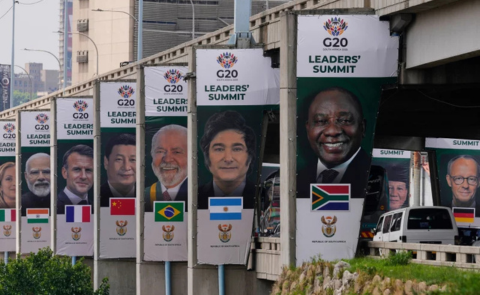
The G20 Summit in Johannesburg ended on a widely-shared sense of satisfaction and achievement, with the Global South’s perspective well-articulated, but divergent from some in the Global North. Now the G20's challenge is to restore its unity and credibility by working toward reconciliation with its next president, the U.S. Can India enhance its credibility and influence as a North-South bridge-builder?

revised design Courtesy: Gateway House
27 November 2025

Rise of the Davos Competitor

U.S. health secretary Robert Kennedy Jr. called the World Economic Forum a “billionaires’ boys club” imposing totalitarian controls. Indeed, since 1971, the elite platform shaped geopolitics. But its Western-centricism kept out the concerns of the rest. This gave rise to alternative forums, which look beyond financial agendas to the perspectives shaping the Global South. Here are 45 of biggest, half of which began just two decades ago.

Website articles  (11) Courtesy: UNDP
20 November 2025

A G20 summit with African characteristics

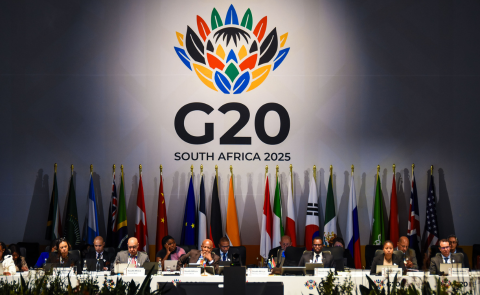
The G20 Summit in Johannesburg in November will close four years of developing countries holding the grouping’s Presidency. It has left a positive imprimateur on the G20. The next President, the U.S., will inherit a more diverse body, with equal attention being given to issues of the Global North and the Global South.

Screenshot 2025-10-13 103335 Courtesy: Körber-Stiftung
13 October 2025

Bandung at 70: Multilateralism in a New Era of Multi-Alignment

The world is facing multiple crises which are shaking the foundations of multilateralism. The West’s structures are faltering, and the need for effective and equitable cooperation is greater than ever. Seventy years after the 1955 Bandung Conference, its principles of sovereignty, territorial integrity, cooperation and solidarity remain vital. This report revisits Bandung’s relevance for today’s reform efforts, urging renewed Global South–Europe collaboration for a sustainable global future.

VOA Courtesy: VOA
2 October 2025

Time to re-burnish Global South credentials

The year 2025 is often compared to the Bandung moment of 1955, and for good reason. With the U.S. reordering traditional relationships, the opportunity for greater emphasis on the Global South is now. It is therefore time for India, Africa and ASEAN among others to re-burnish their Global South credentials and use that identity as a platform to engage each other more deeply.

U.S. Tariffs on Brics+ countries Courtesy: Gateway House
25 September 2025

U.S. Reciprocal Tariffs on BRICS+ countries

Under U.S. President Donald Trump’s reciprocal trade policy, the original five BRICS member countries account for the highest U.S. tariffs globally. India and Brazil are facing the highest tariffs of 50%, while China follows with a tariff of 34%, down from 145% earlier in the year. This infographic details the U.S. reciprocal tariff rates for each BRICS+ member and the sectors that are impacted.