SAARCsummit1 Courtesy: Wikimedia commons
21 November 2014

A primer on SAARC

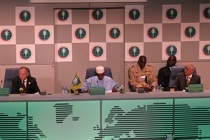
The 18th SAARC Summit will cover a wide range of issues, including connectivity, climate change, and SAFTA. A number of similar issues were discussed at the last summit—what’s been the progress since then? Given its constraints, does the association have a future? Gateway House asks and answers five questions on SAARC
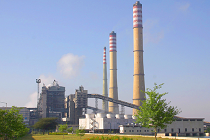
power Courtesy: Wikimedia Commons
9 July 2014

Power sector needs sweeping reforms

The World Bank report highlighting the need for far-reaching reforms in the power sector underlines the necessity for the centre and state governments to arrive at a political consensus. The model of cooperative federalism advocated by Prime Minister Modi has the potential to transform the electricity scenario

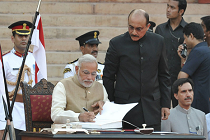
Modi signing register Courtesy: PMO/Government of India
28 May 2014

Narendra Modi: global perspectives

By inviting SAARC leaders to his swearing-in ceremony India’s new prime minister Narendra Modi has signaled a major shift in India’s foreign policy. Gateway House presents perspectives from experts from seven countries on the changes they expect to see in India’s foreign policy in the Modi era

milanspikecallusnavy Courtesy: Spike Call U.S Navy/Wikimedia Commons
21 February 2014

Shaping regional diplomacy

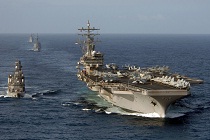
The Indian Navy, through multi-lateral exercises, is increasing its sphere of influence and becoming a regional force. Yet, it needs to be supported by policy decisions that enable it to achieve its potential as a state-of-the-art establishment and a powerful tool in India’s diplomatic repertoire

Yameen Courtesy: Ministry of External Affairs, India
3 January 2014

The Maldives: small gains

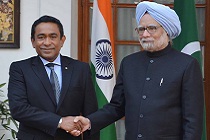
Maldivian President Abdulla Yameen’s visit to India this week aims to repair ties, strained after the Maldives terminated a $500 million contract to the Bangalore-based infrastructure company, GMR. Yameen’s conciliatory stand stems from the need for international help, including India’s, to fix an economy in decline

abdulla yameen The President's Office Republic of Maldives Courtesy: The President's Office, Republic of Maldives
13 December 2013

Maldives: Stability after a storm?

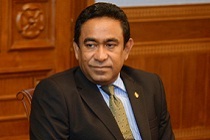
The November 16 election of Abdulla Yameen as president of the Maldives may have ended the two-year long political turmoil, but for the country’s economy to recover Yameen must ensure the stability of his government. He also has to consolidate ties with India, and his visit here on December 23 will be a start

maldives flag Paolo Rosa flickr Courtesy: Paolo Rosa/Flickr
4 October 2013

The Maldives: Awaiting another election

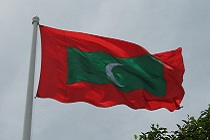
The September 28 run-off presidential election in the Maldives was postponed indefinitely by the country’s Supreme Court after allegations of ballot-rigging. However, national and international observers have said the elections were fair. Settling the political crisis in the Maldives may now require more than an election

Www.Oic-Oci.Org Courtesy:
23 January 2013

India and the OIC: To join or not to join?

India’s relations with Islamic nations, many of which are members of the Organisation of Islamic Cooperation (OIC), have become even more prolific over the last decade. While India does not visualise becoming a member of a religious international body, many reasons militate against our formally joining the OIC.

parliament Courtesy: Shwkyn231/Flickr
31 December 2012

India’s foreign policy: A year in review

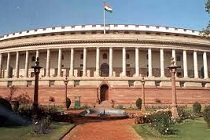
The year 2012 has been a busy one for foreign policy: from escalating disputes in the South China Sea to alternate financial instruments from the emerging world. India’s foreign policy too has its shown strengths and weaknesses. We present our top foreign policy Hotspots, Sweet spots and Blind spots for 2012.

saarc-flags_5 Courtesy: doreview.blogspot.in
6 December 2012

The time for SAARC is now

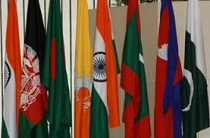
Domestic politics are impacting overall SAARC relations. As the largest SAARC economy, we must strive to minimise differences with our neighbours by understanding how they perceive our policies, and uphold the promise of this regional bloc