
Eastern Europe Goes South
Many eastern European states who are part of the EU and were admitted only after being deemed compliant with the Copenhagen criteria have seen political parties in these countries become increasingly illiberal
Courtesy: Foreign Affairs
Many eastern European states who are part of the EU and were admitted only after being deemed compliant with the Copenhagen criteria have seen political parties in these countries become increasingly illiberal
Courtesy: mac_ivan/Flickr
Crimea will hold a referendum this weekend on secession from Ukraine. The current crisis has brought to the fore Cold War era hostilities. However, an unstable Ukraine is in no one’s interest as it has implications for the region and the EU-Russia trade relationship
Neelam Deo, Director, Gateway House, talks about the ongoing crisis in Ukraine and its possible outcomes. In this interview, she also discusses the issues at stake for Russia and the West, the credibility of assertions made by both sides, the EU’s interests in the region, and how India should respond
In the backdrop of the European Union’s (EU) economic crises, the international community’s focus has shifted towards Asia. Gateway House interviews renowned historian and scholar Timothy Garton Ash on the lessons Asia can learn from Europe, Britian’s role in the EU and political morality.
Courtesy: nazeah/Wikimediacommons - Ramesh Lalwani/Flickr
The year 2011 saw various events - the Arab Spring, anti- corruption protests, Europe's sovereign debt crisis - transform countries and reshape the world order. Gateway House takes a look at what these events mean for India, and presents India's top foreign policy cheers and jeers for the year.
Courtesy: www.kremlin.ru/Flickr
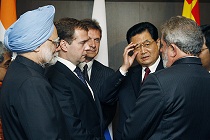
In a reversal of historical roles, the BRICS nations may be coming to Europe’s rescue. During the Asian Financial Crisis, the International Monetary Fund (IMF) introduced structural adjustments in return for IMF loans, and many institutions and individuals went bankrupt. Will it be any different now?