2019-06-14T000000Z_1951021920_RC-2 Courtesy: SCO, Russia (2020)
22 July 2021

China’s quad?

A potential anti-Quad formation of China, Russia, Iran and Pakistan is in the making, and can pose risks to the Quadrilateral Security Dialogue. However, a close analysis of China's bilateral relationship with each country shows that this is a flawed grouping, formed on limited common interests and rivalries.

Countering China's Maritime Greyzone activities Courtesy:
22 July 2021

Countering China’s Maritime Grey Zone Activities

On 15 July, Gateway House co-hosted a webcast with Konrad-Adenauer-Stiftung (KAS) on 'Countering China’s Maritime Grey Zone Activities'. The panel discussed the potential strategies that smaller nations in the region can adopt to overcome the challenges of Chinese maritime grey zone activities, and the role of regional maritime powers in capability-building of maritime law enforcement agencies.

attributing cyber-attacks Courtesy: Shutterstock
15 July 2021

Attributing cyber-attacks

A ransomware attack recently targeted Kaseya, a software services company in the U.S., for $70 million, incapacitating hundreds of its clients globally. There is an increasing incidence of such attacks, with perpetrators targeting government agencies and high-tech companies, leading to considerable economic losses. How can governments mitigate these threats and attribute responsibility to those accountable?

sanctions and counter-sanctions Courtesy: Shutterstock
15 July 2021

Sanctions and counter-sanctions

For years, Western countries have used sanctions as a means of economic warfare against their adversaries. Now, China and Russia are utilising the same tactic against the West. The United Nations Security Council is paralysed by differences between the five permanent members, leaving the tools of unilateral sanctions and counter-sanctions to proliferate at the cost of UN-approved multilateral sanctions.

First,Space,Shuttle,Launch,On,April,12,,1981.,Astronauts,John Courtesy: Shutterstock
8 July 2021

Economic goals will drive space exploration

With the U.S.-led Artemis Accords gathering momentum, and China and Russia joining hands, space exploration is becoming economically important. Countries increasingly want to participate in the space exploration economy and are partnering with space superpowers that have aligned geopolitical and geoeconomic interests. India, too, must do the same, says Dr. Chaitanya Giri, Fellow, Space and Ocean Studies Programme.

Source: Shutterstock Courtesy: Shutterstock
15 June 2021

Shaping the Israel-India-U.S. defense technology partnership

The idea of a U.S.-India-Israel trilateral cooperation is not unknown, but rather unfulfilled. Diaspora associations have repeatedly raised the idea of a technology triangle amongst the three countries, and in 2020, the three countries explored a potential cooperation in 5G communication technology. On these terms, taking advantage of the bilateral synergies and establishing a start-up corridor between Tel Aviv, Silicon Valley, and Bengaluru, can launch this partnership.

four dimensions of the quad Courtesy: Shutterstock
10 June 2021

Four dimensions of the Quad

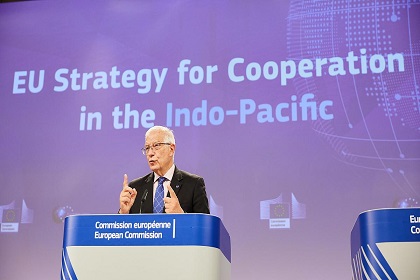
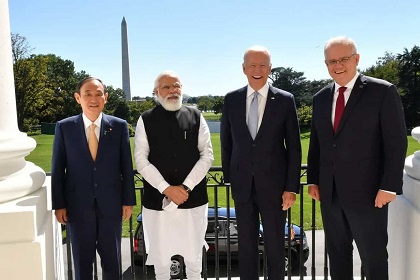
The Quad countries are preparing for an autumn summit in Washington, which will provide an opportunity to discuss multilateral cooperation in various sectors. Four dimensions which merit closer attention and are crucial to the group's future are the Indo-Pacific strategies of European countries and the EU, partnerships with ASEAN and its members, closer India-U.S. ties and maritime security issues in the Pacific.

cyber attacks on critical infrastructure: is india ready? Courtesy: Twitter | @ColPipe
27 May 2021

Cyber attacks on critical infrastructure: Is India ready?

The ransomware attack on Colonial Pipeline in the U.S. has underlined the importance of cyber security in critical infrastructure. India has not escaped the brunt of a recent global surge in cyber attacks. Though New Delhi has taken steps to protect critical infrastructure, problems in information sharing of threat vulnerabilities impede an effective response.

Myanmar event Courtesy: Gateway House
20 May 2021

Myanmar: Hundred days after the coup

We hosted a webcast with Konrad-Adenauer-Stiftung on, Myanmar: Hundred days after the coup on 13 May 2021 at 5:30 PM IST. This webcast discussed the conflict in Myanmar, the pulse of the protesters’ fight for democracy, the ominous presence of China as well as Russia and multilateral measures that the neighbouring countries including India can take towards restoring democratic processes in Myanmar.

taliban3 Courtesy: Middle East Institute
6 May 2021

Securing India’s interests in volatile Afghanistan

The American decision to withdraw troops from Afghanistan will strengthen the Afghan Taliban and possibly ensure its return to Kabul. This has implications for India’s security and economic interests in Afghanistan. India must step up its game by showing willingness to talk to the Taliban, while simultaneously expanding training assistance to the Afghan security forces.