Indo-Pacific: New Geostrategic Reality
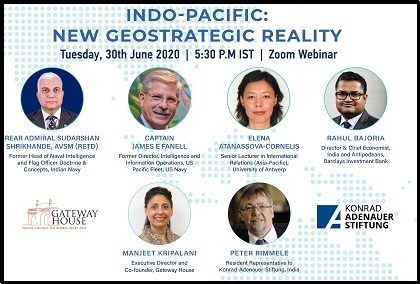
On 30th June, 2020 Gateway House in association with Konrad-Adeneur-Stiftung (KAS) co-hosted a webinar on Indo-Pacific: New Geo strategic reality.

 Courtesy: Gateway House
On 30th June, 2020 Gateway House in association with Konrad-Adeneur-Stiftung (KAS) co-hosted a webinar on Indo-Pacific: New Geo strategic reality.
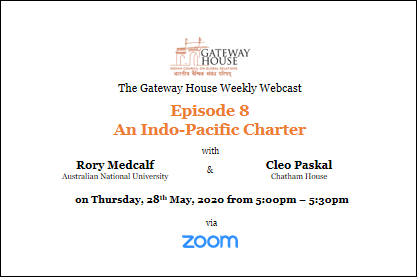
Manjeet Kriplani, Executive Director, Gateway House, in discussion with Prof. Rory Medcalf, Head, National Security College, Australian National University, and author of Indo-Pacific Empire: China, America and the Contest for the World's Pivotal Region; and Cleo Paskal, Associate Fellow, Energy, Environment and Resources, and Asia-Pacific, Chatham House; on the possibility of an Indo-Pacific Charter for the region.
 Courtesy: Gateway House
Manjeet Kripalani, Executive Director, Gateway House, in discussion with Prof. Rory Medcalf, Head, National Security College, Australian National University, and author of Indo-Pacific Empire: China, America and the Contest for the World's Pivotal Region; and Cleo Paskal, Associate Fellow, Energy, Environment and Resources, and Asia-Pacific, Chatham House; on the possibility of an Indo-Pacific Charter for the region.
 Courtesy: Shutterstock
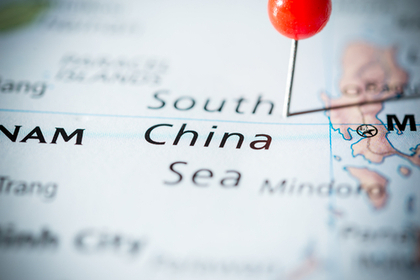
Under the cover of the COVID19 crisis, China has silently, once again, upped aggression in the disputed South China Sea, in March 2020. These incremental actions by China are part of its ongoing attempt to dictate the Code of Conduct in the region.
 Courtesy: MEA Flickr
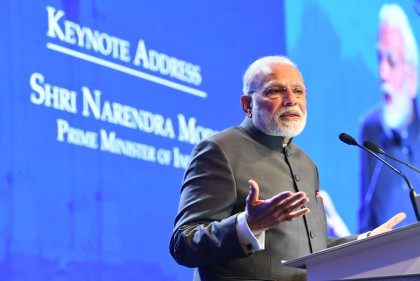
The key global powers are redefining their roles in the Indo-Pacific to promote national interest. China’s rise and increased activism in South Asia and the Indian Ocean region is an uncontested reality even as Asian countries worry about the new cold war in which the U.S. and China are locked. The Quadrilateral Dialogue has reemerged to prevent a unipolar Asia — these are some of the trends unfolding in this arena
 Courtesy: MEA Flickr
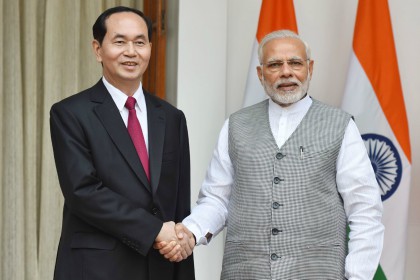
The following remarks were given by Ambassador Rajiv Bhatia, Distinguished Fellow, Foreign Policy Studies, Gateway House as the chair at a panel discussion on 'Geopolitics in the Indo-Pacific: Implications on Maritime Security for India and Vietnam', organised by the Centre for Indo-Pacific Studies, SIS, Jawaharlal Nehru University on January 22, 2019.
 Courtesy: Indian Ocean Conference
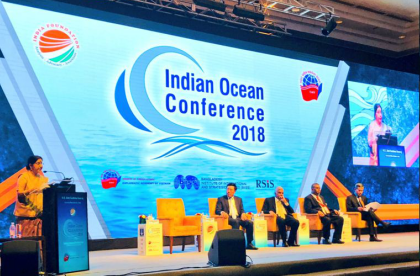
If India wants to become a serious Indo-Pacific player, it has to prioritise implementation of the SAGAR initiative, look beyond the Quad to partner with smaller littoral states and provide alternatives to China’s investment strategies. This was the message from the recent Indian Ocean Conference in Hanoi, Vietnam
 Courtesy: MEA/ Flickr
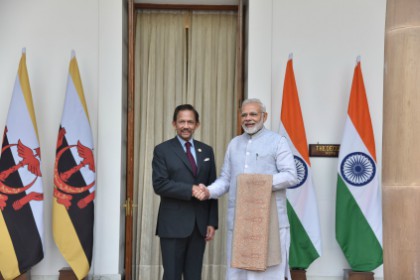
India and Brunei have a 34-year-old diplomatic relationship; but as yet no Indian president or prime minister has paid the country a bilateral visit to strengthen these ties. The strategically-located nation is rich in its history, with a unique political system. Its foreign policy approach is non-controversial, yet noticeably pragmatic.
 Courtesy: Gateway House
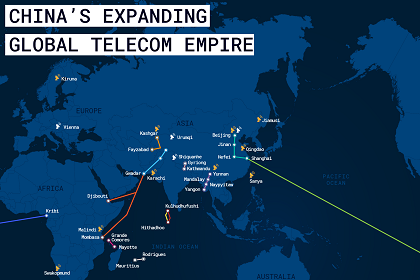
This version of the Gateway House Map on China’s Expanding Global Telecom Empire identifies some more telecommunication assets -- optic-fibre and satellite ground stations -- that Beijing is working on in South and Central America, Africa, Myanmar, the Indian Ocean Region and mainland China besides the existing ones, such as the Pakistan East Africa Cable Express (PEACE). It shows the direction China’s investment is taking, its diplomatic overtures and the larger geopolitical implications of its growing telecom empire
 Courtesy: MEA Flickr
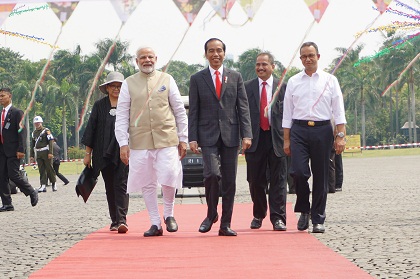
Prime Minister Modi’s visits to South East Asia last week were major steps in furthering the goals of India’s Act East Policy even as major power rivalries unfolded in the region. Most significant was the visit to Indonesia, a low key Asian power but one that India can partner to enhance its regional stature.