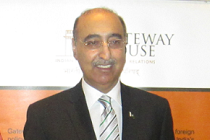
Paradigm change in Pakistan
The newly elected Modi government in India must acknowledge the paradigm change in internal Pakistani politics, and pursue normalization in ties, through an innovative approach.


The newly elected Modi government in India must acknowledge the paradigm change in internal Pakistani politics, and pursue normalization in ties, through an innovative approach.
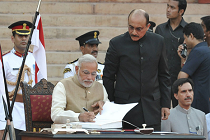 Courtesy: PMO/Government of India
By inviting SAARC leaders to his swearing-in ceremony India’s new prime minister Narendra Modi has signaled a major shift in India’s foreign policy. Gateway House presents perspectives from experts from seven countries on the changes they expect to see in India’s foreign policy in the Modi era
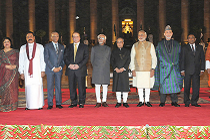 Courtesy: Kotakkalnet/Flickr
The South Asian region is one of the least integrated in terms of trade and human interaction. The presence of SAARC leaders at the swearing-in ceremony of the new government heralds a step towards removing barriers and integrating the economies of this region
Pakistan’s High Commissioner to India Abdul Basit says his country wants to re-engage with India after the next government takes charge. In an interview to Gateway House, he also spoke about the need to promote people to people exchange programmes, especially among the youth
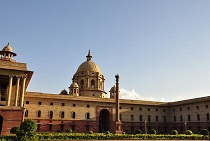 Courtesy: rajkumari1220/Flickr
India’s political and economic future will be determined over the next few weeks. Gateway House recommends a priority diplomacy agenda for the next government – one which puts economics at the heart of our foreign policy
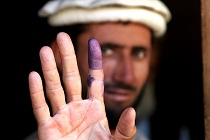 Courtesy: Staff Sgt. Christopher Allison/Wikimedia Commons
The presidential election is vital not only for Afghanistan’s future but also for the stability of the region. The ensuing race has thrown up candidates from various ethnicities and they face an uphill task with a resurgent Taliban and a former President who still hopes to be a force in the political arena
 Courtesy: User:Deepak/Wikimedia Commons
Historically, foreign policy has rarely played a decisive role in the Indian elections although issues like the nuclear deal with the U.S. have led to domestic storms. In this interview Neelam Deo, Director, Gateway House, explains why foreign policy has only occasionally been a key factor in the elections
 Courtesy: Rajkumar1220/Wikimedia Commons
The classified Henderson Brooks report on the India-China War is still relevant for India, considering China’s renewed aggression at the Line of Actual Control. The findings highlight the need to re-think our muddled China policy and coordination among the political, bureaucratic and military establishments
 Courtesy: Press Information Bureau/Wikimedia Commons
What are the implications for India of the scaling down of U.S. forces from Afghanistan, the continuing tension with China at the border, and the political turmoil in Bangladesh? How should India address these and other upheavals in its neighbourhood, which are potential challenges to the country’s security?
 Courtesy: Ministry of External Affairs
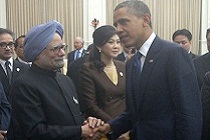
Following Indian diplomat Devyani Khobragade’s expulsion, ties between India and the U.S. have hit a new low. This comes at a time when the two countries should be working closely to address the changing security matrix in Asia