Sanctions,-,Just,Ahead Courtesy: Shutterstock
5 August 2021

Are counter-sanctions effective against sanctions?

Sanctions are an important foreign policy tool, used especially by the West against its adversaries. Now, these rivals are retaliating with counter-sanctions. Are these effective? How does this impact global politics? Where does India stand in this free-for-all sanctions era?
Lisa Curtis and Surjit Bhalla Courtesy: CNBC-TV18 (Youtube)
5 August 2021

Quad collaboration on economics and technology

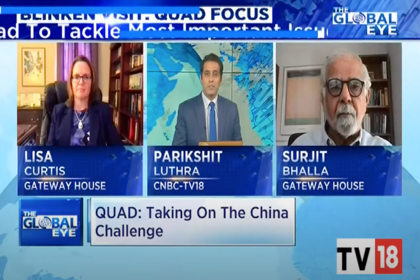
On 30 July 2021, Lisa Curtis and Surjit Bhalla, co-chairs of the Gateway House Quad Economy and Technology Task Force, spoke to CNBC-TV-18 on the various channels of cooperation between the Quad countries in technology, supply chains and undersea cables, and the need to counter China's dominance in the Indo-Pacific.

Countering China's Maritime Greyzone activities Courtesy:
22 July 2021

Countering China’s Maritime Grey Zone Activities

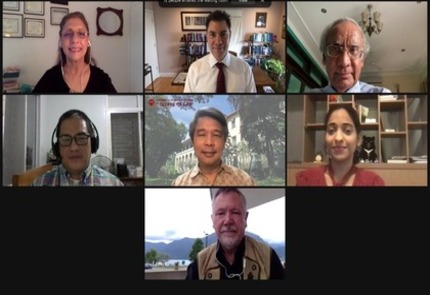
On 15 July, Gateway House co-hosted a webcast with Konrad-Adenauer-Stiftung (KAS) on 'Countering China’s Maritime Grey Zone Activities'. The panel discussed the potential strategies that smaller nations in the region can adopt to overcome the challenges of Chinese maritime grey zone activities, and the role of regional maritime powers in capability-building of maritime law enforcement agencies.

attributing cyber-attacks Courtesy: Shutterstock
15 July 2021

Attributing cyber-attacks

A ransomware attack recently targeted Kaseya, a software services company in the U.S., for $70 million, incapacitating hundreds of its clients globally. There is an increasing incidence of such attacks, with perpetrators targeting government agencies and high-tech companies, leading to considerable economic losses. How can governments mitigate these threats and attribute responsibility to those accountable?

sanctions and counter-sanctions Courtesy: Shutterstock
15 July 2021

Sanctions and counter-sanctions

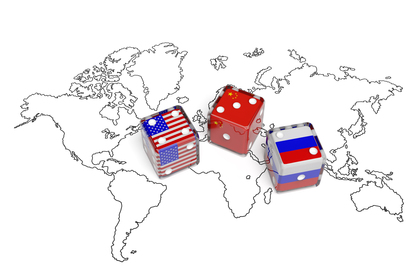
For years, Western countries have used sanctions as a means of economic warfare against their adversaries. Now, China and Russia are utilising the same tactic against the West. The United Nations Security Council is paralysed by differences between the five permanent members, leaving the tools of unilateral sanctions and counter-sanctions to proliferate at the cost of UN-approved multilateral sanctions.

Source: Shutterstock Courtesy: Shutterstock
15 June 2021

Shaping the Israel-India-U.S. defense technology partnership

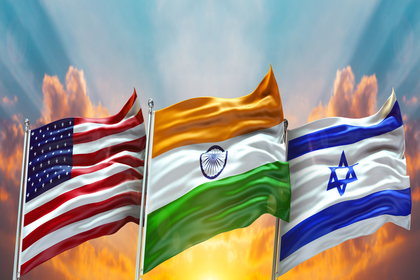
The idea of a U.S.-India-Israel trilateral cooperation is not unknown, but rather unfulfilled. Diaspora associations have repeatedly raised the idea of a technology triangle amongst the three countries, and in 2020, the three countries explored a potential cooperation in 5G communication technology. On these terms, taking advantage of the bilateral synergies and establishing a start-up corridor between Tel Aviv, Silicon Valley, and Bengaluru, can launch this partnership.

Source: Shutterstock Courtesy: Shutterstock
3 June 2021

The Quad hits its stride

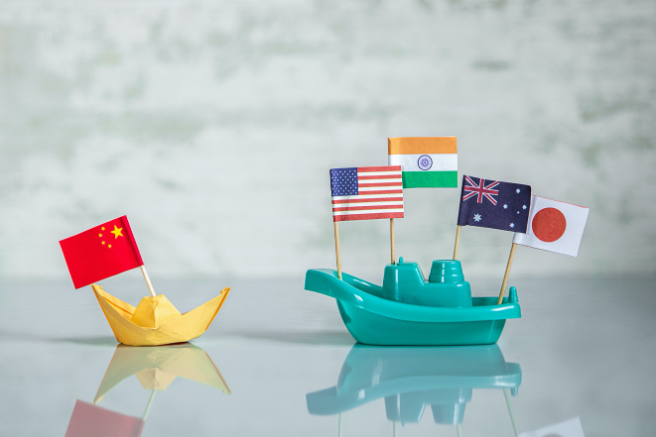
As China’s global competitive edge is sharpening across the military, economic, diplomatic, and technological domains, it is clear that the extent to which the Quad countries (Australia, India, Japan, and the United States) can collaborate across all four domains will be an important factor in determining whether China’s hegemonic designs on the Indo-Pacific will succeed.

India, U.S., Four days of COVID Courtesy: Twitter| @usaid_india
13 May 2021

India, U.S., & four days in COVID

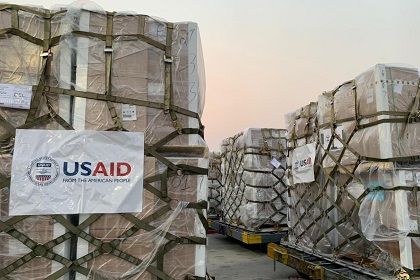
In the past two weeks, the U.S. has been sending planeloads of aid to India. This is a welcome change from its previous hesitation, which turned around in four critical days. It reflects the importance of an effective Indian diaspora and of the Global Comprehensive Strategic Partnership with India.

istanbul summit: last chance for afghanistan Courtesy:
26 April 2021

Istanbul Summit: Last chance for Afghanistan

The Taliban should have been reintegrated into Afghan society several years ago. It is now probably too late to persuade them to accept anything less than a dominant role in Kabul. However, Turkey, Pakistan and the United States may have one last chance to pressure the antagonists into a negotiated settlement, perhaps along the following lines.