A new Asian triangle?
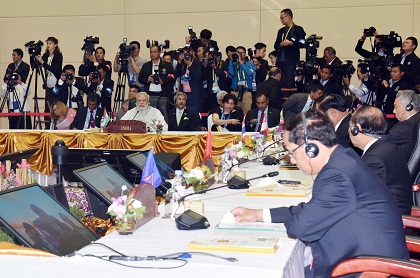
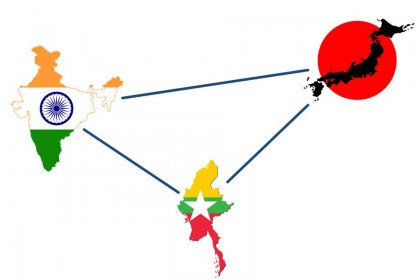
Aung San Suu Kyi paid high-profile visits to both Japan and India recently; economic cooperation would have been high on her agenda. But what could also emerge from such overtures is a diplomatic threesome
Courtesy: Gateway House
Aung San Suu Kyi paid high-profile visits to both Japan and India recently; economic cooperation would have been high on her agenda. But what could also emerge from such overtures is a diplomatic threesome
Courtesy: Ministry of External Affairs/Flickr
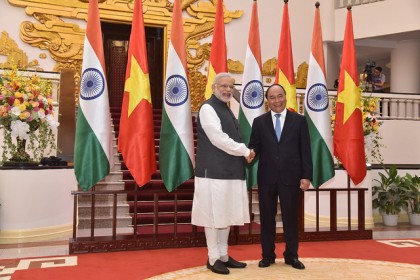
Prime Minister Narendra Modi’s recent trip to Vietnam had both heads of state announcing an upgrade of their ‘Strategic Partnership’ into a ‘Comprehensive Strategic Partnership’. This added term captures the importance both sides have vested in the need to deepen the relationship and the prospect for future cooperation.
Courtesy: MEA/Flickr
During Japanese PM Shinzo Abe’s recent visit to India, both countries made important progress in strengthening their security engagement focused on maritime security, defence purchases and counter-terrorism. Nonetheless, Indian policymakers are conscious of regional concerns about Japan’s renewed nationalism and of balancing this relationship with that of China
Courtesy: India Strategic
The recent re-evaluation by the US, China, Japan, and Russia of their military strategies reflects new geopolitical equations in which the Asia Pacific is a major strategic intersection. Turmoil in this region can impact India’s trade and security interests, and to avoid this India must craft a balance between its relations with all the countries involved
Courtesy: Wikimedia Commons
Narendra Modi, who spent nearly two months abroad in his first year as prime minister, helped India cultivate a wide range of bilateral and multilateral relationships. But of these, it will be the middle powers that hold the key, economically and geopolitically to India’s growth and security, and Modi must continue to widen his middle powers arc
Courtesy: MEA/Government of India
Prime Minister Modi’s visit to Tokyo had raised expectations at home, especially due to the equation between him and his Japanese counterpart Shinzo Abe and the immense potential for Japanese investment in India. However, while the visit showcased warmth and friendliness, it fell short on the strategic and economic front
Courtesy: MEA/Government of India
Prime Minister Narendra Modi’s forthcoming visit to Japan is of considerable significance at a time when the bilateral relationship looks ready to take off. The rise of China, a growing Indian market for Japanese technology and a possible landmark nuclear deal have raised expectations of the outcome of this visit
Courtesy: U.S. Navy photo/Journalist 1st Class Todd Macdonald
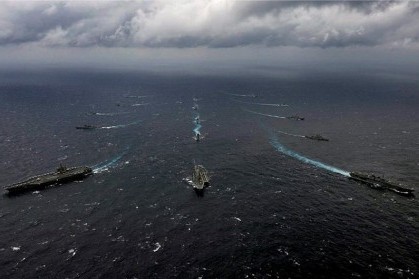
India’s invitation and the subsequent participation of the Japanese navy in the Malabar 2014 exercise is a sign of the deepening of the political-security relationship between India and Japan. However, an actual fruition of the potential requires both the administrations to be more flexible, especially on the nuclear deal and defence purchases
Courtesy: MEA/Indian Embassy Thimphu
Narendra Modi’s first month in office has seen him deftly handle India’s neighbours, accept an invitation to visit Washington, enhance relations with Bhutan and accord due importance to China. In the same manner, Modi will also have to move quickly and firmly to reassure foreign investors of the dependability of India’s fiscal environment
Courtesy: Department of National Defence, Republic of Philippines
The recently held Shangri-La Dialogue, an annual security forum of Asia’s defence establishments, highlighted the growing anxieties over China’s belligerent pursuit of territories under dispute in the South China Sea. The U.S. and Japan have made it clear that they will strongly challenge China’s claims. It’s a tussle that will throw up new security dilemmas for India in the future