e92550d47b6d4ed5ad131f474187f8a7_18 Courtesy: Al Jazeera
6 March 2017

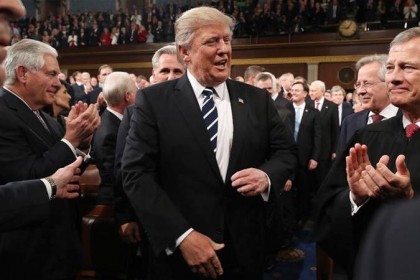
The Trump challenge: unpredictability as norm

Forecasting uncertainty is a full-fledged task for security and foreign policy analysts, but when countries resort to being unpredictable then it is likely to backfire. Uncertainty about his next course of action seems to be Trump’s defining characteristic. How India will manage this to better relations will be critical

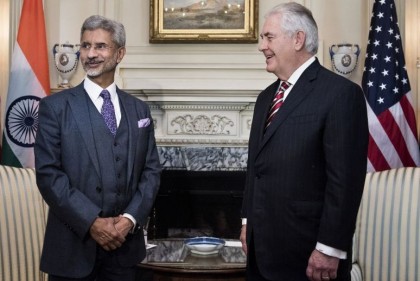
India's Foreign Secretary Subrahmanyam Jaishankar (L) and US Secretary of State Rex W. Tillerson Courtesy: AFP
6 March 2017

India-U.S.: continued ‘solid’ footing

Foreign Secretary Jaishankar’s third visit to the United States since Donald Trump's election is an indication of India’s commitment to engage with all-quarters in Washington with its full diplomatic might. Despite the current situation of concern due to the H-1B visa and the recent shooting of an Indian in Kansas, initial soundings are reassuring and positive.

28912263963_0b75893744_h Courtesy: MEA/ Flickr
14 February 2017

Indo-Pacific: a scenario of possibilities

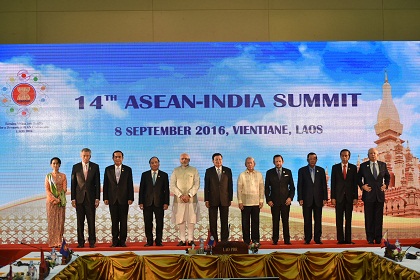
The Indo-Pacific region is home to some of the largest and most rapidly growing economies as also powerful military forces. Nuclear threats, international terrorism and climate change are some of the issues that define the region. Uncertainty dogs relations among the four nations in the top league—U.S., China, India and Japan—but what is emerging is a hawkish, policy stance from the U.S. as opposed to an isolationist outlook apprehended earlier

Barack-Obama-Nawaz-Sharif Courtesy: Wikipedia
10 October 2016

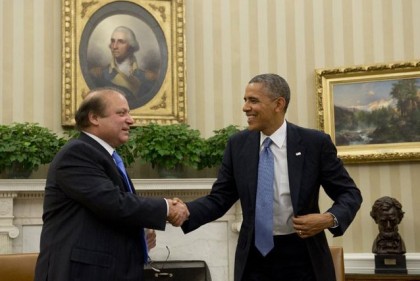
U.S.-Pakistan: still cosy after Uri

There has been a strengthening in the India-U.S. bilateral, which reached new heights with the signing of the LEMOA agreement in August, 2016. However, this strengthened bilateral has not resulted in a strong response to Pakistan by the U.S. Government.

India-US Partnership: $1 Trillion by 2030 by Nish Acharya Courtesy: Oxford University Press
1 July 2016

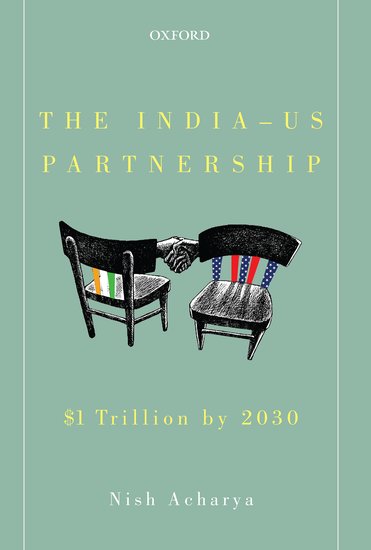
The India-U.S. Partnership: $1 Trillion by 2030

The story of U.S.-India relations is one of unfulfilled potential. Despite their common commitment to democracy, diversity, and free markets, the short- and long-term objectives have not aligned in a way that has enabled the creation of a robust economic and political partnership. These two nations, which will soon be the second and third largest economies in the world, must find ways to increase their economic integration over the next 10 years

screenshot Modi US Congress Courtesy: MEA / Flickr
23 June 2016

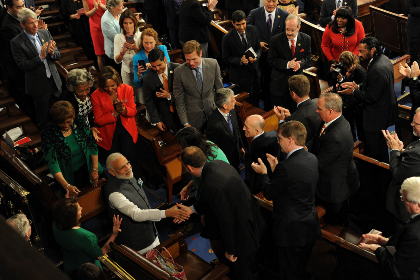
India-U.S.: not yet a priority partner

Prime Minister Narendra Modi's fourth visit to the United States has been met with hails of success and with comments of 'too little, too late'. While Modi's friendship with President Obama is often credited for improving bilateral relations, the U.S. leader is currently nearing the end of his term. The new President will have their own geopolitical demands, which will invariably result in India being relegated to a second-term priority.

IMG_2283 Courtesy: Manjeet Kripalani
2 June 2016

The sanctioned, sleeping beauties awake

The crippling effect of American sanctions are thorough; designed to strangle economies and bring entire nations to a halt. However, they unknowingly pull people together, imparting a deep sense of patriotism and often sparking innovation which can quickly surpass any other world power. With sanctions being lifted on nations like Myanmar, Iran and, hopefully, Cuba, the question remains whether they will retain their uniqueness or fall into line with the rest?

modi RCEP Courtesy: MEA / Flickr
26 May 2016

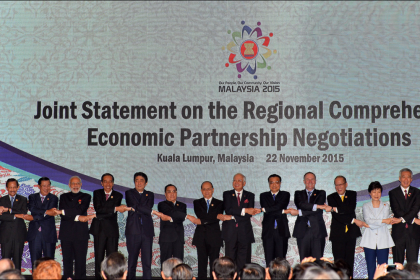
India’s five-cornered trade strategy

Five rather unfavourable trends define India’s trade performance over the past two years; these trends also provide useful pointers as to where India’s future trade strategy can go over the next three years as it deals with a global economic slowdown, the rise of megatrade agreements and a pivot to a more intensive trade relation with the U.S.