Bhatia article image Courtesy: Gateway House
17 February 2022

Has global geopolitics turned multipolar?

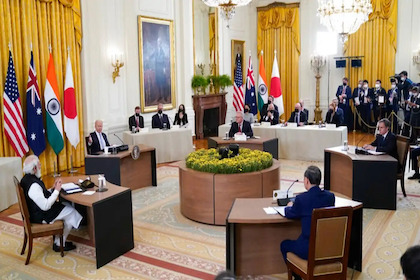
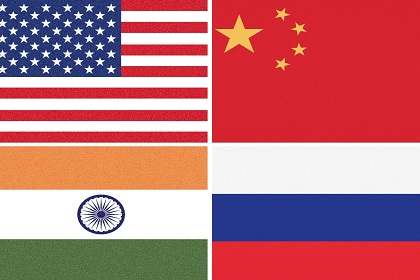
The Quad Foreign Ministers' meeting held on February 11 is the latest example of growing geopolitical cooperation. Several loci of power have emerged, indicating the end of the post-Cold War western hegemony. China's rise and alliance with Russia hints at a bipolar tendency in this nascent global multipolarity. India must ensure power distribution in Asia by sharpening its diplomacy to achieve its own interest - true multipolarity in Asia.

Indian,Ocean,Military,Boat,Reunion,Island Courtesy: Shutterstock
20 January 2022

The Indo-Pacific opportunity in 2022

Nine great powers and a number of important multilaterals have vested interests in the Indo-Pacific. Given the U.S.-China standoff in the region, the role of new groupings like the Quad and AUKUS is significant. The time is ripe for India to use its position in the region, and convert its humanitarian duties into economic and strategic opportunities in 2022.

Omicron, India-Africa ties and a fresh look Courtesy: Gateway House
2 December 2021

India-Africa through a new lens

The new Omicron variant of COVID-19 has caused concern across the globe, especially in Africa. India has shown solidarity with the continent, extending supplies of Made in India vaccines, drugs and medical equipment. Despite some setbacks, there is vast potential for Indo-African collaboration based on strategic advantages and mutual goals.

Europe - IP Courtesy: Club of Three
18 November 2021

Indo-Pacific through the European prism

The EU's Indo-Pacific strategy, released in September, set the tone for a renewed focus on the region. Europe's Asia connect is rich, strong and multi-layered, laying the foundation for an advantageous position for the EU in the Indo-Pacific. This can be achieved if the EU is more candid with itself, more assertive with China, and more cooperative with India.

G20 Rome summit, marching ahead Courtesy: G20
4 November 2021

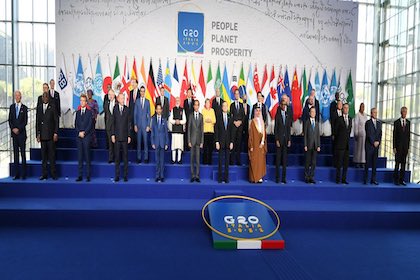
G20 Rome summit, marching ahead

The Oct 30-31 G20 Leaders’ Summit in Rome took several important steps to accelerate economic recovery and health security. In the absence of several Eurasian leaders, India played a significant role especially on climate and energy. The G20 will now acquire greater salience in India's foreign policy, as it readies to lead the grouping in 2023.

The Quad gathers steam Courtesy: Twitter | @AP
3 October 2021

The Quad gathers steam

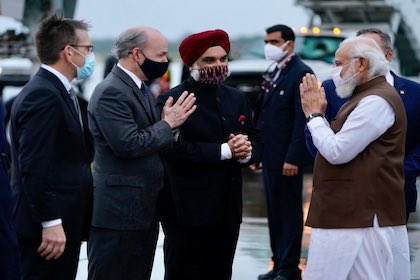
The first in-person Quad Leader's Summit drew global attention for its symbolism and substance. A critical analysis of its outcome shows that the institutionalisation of the organisation has begun. India has a chance to work with the advanced economies, on an equal footing and with much to contribute.

Quad amidst a geopolitical flux Courtesy: Twitter | @narendramodi
23 September 2021

Quad amidst a geopolitical flux

On September 24, the Quad leaders will attend the first in-person summit of the grouping in Washington DC. There is much to discuss for the four leaders, given recent developments: the Taliban takeover of Afghanistan, the Australia-UK-US (AUKUS) security partnership and the EU's new Indo-Pacific strategy. The Quad also needs to focus on long term goals like institutionalising itself and devising a strategy to counter the China challenge.

Sanctions,-,Just,Ahead Courtesy: Shutterstock
5 August 2021

Are counter-sanctions effective against sanctions?

Sanctions are an important foreign policy tool, used especially by the West against its adversaries. Now, these rivals are retaliating with counter-sanctions. Are these effective? How does this impact global politics? Where does India stand in this free-for-all sanctions era?

First,Space,Shuttle,Launch,On,April,12,,1981.,Astronauts,John Courtesy: Shutterstock
8 July 2021

Economic goals will drive space exploration

With the U.S.-led Artemis Accords gathering momentum, and China and Russia joining hands, space exploration is becoming economically important. Countries increasingly want to participate in the space exploration economy and are partnering with space superpowers that have aligned geopolitical and geoeconomic interests. India, too, must do the same, says Dr. Chaitanya Giri, Fellow, Space and Ocean Studies Programme.

BigTech Report (1) Courtesy: Gateway House
1 July 2021

Regulating Big Tech: A Balancing Act

Big Tech is powerful and its profits are growing - by 105% over the last year. It dominates economies. This raises concerns about data protection and privacy, anti-trust, fintech and the specific role of intermediaries. India is leading the way on fintech, but is behind several countries and institutions on digital rules. It is important to establish laws and rules to govern technology – whether domestic or through multilateral bodies – with the aim to strike the right balance between innovation and regulation.