G20 Courtesy: Ministry of External Affairs
2 April 2020

The action imperative for G20

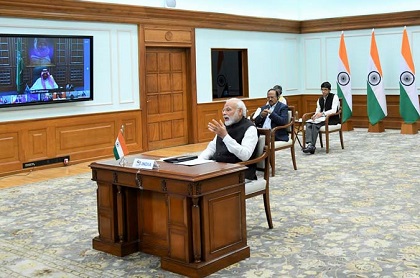
COVID-19 unified G20 leaders at an extraordinary summit last week. An idea given a nudge by Prime Minister Narendra Modi, here was an opportunity for all participants to put together a plan and make a pledge for international cooperation, focusing on four main themes. Next, will they be able to turn words into action?
shutterstock_1420700369 Courtesy: Shutterstock
24 October 2019

Global protests: leaderless, youthful, persistent

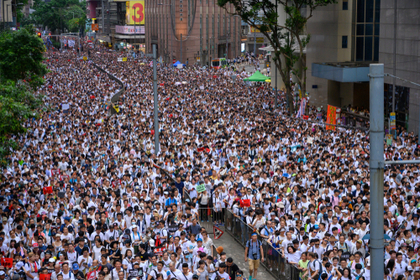
There has been a wave of civil protests across the globe since early 2019 which have taken governments by surprise by their sheer intensity and resilience. The common impelling factor has been discontent with government. Other factors for the current wave, beginning with the Arab Uprising in 2011, have been corruption and regressive constitutional changes. This infographic charts the arc of the outcry

indias-global-energy-footprint Courtesy: Gateway House
14 February 2017

India’s global energy footprint

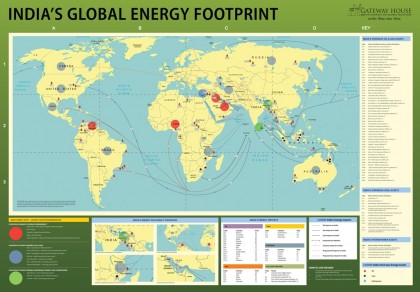
Trends in technology, geopolitics and geoeconomics have dramatically transformed the global energy scenario in the last two years. This means favourable conditions for import-dependent India, which must use the opportunities available to reduce its vulnerability to high energy prices. The jump in oil prices past the $60 mark suggests that India must act with alacrity. India’s Energy Footprint Map offers a profile of India’s global trade and investment in energy, and indicates what India can do to access cheap and reliable supplies

GH_Demonetisation_Web-724x1024 Courtesy: Gateway House
24 November 2016

Demonetisation around the world

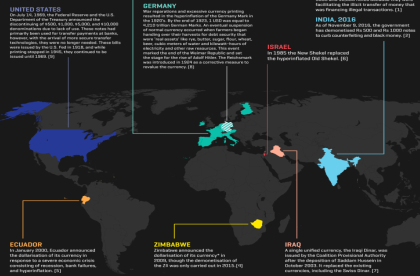
Prime Minister Narendra Modi's announcement on November 8 to demonetise notes of the denomination of Rs 500 and Rs 1000 has a precedent. This infographic traces some interesting demonetisation initiatives around the world. From discontinuation of high denomination notes due to lack of circulation, to the use of beer and water as 'real assets' in place of hyper-inflated currency.

Www.Oic-Oci.Org Courtesy:
23 January 2013

India and the OIC: To join or not to join?

India’s relations with Islamic nations, many of which are members of the Organisation of Islamic Cooperation (OIC), have become even more prolific over the last decade. While India does not visualise becoming a member of a religious international body, many reasons militate against our formally joining the OIC.

parliament Courtesy: Shwkyn231/Flickr
31 December 2012

India’s foreign policy: A year in review

The year 2012 has been a busy one for foreign policy: from escalating disputes in the South China Sea to alternate financial instruments from the emerging world. India’s foreign policy too has its shown strengths and weaknesses. We present our top foreign policy Hotspots, Sweet spots and Blind spots for 2012.

Global Stability Map Courtesy: Gateway House
1 August 2012

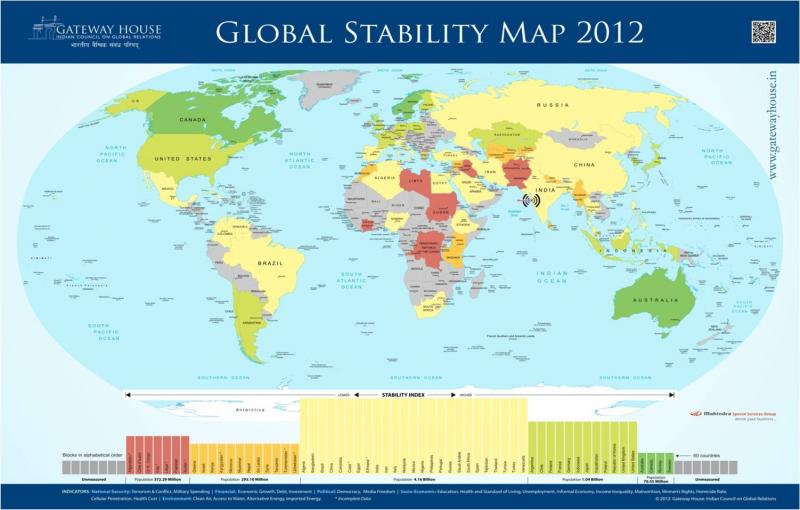
Global Stability Map 2012

Gateway House prepared a Global Stability Map, using 20 differing indicators, to analyze the stability of 60 countries around the world. Using criteria that are important to the emerging economies of the world, the map provides an Indian perspective of the world today.

debnath shaw Courtesy: Gateway House
5 July 2012

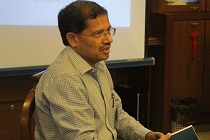
“Russia still dominates Central Asia”

Though some countries like Russia gained a strong foothold in Central Asia and the Caucasus post-1991, India has been a late-comer. Gateway House interviews former Ambassador to Azerbaijan Debnath Shaw to discuss India’s energy interests in the region, the Shanghai Cooperation Organization and the TAPI pipeline.

Courtesy: IAEA Imagebank
9 April 2012

Iran: An opportunity for BRICS

The scope for any process on nuclear talks with Iran to founder on distrust, misunderstanding and political in-fighting in both Tehran and Washington remains formidable. Equally disturbing are the wider political realities. Can the upcoming talks in Istanbul launch a process that can, over time, lead to agreement?