President of Russia Courtesy: President of Russia
2 October 2025

Valdai frames Russia’s global doctrine

Each autumn, Russia convenes its flagship Annual Summit — a gathering of global leaders, business elites and intellectuals. Often compared in scale to Davos or Shangri-La, what sets Valdai apart is President Vladimir Putin’s extended, unscripted dialogue with the audience. Over the years, India has moved to the centre of this dialogue, reflecting its strategic weight and offering rare insight into Moscow’s evolving worldview.

Gateway House Courtesy: Gateway House
3 July 2025

China Plus One and global supply chains

A slowdown of the Chinese economy, and the shift, particularly by MNCs, from China to other more competitive locations has opened up business opportunities for latecomers to supply chains in the developing world. Evidence suggests that Southeast Asia and some South Asian countries like India, Sri Lanka, Bangladesh, could be beneficiaries of the supply chain shift, particularly in labour-intensive segments.

Getty (1) Courtesy: Gateway House
15 May 2025

The New Geopolitics and South Asia’s Trade Architecture – What Next?

Geopolitics is increasingly intertwined with the economic destiny of South Asia. Even before the U.S. tariffs were rolled out, growing polycrises had hit the global economy, which has been struggling since the pandemic. South Asia seems a relatively bright spark of regional trade and growth. This paper analyses South Asia’s trade architecture in the backdrop of a sluggish world economy in the 2020s, and makes recommendations for closer regional economic integration.

New,Delhi,,India-aug,24,2021:,Group,Of,Afghan,Women,Sitting Courtesy: Shutterstock
27 January 2022

Developing a balanced Indian refugee policy

India has seen a recent influx of refugees from Afghanistan and Myanmar. This has highlighted the absence of a concrete refugee policy in India. India must formalise its approach towards refugees. The Citizen Amendment Act of 2019, is a start. India can move this forward by learning from the examples of other democracies like the U.S., Kenya and South Korea, on how to balance international law with its national security interests.

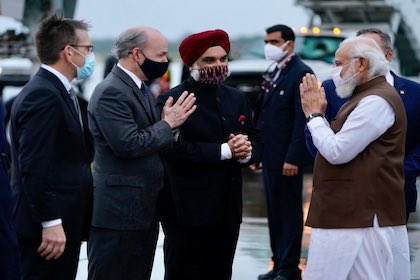
Quad amidst a geopolitical flux Courtesy: Twitter | @narendramodi
23 September 2021

Quad amidst a geopolitical flux

On September 24, the Quad leaders will attend the first in-person summit of the grouping in Washington DC. There is much to discuss for the four leaders, given recent developments: the Taliban takeover of Afghanistan, the Australia-UK-US (AUKUS) security partnership and the EU's new Indo-Pacific strategy. The Quad also needs to focus on long term goals like institutionalising itself and devising a strategy to counter the China challenge.

shutterstock_1091235845 Courtesy: Shutterstock
15 October 2020

UN: Necessary but reformed

The UN turned 75 this year but instead of grand celebrations, the world witnessed an empty UNGA with world leaders addressing it via video screening because of the pandemic. The UN is under unprecedented stress and being shown up for its inability to tackle the challenges of today like the pandemics, climate change, terrorism or global peace and security. The institution's key governing structures, especially the UN Security Council, are inadequate and demand reform. India must now use gritty resolve to ensure its place in these governing structures.

ibc-center-oil-gaz-4-696x392 Courtesy: ibctrain.com
2 April 2019

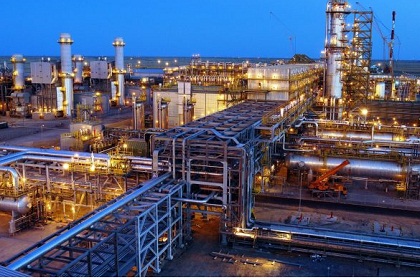
India & the influential SCO Energy Club

The main objective of the Shanghai Cooperation Organisation’s (SCO) Energy Club, when Russia formed it, was to market its member states’ substantial oil and natural gas reserves. This map shows some of the important natural gas pipelines, originating from Russia and its neighbouring countries that are not members of the SCO. What can India do to secure supplies from these abundant but currently inaccessible natural gas reserves?