GH_EcoSummit-4x6 Courtesy: Gateway House
6 October 2016

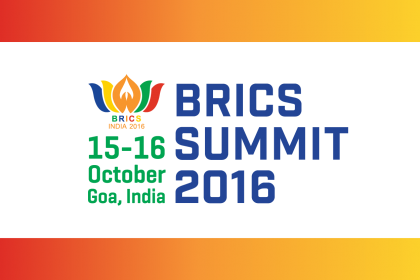
BRICS: expectations from the Goa Summit

The 8th BRICS summit in Goa comes in the midst of major geopolitical events; Brexit, the U.S. elections, the South China Sea dispute, and the terror attacks in Uri. There is much need for BRICS to demonstrate to the world, its capability to manage internal differences and showcase a collective sense of cooperation

WhatsApp Image 2016-09-12 at 18.40.58 Courtesy: Gateway House
15 September 2016

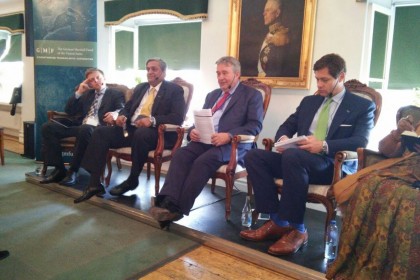
India Trilateral Forum: building bridges

The 11th India Trilateral Forum, a meeting series between India, Europe and the U.S., reflects a more confident India from whom expectations – especially to counter China – are high. This will require a realistic re-labelling of India by the Western powers.

INS_Vikramaditya_in_Baltic_Sea Courtesy: Wikipedia
6 September 2016

India’s ocean strategy crystallises

India's policy towards the Indian Ocean has begun to take a clear, coherent form with the signing of the Logistics Exchange Memorandum of Agreement with the United States, an important bilateral visit to Vietnam by Prime Minister Modi, and an ambitious future being laid out by Foreign Secretary Jaishankar

GST pic1 Courtesy: Reuters
11 August 2016

Key GST lessons from the world

The long march to implement the long-awaited Good and Services Tax in India has just begun. It is instructive to understand how other countries introduced this tax and cherry-pick lessons from their experiences

Tokat_darbe_karşıtları Courtesy: Wikipedia
27 July 2016

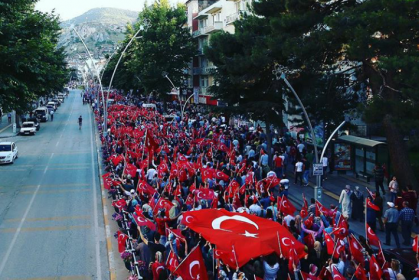
The beginning of the end for Erdogan

The attempted coup on July 15 in Turkey as well as its aftermath have irreparably dented President Erdogan’s international image and impacted Turkey's standing as a democratic state, a military power, a NATO member, an EU aspirant, and an emerging economy. This downtrend is unlikely to be reversed in the near future and the country is in for an extended period of instability

bank-getty-images-harold-cunningham Courtesy: Quartz
27 July 2016

Imperatives of regulatory diplomacy

Regulations are the new focus of economic statecraft. Their increasing importance is reflected in the negotiations on global financial standards, plurilateral trading rules, and regional economic unions.

India-US Partnership: $1 Trillion by 2030 by Nish Acharya Courtesy: Oxford University Press
1 July 2016

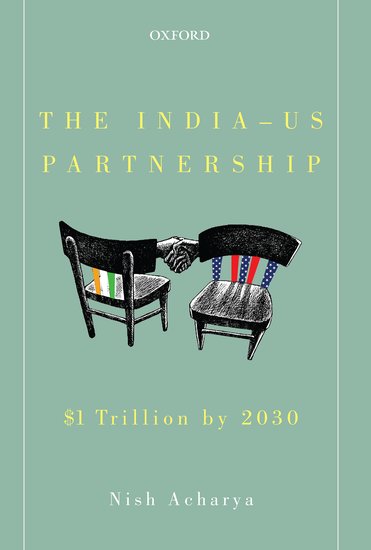
The India-U.S. Partnership: $1 Trillion by 2030

The story of U.S.-India relations is one of unfulfilled potential. Despite their common commitment to democracy, diversity, and free markets, the short- and long-term objectives have not aligned in a way that has enabled the creation of a robust economic and political partnership. These two nations, which will soon be the second and third largest economies in the world, must find ways to increase their economic integration over the next 10 years

1023-modi-cameron-mea Courtesy: MEA / Flickr
30 June 2016

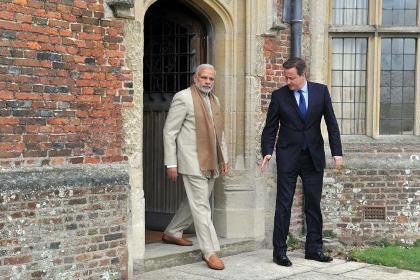
The dislocations of Brexit: can India gain?

The result of the Brexit referendum is nothing less than a body blow to Bretton Woods organisations, International Monetary Fund-North Atlantic Treaty Organisation (NATO)-World Bank, that originated at the end of the Second World War. The possibility of an Asian century becomes more feasible, if India can be nimble enough to make the most of the opportunity which has presented itself in Europe.

screenshot Modi US Congress Courtesy: MEA / Flickr
23 June 2016

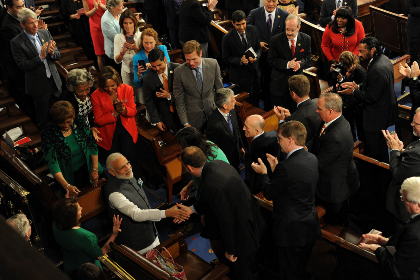
India-U.S.: not yet a priority partner

Prime Minister Narendra Modi's fourth visit to the United States has been met with hails of success and with comments of 'too little, too late'. While Modi's friendship with President Obama is often credited for improving bilateral relations, the U.S. leader is currently nearing the end of his term. The new President will have their own geopolitical demands, which will invariably result in India being relegated to a second-term priority.

IMG_2283 Courtesy: Manjeet Kripalani
2 June 2016

The sanctioned, sleeping beauties awake

The crippling effect of American sanctions are thorough; designed to strangle economies and bring entire nations to a halt. However, they unknowingly pull people together, imparting a deep sense of patriotism and often sparking innovation which can quickly surpass any other world power. With sanctions being lifted on nations like Myanmar, Iran and, hopefully, Cuba, the question remains whether they will retain their uniqueness or fall into line with the rest?