shutterstock_1469502182 Courtesy: Shutterstock
27 February 2020

India-U.S. shale oil opportunity

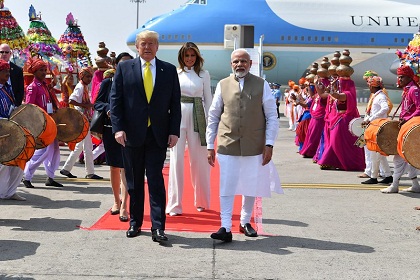
U.S. President Donald Trump's recent visit to India gave a boost to bilateral energy ties. To really benefit, India’s state-owned oil companies should consider investing in U.S. shale oil. The U.S. is politically and economically stable and investors are not subject to arbitrary action. Indian companies should only be financial investors, not operators of assets, and bet on companies with manageable debt and efficient operations rather than short-term winners
49577427353_7082006d59_c Courtesy: MEA/Flickr
24 February 2020

Deepening bilateral ties

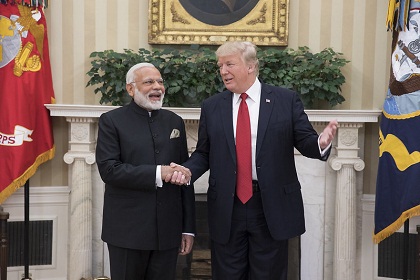
The outcome of the U.S. presidential elections could have a significant impact on the deepening Indo-U.S. bilateral. The partnership has grown substantially in the last two decades resulting in a deepening of economic and strategic relations. Defence dominates the strategic partnership and also stimulates the economic engagement. The newly signed BECA agreement is a testament to this. The next U.S. administration's policies will be critical for India, given repeated Chinese incursions into Indian territory on the Line of Actual Control at the border, the U.S.-China rivalry and China's ambitions to dominate Asia. Gateway House has an extensive repository of primary research, analysis and reporting on the Indo-U.S. bilateral, addressing issues such as trade, technology exchange and defence cooperation.

34752548343_6bd510e0ac_c Courtesy: MEA/Flickr
20 February 2020

Trump’s visit: trade differences exaggerated

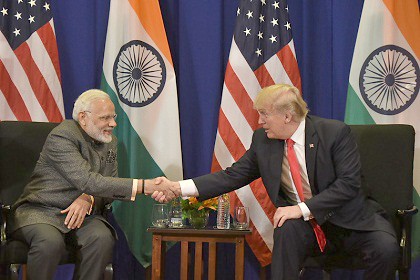
In the run-up to President Trump’s visit to India on 24-25 February 2020, Ambassador Neelam Deo, Director and Co-founder of Gateway House, discusses in this interview how he has made balanced trade a global issue, but given substance to the India-U.S. defence bilateral, sharpening the concept of the Indo-Pacific and the Quad’s profile

shutterstock2_1027256470 Courtesy: Shutterstock
13 February 2020

Pakistan under FATF’s critical review

The upcoming Financial Action Task Force (FATF) plenary session 16-21 February will be crucial for both Pakistan and Iran as the anti-money laundering and anti-terrorist financing measures undertaken by the two countries will be reviewed by the 39 member states of the FATF. Decisions will be taken on their retention or removal from the grey list and black list respectively

shutterstock_752563282 Courtesy: Shutterstock
31 January 2020

Brexit, finally?

Britain left the European Union on 31 January 2020. There will be no immediate outcome, but the intention of all the European leaders is to make it an amicable departure over the course of the year. Ambassador Neelam Deo, Director and Co-founder of Gateway House, discusses Brexit’s geopolitical implications and its impact on India’s relations with the EU and UK

shutterstock_730156222 Courtesy: Shutterstock
16 January 2020

NEST-ling new tech in foreign policy

The recently announced New and Emerging Strategic Technologies (NEST) Division of India’s Ministry of External Affairs is timely. It can become vital for India’s national technosecurity in the imminent Fourth Industrial Age if a new Cabinet Committee on Futuristic Science and Technologies is established along with it

shutterstock_1441151312 Courtesy: Shutterstock
2 January 2020

Regulating services trade in India

The services sector is the most dynamic in the global economy, constituting nearly 25% of global trade, but its intangibility – unlike the materiality of trade in goods – makes it difficult to monitor. Service providers in this sector need a national regulatory governing framework

kcmodi0312_0 Courtesy: Flickr/MEA
28 November 2019

Assessing the 35th ASEAN Summit

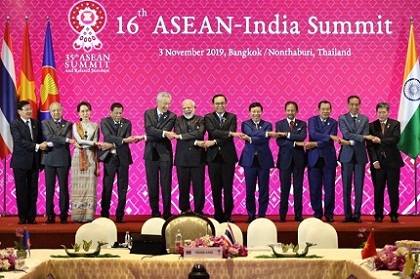
The 35th summit of the Association of South East Asian Nations, held in Bangkok early in November, showed that a shifting geostrategic landscape notwithstanding, “ASEAN centrality” in the region is a top priority with members. It also served as a backdrop for three summits that ASEAN held on November 4 with China, U.S. and India