PM Modi’s five-nation tour
PM Modi's five-nation tour highlights that despite geopolitical conflicts, New Delhi remains confident in its ability to balance relationships with the North and South.

 Courtesy: X / PMOIndia
PM Modi's five-nation tour highlights that despite geopolitical conflicts, New Delhi remains confident in its ability to balance relationships with the North and South.
 Courtesy: The China-Global South Podcast
In the current era of geopolitical uncertainty, the Middle Power states are deepening engagement with countries of the Global South while reducing their exposure to the U.S. and China. Manjeet Kripalani and Carlos Coelho spoke to Eric and Cobus from The China-Global South Podcast, on how countries like India and Brazil are navigating this increasingly contested world.
 Courtesy: Abhijit Chavda Podcast
The rules-based world, perceived to be functional till last year, seems broken, giving way to an increasingly multipolar order. Manjeet Kripalani, Executive Director, Gateway House discusses in the Abhijit Chavda podcast, how emerging middle powers like India, Brazil, and Indonesia to name a few, have the heft to rewrite the rules of global trade and reform, away from U.S. and China.
 Courtesy: The Diplomatist
The traditional label of ‘middle power’ fails to capture India’s growing status. The country’s ability to shape the international discourse is no longer in question. India sees itself as a key player the global order.
 Courtesy: Körber-Stiftung
The world is undergoing profound transformations that are not being driven only by the United States, China or Russia. Small and medium-sized States are carving out a legitimate place for themselves in the emerging new order. This second edition of our annual Emerging Middle Powers Report is a reminder that the signs of the times are showing a new momentum for middle powers.
 Courtesy: Institute for Global Dialogue
The G20 and South Africa - its presiding nation - will both face a difficult year. The U.S., one of the G20’s most vital members has not yet participated, notable by its absence from two important ministerial meetings. The U.S.’ changed foreign policy stance will be a tough challenge for G20; the Global South members will have to step up and become proactive.
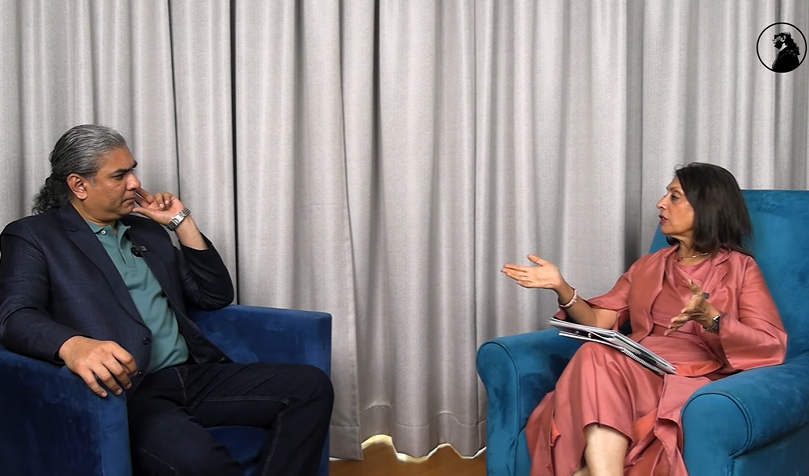 Courtesy: Abhijit Chavda Podcast
Emerging middle powers like India, Brazil and South Africa are articulating their interests on the global stage with growing assertiveness. Manjeet Kripalani, Executive Director, Gateway House, joins Abhijit Chavda on his eponymous podcast to discuss changing dynamics between the West and the Global South, and how western and emerging middle powers can collaborate on shared priorities like multilateral reform, technology transfer and international trade.
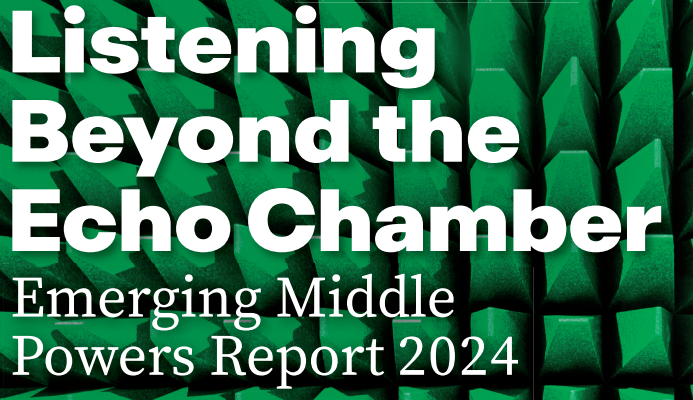 Courtesy: Körber-Stiftung
Divergent global reactions to major crises such as those sparked by the war in Ukraine and NATO’s Afghanistan withdrawal have widened the chasm between Western countries and emerging middle powers. This survey, conducted among nearly 1,000 experts from India, Brazil, South Africa and Germany, examines key foreign policy priorities in these countries, and reveals that despite differences, dialogue is possible.
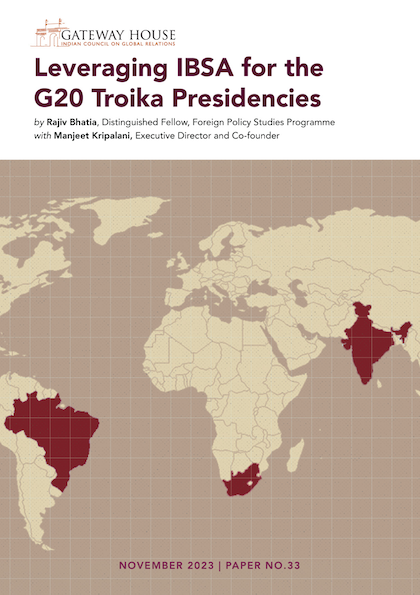 Courtesy: Gateway House
On December 1, 2023, India will hand over the G20 Presidency to Brazil. The G20 troika will now comprise the three IBSA countries – India, Brazil, South Africa – till November 2025. This trio has an agenda in common and with the G20, such as multilateral reform, energy transitions and digitalisation. IBSA should use its mechanisms and natural solidarity to advance the interests of the Global South.
 Courtesy: Gateway House
Significant progress has been made globally in adopting green energy. Technological advances, easier availability of capital and regulatory measures have helped. But progress is likely to slow due to the shocks caused by Covid-19 and the Ukraine crisis. How to continue the green transition whilst ensuring that lower-income countries have access to affordable energy? This Task Force offers recommendations for India’s G20 Presidency.