The Irony of American Strategy
A decade ago, the U.S. immersed itself in the greater Middle East with its wars on Afghanistan and Iraq. Will the current economic scenario force it to turn away from this region?

 Courtesy: Foreign Affairs
A decade ago, the U.S. immersed itself in the greater Middle East with its wars on Afghanistan and Iraq. Will the current economic scenario force it to turn away from this region?
 Courtesy: Foreign Affairs
For long, deterrence has been the backbone of the U.S. national security strategy. It has applied deterrence to Russia, failed to apply it to Iraq and Iran, and is confused about applying it to China. Does the U.S. need to relearn the basics of deterrence?
 Courtesy:
Overall, the U.S.-Pakistan alliance hasn't been pleasant. Despite their growing mutual distrust for each other, which has become evident in the past few years, the alliance still continues. Is it worth all the troubles it comes with?
 Courtesy: Foreign Affairs
The U.S. has continually been trying to coerce Iran into giving up its nuclear program for years now, but with little success. What should Washington do to avoid both military action, and deterrence?
 Courtesy: Foreign Affairs
The Obama administration plans to restrain Chinese belligerence by reinforcing U.S. military and diplomatic links to the Asia-Pacific. However, in order to avoid further Chinese resistance to its policies, the U.S. must look for possible avenues of cooperation with the country.
 Courtesy: Foreign Affairs
There’s been much talk about the “the rise of the rest,” with Brazil, Russia, India, and China leading the charge. However, few countries can sustain unusually fast growth for a decade, and even fewer, for more than that. As the boom years begin to end, the international order won’t change as much as expected.
 Courtesy: Foreign Affairs
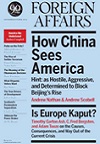
Jeffrey D. Sachs argues that the mono-causal analysis of the book, 'Why Nations Fail,’ – that economic development hinges on a country’s political institutions – ignores important factors (such as geography) that can also affect growth.
 Courtesy: Foreign Affairs
Since weak demand is at the heart of the recession, governments need to enact stimulus programs along with structural reforms, argues Menzie Chinn. Structural reforms don’t always work out, writes Karl Smith. Raghuram Rajan demurs.
 Courtesy: Foreign Affairs
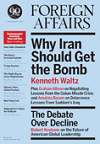
Until now, the U.S.-China policy has been driven by a blend of engagement and balancing. The Obama administration’s concentration on ‘engagement’ has done nothing to halt Beijing’s military build-up. The next administration should work towards bolstering the ‘balancing’ half of Washington’s strategic equation.
 Courtesy: Foreign Affairs
To leave behind a stable government in Afghanistan in 2014, the U.S. needs to work towards electoral reforms, negotiations with the Taliban, and a regional settlement involving Pakistan.