shutterstock_1655303551 Courtesy: Shutterstock
5 March 2020

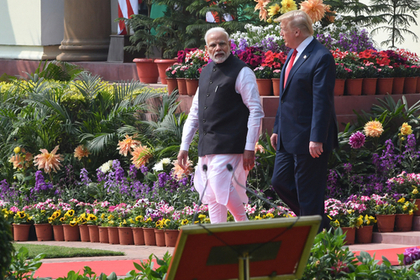
Hype & substance in Trump’s visit

President Trump enjoyed every moment of the hype that attended his February 2020 visit to India, says Ambassador Neelam Deo, Director and Co-founder of Gateway House, in this podcast, even as the focus was on concrete outcomes, such as defence purchases and oil procurement deals. She discusses the geopolitical implications of a closer India-U.S. strategic relationship and the weaknesses of the U.S.-Taliban peace deal

shutterstock_1441151312 Courtesy: Shutterstock
2 January 2020

Regulating services trade in India

The services sector is the most dynamic in the global economy, constituting nearly 25% of global trade, but its intangibility – unlike the materiality of trade in goods – makes it difficult to monitor. Service providers in this sector need a national regulatory governing framework

46118329451_16cf134eac_o Courtesy: MEA/Flickr
27 June 2019

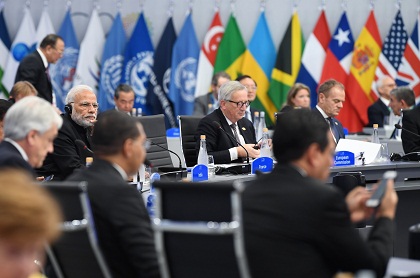
Gateway House on the G20

The 2019 G20 Summit in Osaka on June 28-29, is the 14th meeting of the Group of 20 leaders. The G20 is the world’s most influential economic multilateral forum. It is the agenda-setting forum that develops and guides rules of global economic governance. Under the Japanese Presidency, this summit will be the first to discuss and establish the rules for the worldwide governance of data, including current hot-button issues like data localisation and data sovereignty. India has both a preparatory and a contributory role to play in the G20 this year. For in 2022, it will be the President of the G20. India must identify its agenda early on; its a weighty responsibility but also an opportunity to set the global economic agenda.

President_Donald_Trump_and_Prime_Minister_Justin_Trudeau_Joint_Press_Conference_February_13_2017 Courtesy: Wikimedia Commons
25 October 2018

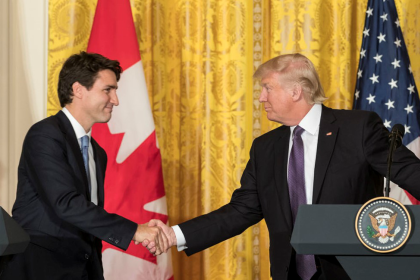
Three pillars of Canada’s worldview

The United States, Europe and the Asia Pacific today form Canada’s tripartite foreign policy priorities. The ASEAN is its sixth largest partner, which was not so 20 years ago, but economic engagement with India – still small, compared to China and Japan – has scope to grow

indias-global-energy-footprint Courtesy: Gateway House
14 February 2017

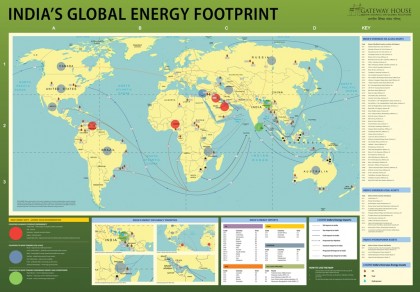
India’s global energy footprint

Trends in technology, geopolitics and geoeconomics have dramatically transformed the global energy scenario in the last two years. This means favourable conditions for import-dependent India, which must use the opportunities available to reduce its vulnerability to high energy prices. The jump in oil prices past the $60 mark suggests that India must act with alacrity. India’s Energy Footprint Map offers a profile of India’s global trade and investment in energy, and indicates what India can do to access cheap and reliable supplies

space Courtesy: NASA's Marshall Space Flight Center/Flickr
28 June 2013

Mining and industry in space?

An increase in the global demand for rare earth elements, used in high-technology industries, coupled with limited supplies on Earth, has accelerated extra-terrestrial exploration. International cooperation and competition for these space-based resources will determine the next human footprint and race in space.

Global Stability Map Courtesy: Gateway House
1 August 2012

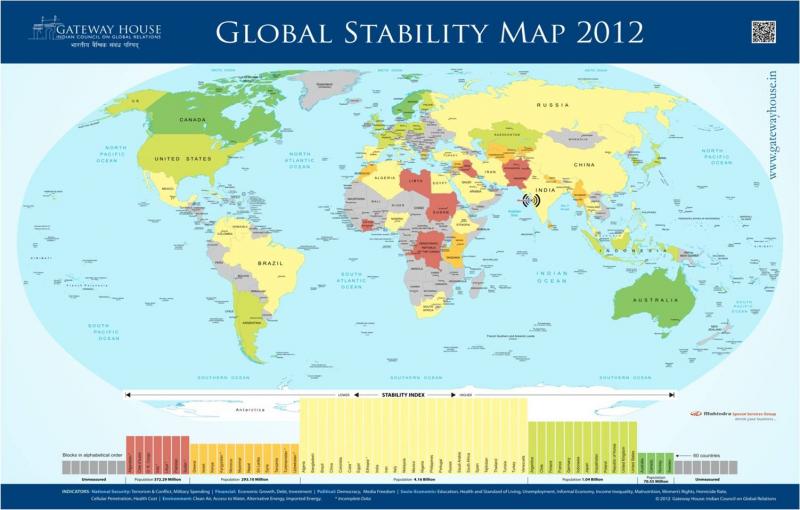
Global Stability Map 2012

Gateway House prepared a Global Stability Map, using 20 differing indicators, to analyze the stability of 60 countries around the world. Using criteria that are important to the emerging economies of the world, the map provides an Indian perspective of the world today.