A time for concerted action among Quad countries: Gateway House Task Force Report
Group identifies areas of potential economic and technological cooperation between four like-minded democracies in the Indo-Pacific
Courtesy: Gateway House
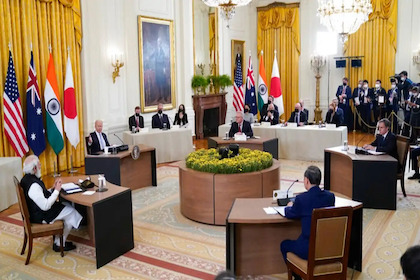
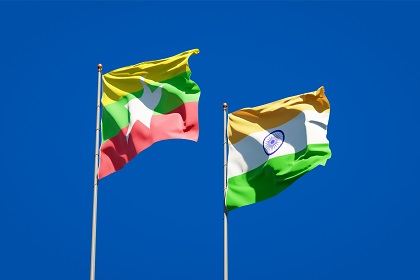
Conceived in 2020, the task force studied promising areas for cooperation between the Quad countries beyond their pre-existing maritime security partnership. The report highlights the need to increase economic and technological interdependence among the Quad countries and to establish common and updated rules and standards for emerging technologies in five study areas. The unique mix of the group – three developed and one developing nation, three Pacific and one Indian Ocean nation, three producer-trading nations with one massive emerging market – lends itself to innovation, experimentation and cooperation that can be a template for a new, post-pandemic geopolitical era.
Courtesy: The Times of India
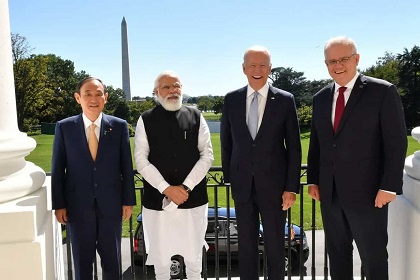
In an interview with Garrison Moratto of The New Diplomatist, Amb. Rajiv Bhatia, Distinguished Fellow, Foreign Policy Studies, counters China's claims that the Quad is an "Asian NATO." He highlights how the India-U.S.-Japan-Australia Quadrilateral initiative aims to increase cooperation in the Indo-Pacific on international law and security. This podcast delves into the history of the Quad's formation, current strategic characteristics, and future geopolitics, ahead of the fall in-person Leaders' Summit in the U.S.
Courtesy: Shutterstock
Sanctions are an important foreign policy tool, used especially by the West against its adversaries. Now, these rivals are retaliating with counter-sanctions. Are these effective? How does this impact global politics? Where does India stand in this free-for-all sanctions era?
Courtesy: CNBC-TV18 (Youtube)
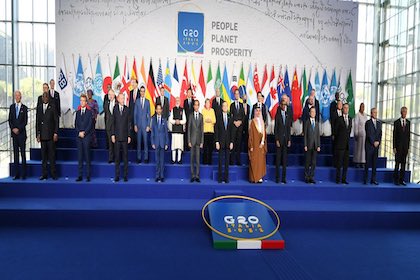
On 30 July 2021, Lisa Curtis and Surjit Bhalla, co-chairs of the Gateway House Quad Economy and Technology Task Force, spoke to CNBC-TV-18 on the various channels of cooperation between the Quad countries in technology, supply chains and undersea cables, and the need to counter China's dominance in the Indo-Pacific.
Courtesy: Flickr
Three senior U.S. officials visited Asia in July in a well-choreographed diplomatic outreach strategy by the Biden administration. The U.S is willing to prioritise the Indo-Pacific and counter China. Asia cannot afford to be a reticent bystander.
Courtesy: SCO, Russia (2020)
A potential anti-Quad formation of China, Russia, Iran and Pakistan is in the making, and can pose risks to the Quadrilateral Security Dialogue. However, a close analysis of China's bilateral relationship with each country shows that this is a flawed grouping, formed on limited common interests and rivalries.
Courtesy:
On 15 July, Gateway House co-hosted a webcast with Konrad-Adenauer-Stiftung (KAS) on 'Countering China’s Maritime Grey Zone Activities'. The panel discussed the potential strategies that smaller nations in the region can adopt to overcome the challenges of Chinese maritime grey zone activities, and the role of regional maritime powers in capability-building of maritime law enforcement agencies.
Courtesy: Shutterstock
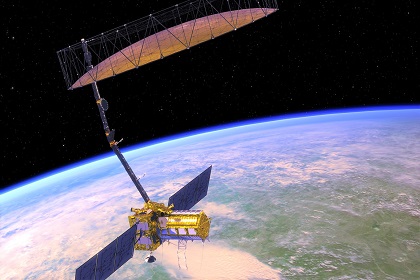
With the U.S.-led Artemis Accords gathering momentum, and China and Russia joining hands, space exploration is becoming economically important. Countries increasingly want to participate in the space exploration economy and are partnering with space superpowers that have aligned geopolitical and geoeconomic interests. India, too, must do the same, says Dr. Chaitanya Giri, Fellow, Space and Ocean Studies Programme.
Courtesy: Reuters
On 23 June 2021, Gateway House hosted the Interim Meeting of the Quad Economy and Technology Task Force. Lisa Curtis and Surjit Bhalla, co-chairs of the task force, explain how the Quad can scale up economic and technological collaboration and pool resources to counter Beijing’s plans to dominate supply chains and global tech.