BIMSTEC, bridge between South & South East Asia?
TIMES NOW featured our Distinguished Fellow in Foreign Policy Studies, Amb. Rajiv Bhatia on their show to discuss the fourth BIMSTEC Summit. Watch the full episode here.

 Courtesy:
TIMES NOW featured our Distinguished Fellow in Foreign Policy Studies, Amb. Rajiv Bhatia on their show to discuss the fourth BIMSTEC Summit. Watch the full episode here.
 Courtesy: Mea/ Flickr
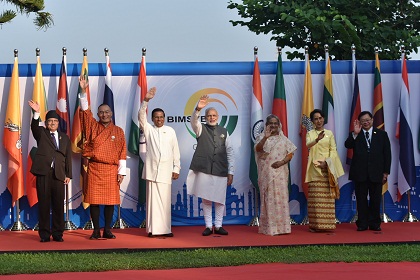
The 21-year-old regional organisation, which will hold its fourth summit on August 30-31, was formed because of the opportunities to make headway in economic and social development through cooperation, but it has achieved modest success. It has a relevance independent of SAARC or ASEAN and goals of its own to pursue
 Courtesy: Gateway House
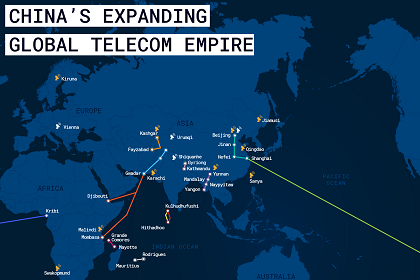
This version of the Gateway House Map on China’s Expanding Global Telecom Empire identifies some more telecommunication assets -- optic-fibre and satellite ground stations -- that Beijing is working on in South and Central America, Africa, Myanmar, the Indian Ocean Region and mainland China besides the existing ones, such as the Pakistan East Africa Cable Express (PEACE). It shows the direction China’s investment is taking, its diplomatic overtures and the larger geopolitical implications of its growing telecom empire
 Courtesy:
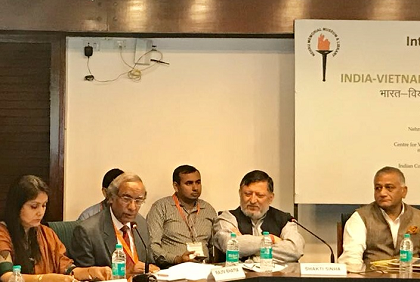
The following remarks were given by Rajiv Bhatia, Distinguished Fellow, Foreign Policy Studies, Gateway House at the international conference on India-Vietnam: Strengthening Economic Ties July 26-27, 2018.
 Courtesy: Zee News
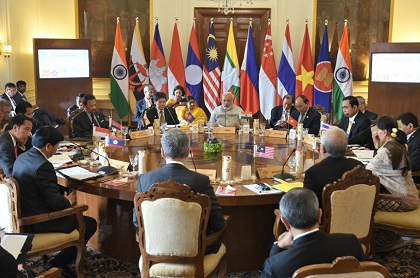
Indonesia and Malaysia appreciate India’s leadership role in the Indo-Pacific, but are also aware of all that keeps it from delivering on its commitments. A policy visit to the two countries enabled a closer look at some key issues, such as ASEAN’s centrality, the Quad and India’s stand on the Regional Comprehensive Economic Partnership
 Courtesy:
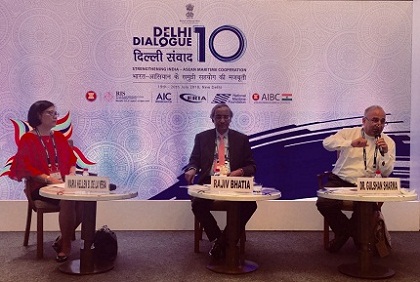
The following remarks were given by Rajiv Bhatia, Distinguished Fellow, Foreign Policy Studies, Gateway House as chair of the session on Tourism Cooperation at Delhi Dialogue X on July 20, 2018
Yuan Peng, Vice President, and Dr. HU Shisheng, director, respectively of the Institute of South & Southeast Asian and Oceanian Studies, China Institute of Contemporary International Relations, Beijing, spoke to Gateway House about working towards ‘the final goal of denuclearisation’, India-China relations since the Doklam stand-off and addressing security concerns raised by the Belt and Road Initiative
 Courtesy: MEA/ Flickr
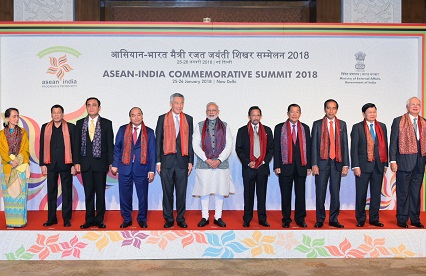
Change and uncertainty have marked geopolitical equations in the East Asian segment of the Indo-Pacific in the last six months. India-China relations changed visibly for the better while the U.S.-China trade war became more polarised. The Quad remained inert as did negotiations on the proposed Code of Conduct for the South China Sea. An analysis of some of the major trends
 Courtesy: Narendra Modi/ Twitter
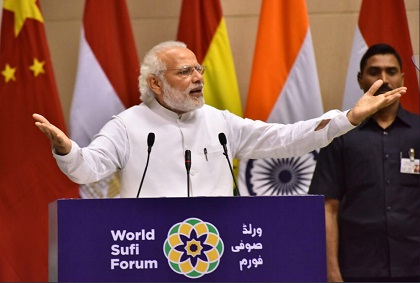
Religion is an important component of the soft power countries use in their foreign policy. Yet, no Indian government has given Islam adequate prominence, especially in its interactions with South-East Asia, where the majority of people are Muslim
 Courtesy: Wikipedia
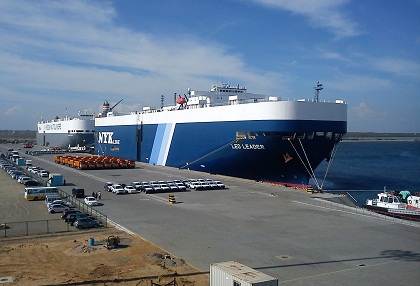
The high cost and political impact of Chinese-funded infrastructure in countries like Myanmar, Malaysia and Sri Lanka make it imperative for India to work with Japan to provide alternatives, to ensure that the region is neither bankrupted nor militarised by Chinese influence.