soichi 2 Courtesy: Rajeshwari K/Gateway House
13 June 2013

‘Japanese technologies can boost the Indian economy’

The annual India-Japan Prime Ministers’ summit, held recently in Tokyo, charted the path for increased Japanese assistance in India’s infrastructural arena. Gateway House interviews Soichi Yamamoto on the potential of this bilateral engagement

Asia-Briefing_0 Courtesy: Asia Briefing
7 June 2013

Why India is Winning the Entrepreneurial Battle with China

While India may be lagging behind China in its infrastructure development, it has inherited a worker demographic dividend. With most of the Chinese business being state owned, will India be the destination to look for new entrepreneurial talent?

ansari AU Courtesy: Ministry of External Affairs, India
7 June 2013

Destination Africa

The role of the emerging economies of Africa was discussed at the recent summit of the African Union. Africa’s resources are crucial to fuel such economic powerhouses as India, Brazil and China, and India must accelerate its trade and aid relationship with the continent.

chinesearmy Courtesy: cornfed1975/Flickr
7 June 2013

Lessons from Depsang

The Depsang valley incursion by the Chinese army may have moved the Indian Ministry of Defence out of its inertia in implementing long-pending proposals; but the lack of a comprehensive strategy to deal with the Chinese threat was especially evident in the manner in which decisions were taken to handle the situation.

abe manmohan sinha MEA Courtesy: Ministry of External Affairs, India
31 May 2013

India-Japan: A new model for Asian collaboration

Many parts of Asia lack adequate infrastructure and skilled human resources, but have potential for rapid growth. Sanjeev Sinha blogs about how Japan and India can collaborate to develop a model – where Tokyo pools in technology and capital, and India manages human resources – to generate growth in Asia.

Li manmohan abe Courtesy: Ministry of External Affairs, India
31 May 2013

Li and Abe

While the recent India-Japan Joint Statement contains significant breakthroughs, the China-Pakistan Joint Statement reveals the absence of warmth between India and China. With the current flurry of bilateral exchanges, India is fine-tuning its approach to emerging regional realities, as are others.

Manmohan - Abe MEA Courtesy: Ministry of External Affairs, India
30 May 2013

A new configuration to the East

During his visit to Japan, Prime Minister Manmohan Singh spoke of the need to increase bilateral consultations on strategic issues. This, and other moves, indicate new developments in India’s Look East Policy, with alternative security and economic scenarios for regional actors in the context of the rise of China

vavau tondga Courtesy: Jessica Taekman/Flickr
29 May 2013

India and Japan’s Pacific agenda

Indian Prime Minister Manmohan Singh and Japan’s Shinzo Abe are giving heft to a renewed partnership and a focus on the Indo-Pacific. Both nations must collaborate and work with South Pacific countries, especially Tonga, to counter China’s growing influence in this increasingly geopolitically important region

li manmohan Courtesy: Ministry of External Affairs, India
24 May 2013

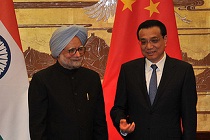
India-China: Diverging, still

India has concerns vis-à-vis China such as the recent border intrusion, the sharing of water resources and the growing bilateral trade imbalance. Gateway House examines how the Indian government addressed these issues during the recently concluded visit of Chinese Premier, Li Keqiang.

agni II Courtesy: Nikkul/WikimediaCommons
23 May 2013

A battle of nuclear narratives

On April 24, former Indian Foreign Secretary, Shyam Saran, spoke in depth about India’s nuclear weapons policy. How can his speech be instrumental in dismissing the doubts that some in Washington have had over the credibility of India’s nuclear deterrent?