Why Italy turned right
Disenchantment with traditional parties and politics, changed constitutional organisation of Parliament and the election system, over-regulation by the EU, immigration issues. This is why Italy turned right.
Courtesy: Reuters
Disenchantment with traditional parties and politics, changed constitutional organisation of Parliament and the election system, over-regulation by the EU, immigration issues. This is why Italy turned right.
Courtesy: Justin Lane/European Pressphoto Agency
The BRICS have largely abstained from the UNSC resolution condemning Russia’s attempts to annex four Ukrainian provinces. Is it BRICS solidarity or is it because the interests of the Global North and its allies, and those of the Global South, are diverging?
Courtesy: Shutterstock//Creativa Images
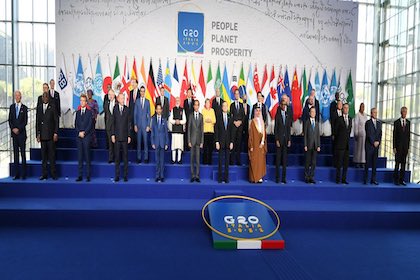
Indonesia has managed its G20 Presidency year by understanding the importance of not going it alone. This trading nation has used its deep regional and multilateral cooperative processes which provided trusted back-up and support at every step, and was book-ended by strong linkages and investment partnerships with Japan and Australia. In this, it has laid the groundwork for India’s 2023 presidency.
Courtesy: Toyota Tsusho Corporation
The Japan-Africa partnership continues to be emphasised. The goal is to build human capital, sustainable and high-quality growth and the security and stability of the global order in which government, business, and civil society leaders participate on an equal basis. It is an opportunity for Indian companies to work together in Africa, to achieve bilateral goals.
Courtesy: Narendra Modi/Facebook
India will be president of the G20 in 2023. The world’s most influential economic governance body is facing an existential crisis, where the major powers have fallen out. With geopolitical currents redefining geo-economics, India needs to be ready to emerge as the chief global diplomat.
Courtesy: Juggernaut
In his new book, former Foreign Secretary Shyam Saran demystifies China's imagined belief of itself as the Middle Kingdom. Contemporary China's propensity to cut and paste history has resulted in China's resentment of India based on a limited understanding of Indian history and of China's past recognition of India as an advanced civilisation which impacted Chinese culture. Today the West recognises India's potential to match China, with depth and skills, over the long term.
Courtesy: telegraphindia.com
The G7 has reached out to emerging economies which have, of late, been facing challenges on the economic front, brought on by the lingering pandemic and the mismanagement of the Ukraine crisis. They are also seeking, from the global south, a broader acceptance of their world view. Will it be forthcoming?
Courtesy: The Loadstar
The West is using the Ukraine crisis as a watershed moment to weaponize sanctions in a volatile global setting. This infographic shows the extent and scale of Western sanctions against Russia, both public and private, across different sectors, and in a coordinated manner.
Courtesy: iStock Images
Holding one of the G20 meetings in Jammu and Kashmir is a bold, audacious and timely move. It is possible because of the ceasefire along the Line of Control which has been holding since February 25, 2021. The new geopolitical setting offers India an opportunity to diplomatically disdain the Chinese, camping not too far away in the un-demarcated border areas with India.
Courtesy: The Print
The shadow of the Ukrainian war was visible at the G7 summit. Anti-Russian formations were expected, but the extensive reference to China drew attention. The leaders did their part by extensively discussing challenges relating to climate, energy, environment, health, and food security. It is now for the G7 governments to deliver, to be taken seriously.