Piracy: A Somalian viewpoint
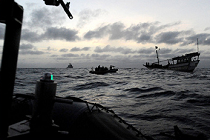
Gateway House’s Alisha Pinto interviews former Somali Ambassador to India, Mohammad Osman Omar, on piracy issues and maritime security from the coast of Somalia to the waters of the Indian Ocean.
Courtesy: UN Photo/Paul Banks
After the crass misuse of Responsibility to Protect (R2P) in Libya, the broader question is: where is R2P headed? Do the events in Libya herald a more explicit assertion of this doctrine in other parts of the world? And should India rethink its viewpoint towards this ambiguous doctrine?
Courtesy: White House photo/WikimediaCommons
The Wahhabis, who now merit NATO backing, continue on their global mission of converting the Muslim Ummah to its relatively harsh and antediluvian ways of thinking and living. For NATO, this is a geopolitical miscalculation that will have tragic security consequences for the alliance within a decade.
Courtesy: PMO
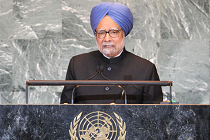
Indian Prime Minister Manmohan Singh’s speech at the UN General Assembly has put Indian perceptions on the record and clearly outlined India’s independent foreign policy. India came out unequivocally in support of the Palestinian struggle & reiterated its traditional stance of respecting countries’ sovereignty.
Corruption has become a galling global phenomenon: structured, vertically-integrated networks, whose objective is the extraction of resources, are forming in countries around the globe. And strikingly, these structures are masquerading as democratically-elected, seemingly-open governments.
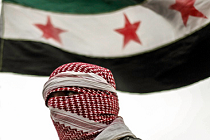
Former Indian Ambassador to Syria, Rajendra Abhyankar, speaks to Gateway House’s Samyukta Lakshman about the developments in Syria, the impact on India-Syria relations and the future of the region.
Courtesy: Lear21,ThomasWolf/Wikipedia
Germany’s abstention on the UN Resolution on Libya heralds the mellowing of a nation blamed for last century’s most catastrophic wars. This time, Berlin may determine the history of Europe by choosing to pursue its national interests peacefully rather than subjugating an entire populace.
Courtesy: UNPhoto/MarcoDormino
A new United Nations doctrine is revolutionising the manner in which Western powers achieve regime change. Under the pretext of “Responsibility to Protect” –as the doctrine is named –armed intervention does not depend on the aspirations of a populace but the facilitation of existing power equations
Courtesy: AlJazeeraEnglish/Flickr
The fundamental problem when supporting an anti-regime opposition is to ascertain the identity and purpose of the rebels. It is a question –which M.D. Nalapat discovers –is never asked by the United States, no stranger to shoring up rebels in far-off countries.
Frank Wisner, the legendary US diplomat who was not only President Barack Obama's special envoy to Egypt but also a former ambassador to India, discusses the outlook for Egypt, resolving the mayhem in the Middle East and India-Pakistan relations in a Gateway House exclusive.