Book review: Improving U.S.-Pakistan ties
In ‘No Exit from Pakistan: America’s Tortured Relationship with Islamabad,’ author Daniel Markey analyses the complex U.S.-Pakistan bilateral and suggests ways for Washington to improve the relationship.

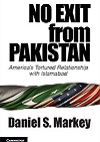 Courtesy: Cambridge University Press
In ‘No Exit from Pakistan: America’s Tortured Relationship with Islamabad,’ author Daniel Markey analyses the complex U.S.-Pakistan bilateral and suggests ways for Washington to improve the relationship.
 Courtesy: danxoneil / Flickr
Across the globe, governments trying to control the internet are violating the privacy and rights of internet users. China’s censorship model is limited to its borders, the U.S.’ surveillance affects everyone internationally. A multilaterally-acceptable mandate for cyber governance is now an imperative.
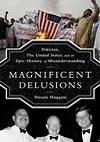 Courtesy: PublicAffairs
In ‘Magnificent Delusions: Pakistan, the United States, and an Epic History of Misunderstanding,’ author Husain Haqqani writes that the U.S. and Pakistan have few shared interests and very different political needs.
 Courtesy: WikimediaCommons
Earlier in November, U.S. drone strikes killed Hakeemullah Mehsud, the leader of the Tehreek-e-Taliban Pakistan, a militant outfit in Pakistan. What does this mean for the U.S.-Pakistan bilateral relationship, and more importantly, what are its implications for Pakistan’s domestic security situation?
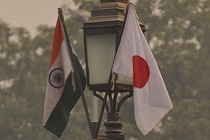 Courtesy: generalising/Flickr
The India-Japan alliance needs to be viewed through a prism broader than that of "containing" China, and by treating the Indian and Pacific oceans as a single entity. Such an alliance has the potential to strengthen the geopolitical security of India and Japan, along with that of all their allies and associates
 Courtesy: Ministério da Saúde/Flickr
After revelations that the U.S.’s NSA spied on her, Brazilian President Dilma Rousseff has ordered a series of measures to ensure online independence and called for an equitable global internet infrastructure. India can follow Brazil’s lead and make its communication systems less vulnerable
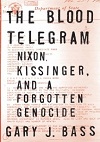 Courtesy: Knopf
In ‘The Blood Telegram’ Gary Bass jolts us into recalling one of the most horrific genocides of the last century that occurred during the creation of Bangladesh
 Courtesy: Indian Embassy, Washington D.C.
This daily column includes Gateway House’s Badi Soch – big thought – of the day’s foreign policy event. This Badi Soch analyses the implications of revelations about surveillance on Indian missions, by the U.S. government.
 Courtesy: United Nations
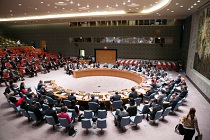
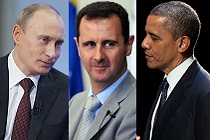
The recent UNSC Resolution, which mandates the complete destruction of Syria’s chemical weapons, demonstrates that after more than a year, a degree of international agreement on the Syrian issue has been possible. In the evolving situation, Russia will now emerge as a major player
 Courtesy: WikimediaCommons
Can the world aspire to a future where the use of force is not seen as leadership? Can the U.S. and former colonial powers like France and UK, think differently and reject the use of force as first resort? Can China and India craft alternatives?