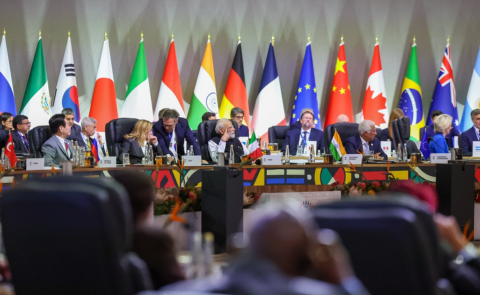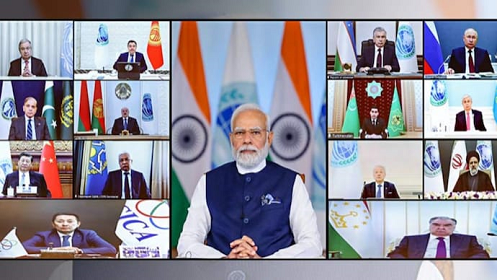
Foreign ministers and officials of the Shanghai Cooperation Organisation (SCO) pose for a group photo during a meeting in Dushanbe, Tajikistan July 14, 2021. Russian Foreign Ministry/Handout via REUTERS Courtesy: Reuters
20 April 2022

The SCO in Afghanistan

The Shanghai Cooperation Organisation has been focused on resolving the Afghan crisis. But divergent views of members and the influence of China and Pakistan have eluded a solution. This has been further impeded by the ongoing sanctions and humanitarian issues which are beyond the organisation's scope.

india central asia Courtesy: ANI
25 January 2022

Quantum leap forward with Central Asia

India hosted a summit with five Central Asian states on January 27, marking 30 years of diplomatic relations with the region, and an important step forward to pursue greater connectivity between India and Central Asia. New Delhi's engagement holds promise for ambitious bilateral agendas including security in Afghanistan, the revival of dormant projects, and potential collaboration in renewable energy, space and information technology.

Afg_Province_Poppy_cultivation hp Courtesy: UNODC
19 January 2022

Funding the insurgency: The Taliban in Afghanistan

The Taliban's resurgence since 2001 has been largely funded by the creation of an opium economy and extortion. Now, with the withdrawal of U.S. troops, legitimate aid from Afghanistan and the freezing of Afghan funds abroad, the Taliban will revive its informal sources of finance to stay afloat. A look at the financing that brought the Taliban back to Kabul.

The China-Pakistan-Taliban-Iran nexus Courtesy: Xinhua
11 November 2021

The China-Pakistan-Taliban-Iran nexus

China has followed Sun Tzu’s strategy of focussing on alliances - building its own and weakening those of its adversaries. Beijing’s carefully nurtured formations in West and Central Asia are part of this global power projection, especially with Pakistan, Iran and now, the Taliban, through projects like the Belt and Road Initiative. India must recalibrate its China policy and push for concerted regional responses to emerge as a balancing force against it.

afghanistan airport Courtesy: Haroon Sabawoon
13 August 2021

Afghanistan: Limited options for regional powers

The Taliban’s rapid advance towards Kabul shows clear signs of learning from previous failures. The chances of a revival of the old Northern Alliance are minimal. Regional powers are left with the option of maintaining diplomatic contact with the Taliban whilst not taking any assurances on trust.

2019-06-14T000000Z_1951021920_RC-2 Courtesy: SCO, Russia (2020)
22 July 2021

China’s quad?

A potential anti-Quad formation of China, Russia, Iran and Pakistan is in the making, and can pose risks to the Quadrilateral Security Dialogue. However, a close analysis of China's bilateral relationship with each country shows that this is a flawed grouping, formed on limited common interests and rivalries.

Capture d’écran 2020-02-04 à 16.00.17 Courtesy: Foreign Affairs
4 February 2020

The Unwanted Wars

Countries in the Middle East, such as Iran, Israel or Saudi Arabia, do not want a military confrontation. Yet, current circumstances conduce to the breaking out of just such a war

49388354208_649e77048e_c Courtesy: MEA/Flickr
23 January 2020

A new normal for Iran

India-Iran ties span culture, economics and geopolitics. Iran is one of India’s most important neighbours and must be viewed on its own standing, not through a Western prism. Gateway House has an extensive repository of research and reporting on Iran, ranging from India-Iran historical ties, Iran’s role in India’s energy security and the impact of U.S. sanctions on Iran and on India, which helps to better understand this crucial nation.

1234 Courtesy: MEA/Flickr
23 January 2020

Javad Zarif’s India outreach

Iran’s foreign minister Javad Zarif was in Mumbai on 16-17 January 2020, just days after the Iran-U.S. showdown in Iraq and the assassination of Iran’s top general. Zarif explained Iran’s dilemma to audiences in India and was hoping for public support. But the fact is that the January tensions are not Iran’s problem alone; it’s a global game-changer that has propelled the formation of new alliances