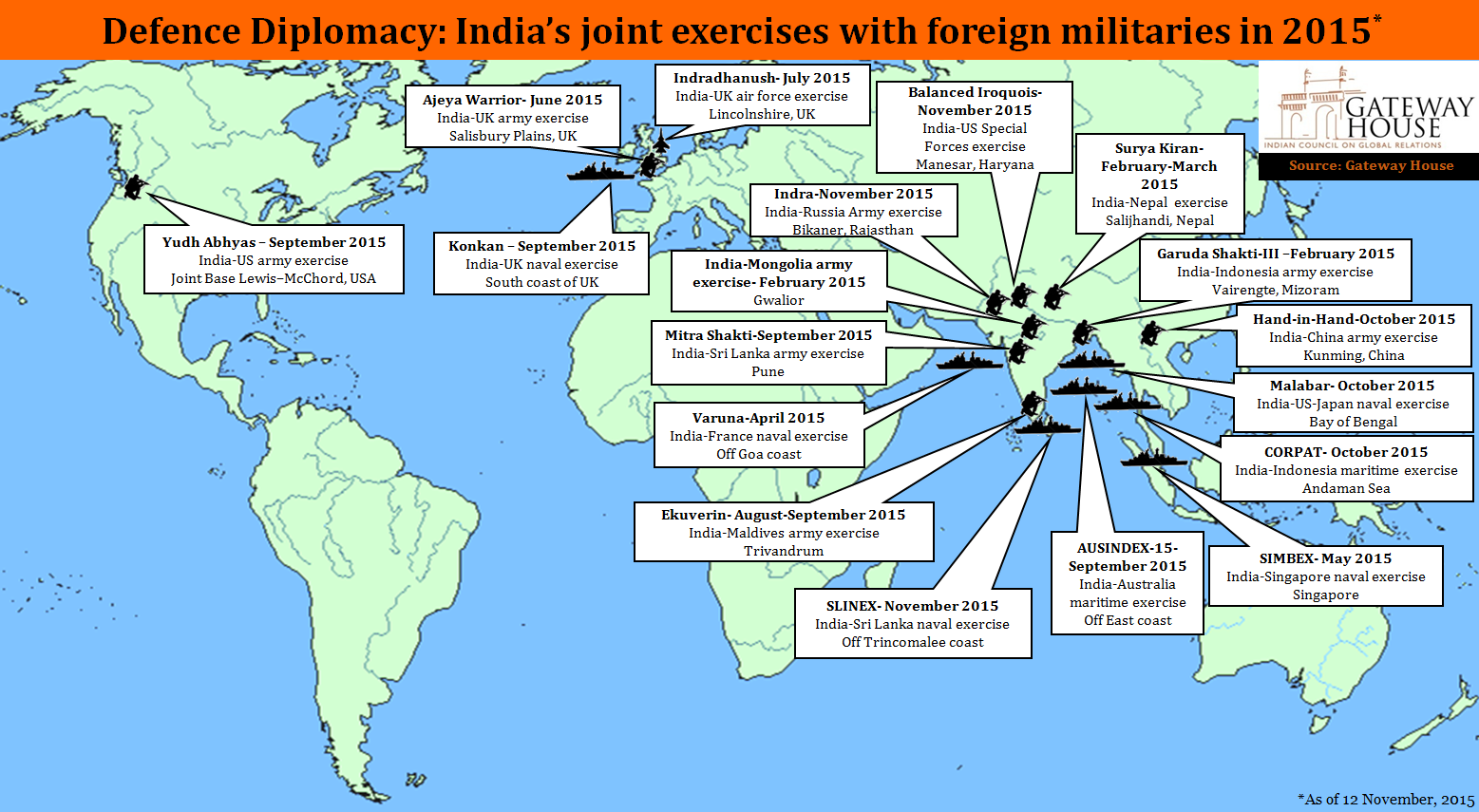
This year, India's defence diplomacy has ramped up. In 2015 alone there have been 18 military exercises- naval, army and air force- with 13 countries, among the largest engagements the country has had. Most significant is Japan joining the Malabar exercises in the Bay of Bengal and the first-ever maritime exercise with Australia. This is increasing India's presence from the Arabian Sea to the Bay of Bengal. As these exercises intensify India will be better positioned to handle regional security challenges. Courtesy:
12 November 2015

India’s defence diplomacy

This year, India's defence diplomacy has ramped up. In 2015 alone there have been 18 military exercises- naval, army and air force- with 13 countries, among the largest engagements the country has had. Most significant is Japan joining the Malabar exercises in the Bay of Bengal and the first-ever maritime exercise with Australia. This is increasing India's presence from the Arabian Sea to the Bay of Bengal. As these exercises intensify India will be better positioned to handle regional security challenges.
SAARC Courtesy:
2 March 2015

An Indian democracy template for SAARC?

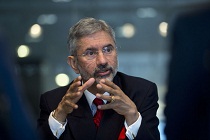
Indian foreign secretary S. Jaishankar’s visit to SAARC countries from March 1 is an opportunity to examine the political trajectories in the region. While democracy in some countries like Sri Lanka is on an upswing, in others, like Bangladesh, it is in decline. With China’s growing economic influence in South Asia, can Indian democracy be an effective counterpoint?

Jaishnkar Courtesy: Saddahaq.com
26 February 2015

SAARC sojourn: surmounting the entropy

The SAARC Yatra to be undertaken by foreign secretary S. Jaishankar from March 1 is an opportunity for India to improve relations, resurrect stalled projects and create new synergies with its neighbourhood. An initiative like this could hold the key to India shedding the ‘hegemon’ tag and pursuing mutually beneficial policies with its neighbours

15267919794_c437878c2b_z (1) Courtesy: MEA
28 November 2014

SAARC debriefing

The 18th SAARC Summit held in Nepal concluded on November 27 with the release of the Kathmandu Declaration. Did the summit live up to its expectations? Was concrete progress made, and if so in which areas? Where is SAARC heading now? Gateway House asks and answers five questions on the outcome of the summit

SAARC Courtesy: pmindia.nic.in
21 November 2014

Will SAARC embark on a new path?

The 18th SAARC Summit in Kathmandu next week is an opportunity for member countries to start shaking off the shackles of distrust. Instead, SAARC must robustly move forward on such issues as regional connectivity, SAFTA, climate change, and security—and India can be the prime mover in building this renewed cooperation

SAARCsummit1 Courtesy: Wikimedia commons
21 November 2014

A primer on SAARC

The 18th SAARC Summit will cover a wide range of issues, including connectivity, climate change, and SAFTA. A number of similar issues were discussed at the last summit—what’s been the progress since then? Given its constraints, does the association have a future? Gateway House asks and answers five questions on SAARC

Modi signing register Courtesy: PMO/Government of India
28 May 2014

Narendra Modi: global perspectives

By inviting SAARC leaders to his swearing-in ceremony India’s new prime minister Narendra Modi has signaled a major shift in India’s foreign policy. Gateway House presents perspectives from experts from seven countries on the changes they expect to see in India’s foreign policy in the Modi era

SAARC Courtesy: Kotakkalnet/Flickr
27 May 2014

Hopes for a South Asia union

The South Asian region is one of the least integrated in terms of trade and human interaction. The presence of SAARC leaders at the swearing-in ceremony of the new government heralds a step towards removing barriers and integrating the economies of this region

milanspikecallusnavy Courtesy: Spike Call U.S Navy/Wikimedia Commons
21 February 2014

Shaping regional diplomacy

The Indian Navy, through multi-lateral exercises, is increasing its sphere of influence and becoming a regional force. Yet, it needs to be supported by policy decisions that enable it to achieve its potential as a state-of-the-art establishment and a powerful tool in India’s diplomatic repertoire

Yameen Courtesy: Ministry of External Affairs, India
3 January 2014

The Maldives: small gains

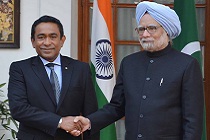
Maldivian President Abdulla Yameen’s visit to India this week aims to repair ties, strained after the Maldives terminated a $500 million contract to the Bangalore-based infrastructure company, GMR. Yameen’s conciliatory stand stems from the need for international help, including India’s, to fix an economy in decline