Themba HadebeAP Courtesy: Themba Hadebe/AP
27 November 2025

Johannesburg G20 summit: advancing amidst anxiety

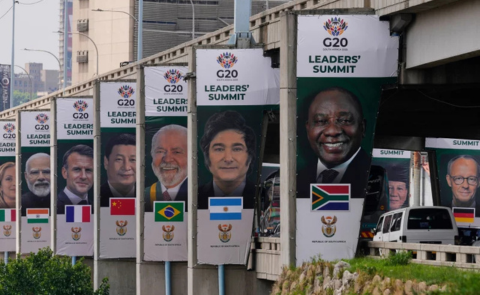
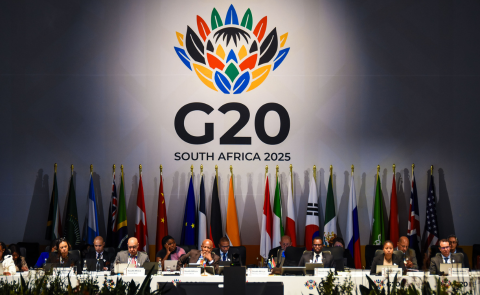
The G20 Summit in Johannesburg ended on a widely-shared sense of satisfaction and achievement, with the Global South’s perspective well-articulated, but divergent from some in the Global North. Now the G20's challenge is to restore its unity and credibility by working toward reconciliation with its next president, the U.S. Can India enhance its credibility and influence as a North-South bridge-builder?

revised design Courtesy: Gateway House
27 November 2025

Rise of the Davos Competitor

U.S. health secretary Robert Kennedy Jr. called the World Economic Forum a “billionaires’ boys club” imposing totalitarian controls. Indeed, since 1971, the elite platform shaped geopolitics. But its Western-centricism kept out the concerns of the rest. This gave rise to alternative forums, which look beyond financial agendas to the perspectives shaping the Global South. Here are 45 of biggest, half of which began just two decades ago.

Website articles  (11) Courtesy: UNDP
20 November 2025

A G20 summit with African characteristics

The G20 Summit in Johannesburg in November will close four years of developing countries holding the grouping’s Presidency. It has left a positive imprimateur on the G20. The next President, the U.S., will inherit a more diverse body, with equal attention being given to issues of the Global North and the Global South.

Screenshot 2025-10-13 103335 Courtesy: Körber-Stiftung
13 October 2025

Bandung at 70: Multilateralism in a New Era of Multi-Alignment

The world is facing multiple crises which are shaking the foundations of multilateralism. The West’s structures are faltering, and the need for effective and equitable cooperation is greater than ever. Seventy years after the 1955 Bandung Conference, its principles of sovereignty, territorial integrity, cooperation and solidarity remain vital. This report revisits Bandung’s relevance for today’s reform efforts, urging renewed Global South–Europe collaboration for a sustainable global future.

VOA Courtesy: VOA
2 October 2025

Time to re-burnish Global South credentials

The year 2025 is often compared to the Bandung moment of 1955, and for good reason. With the U.S. reordering traditional relationships, the opportunity for greater emphasis on the Global South is now. It is therefore time for India, Africa and ASEAN among others to re-burnish their Global South credentials and use that identity as a platform to engage each other more deeply.

G20.Org Courtesy: G20.org
28 August 2025

Appraising Brazil’s G20 Presidency

The G20’s current cycle is unique, with four Global South nations presiding consecutively: Indonesia, India, Brazil, and now South Africa. Brazil’s 2023-24 presidency exhibited both achievements and struggles, prioritising social inclusion, hunger, energy transition, and governance reform. The handover to South Africa marks a significant milestone in G20 history. Will the momentum be followed by the U.S., the next G20 president but also a G20 sceptic?

indo pacific  (2) Courtesy: Getty Images
24 July 2025

India’s footprint in the Indo-Pacific region

India is strategically expanding its influence across the Indo-Pacific region, positioning itself as a key player in regional affairs. Three elements anchor the effort: development aid, trade and the diaspora. The country now has 20 Free Trade Agreement partners in the Indo-Pacific. The 21.8 million-strong Indian diaspora across the region is a significant source of soft power for India.

Global South World Courtesy: Global South World
17 July 2025

Argentina-India grow the strategic partnership

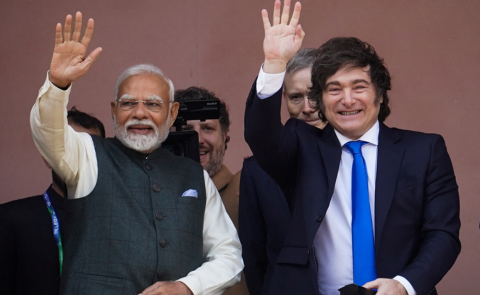
Prime Minister Modi’s visit to Argentina is a boost to the growing bilateral. Modi and Argentinian President Javier Milei are committed to their countries’ economic and political advancement, and see trade with each other as key. Argentina being in the lithium triangle gives India access to critical minerals.

Website articles  (12) Courtesy: Gateway House
15 May 2025

U.S., global emperor of sanctions

Over two centuries, the U.S. has amassed vast economic powers across the globe during and after the two World Wars , and sanctions slowly became an effective tool it used to achieve its foreign policy goals, becoming the global emperor of sanctions.