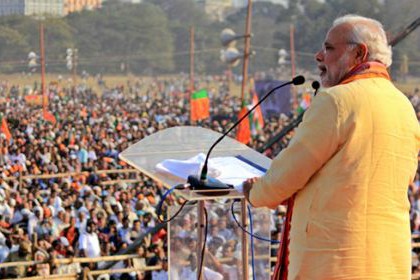
Indian Foreign Policy in 21st Century
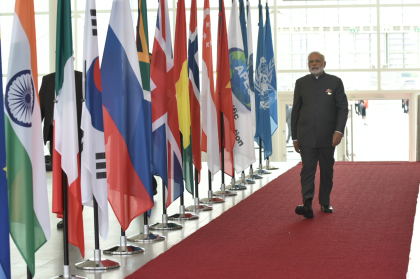
The following remarks were given by Ambassador Rajiv Bhatia, Distinguished Fellow, Foreign Policy Studies, Gateway House as Distinguished Guest Lecturer at IIM Tiruchirappalli on February 3, 2019

 Courtesy: MEA/Flickr
The following remarks were given by Ambassador Rajiv Bhatia, Distinguished Fellow, Foreign Policy Studies, Gateway House as Distinguished Guest Lecturer at IIM Tiruchirappalli on February 3, 2019
 Courtesy: MEA Flickr
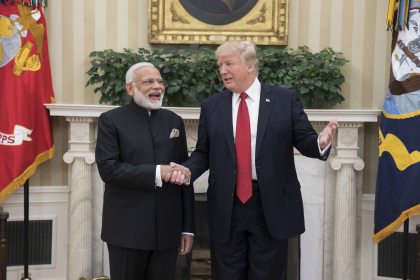
The imperative for India to move away from its non-aligned posture is now, especially if it wants to be consequential in the global reordering underway. This will play out in the contention between the U.S. on one side, and China and Russia on the other.
 Courtesy: Nikkei Asia
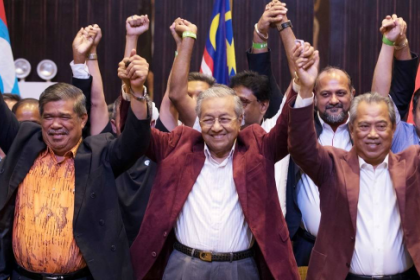
Six months after Malaysia’s parliamentary elections, its domestic affairs are still untidy. The government is combating corruption, but not bringing in constitutional reform. A successor’s name is not emerging clearly either. But Prime Minister Mahathir Mohammad’s foreign relations priorities – principally, Japan and China – are in order
Academic and columnist M.D. Nalapat, in this interview with Manjeet Kripalani, speaks of how a tardy bureaucracy has brought about “a too-cautious” policy towards the U.S. and China as opposed to the former Gujarat chief minister’s greater openness in consulting people before handing over policy implementation to the bureaucracy. He also discusses the prime minister’s shrewd approach to South Asia, the dependable warmth of the Japanese and a range of other topics
 Courtesy: Western Naval Command
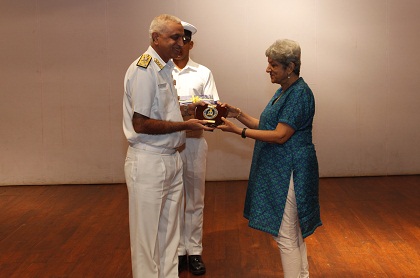
China has expanded its presence in the Indian Ocean Region. President Xi Jinping has abandoned Deng Xiaoping’s conciliatory posture for an aggressive, money-fuelled search for super power status
 Courtesy: Narendramodi.in
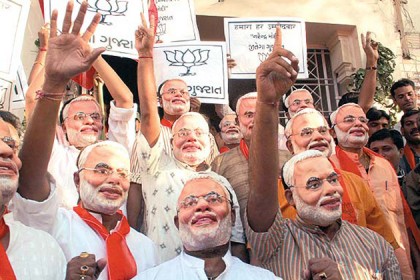
Narendra Modi’s landslide victory in India's 2014 general elections, despite his hardline nationalist image, was viewed as a localised phenomenon. But two years later, voters across the world from Europe to Philippines seem to be tilting towards leaders with the same nationalist tag.
 Courtesy: CSIS/Flickr
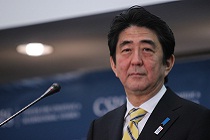
After winning control of the legislature on July 21, Japanese Prime Minister Shinzo Abe has plans to alter the Constitution. In ways that could lead to a rearmed Japan, with a large defence force. What will be the consequences of this new face of Japan?
 Courtesy: Ministry of External Affairs, India
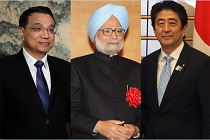
While the recent India-Japan Joint Statement contains significant breakthroughs, the China-Pakistan Joint Statement reveals the absence of warmth between India and China. With the current flurry of bilateral exchanges, India is fine-tuning its approach to emerging regional realities, as are others.
 Courtesy: nazeah/Wikimediacommons - Ramesh Lalwani/Flickr
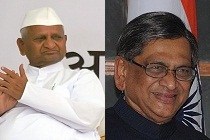
The year 2011 saw various events - the Arab Spring, anti- corruption protests, Europe's sovereign debt crisis - transform countries and reshape the world order. Gateway House takes a look at what these events mean for India, and presents India's top foreign policy cheers and jeers for the year.

Amidst myriad country groupings that already exist – BRICS, IBSA, APEC, SCO and many others – a new initiative in the Pacific is looking to integrate more powerful countries to form a multilateral free trade agreement – the Trans Pacific Partnership. How important is this towards the reshaping of trade and power?