revised design Courtesy: Gateway House
27 November 2025

Rise of the Davos Competitor

U.S. health secretary Robert Kennedy Jr. called the World Economic Forum a “billionaires’ boys club” imposing totalitarian controls. Indeed, since 1971, the elite platform shaped geopolitics. But its Western-centricism kept out the concerns of the rest. This gave rise to alternative forums, which look beyond financial agendas to the perspectives shaping the Global South. Here are 45 of biggest, half of which began just two decades ago.
Map-2-International-Trade Courtesy: Oxford University Press
23 January 2025

The ancient precursor to IMEC

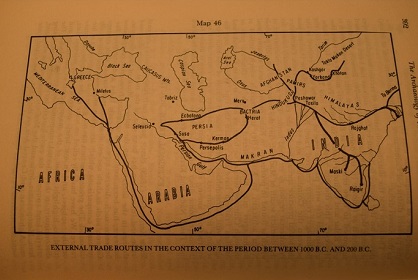
The India Middle-East Europe Economic Corridor (IMEC) announced during India’s G20 leaders’ summit in September 2023 aims at security and ease of connectivity by multi-modal physical, digital and energy corridors connecting India, UAE, Saudi Arabia, Israel, and Europe. Like many of the connectivity projects created around the world today, IMEC’s origins are 2,300 years old, ancient routes that connected the Indian Ocean to the Mediterranean Sea

G7GS Courtesy: telegraphindia.com
13 July 2022

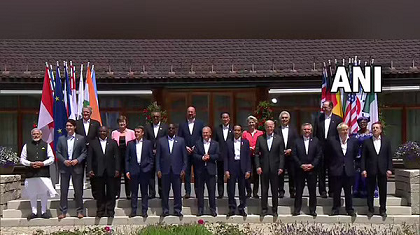
The G7 woos the global south

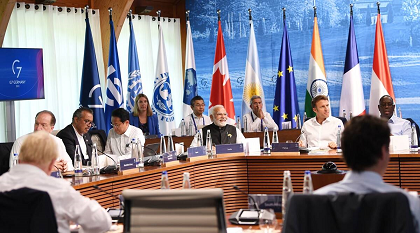
The G7 has reached out to emerging economies which have, of late, been facing challenges on the economic front, brought on by the lingering pandemic and the mismanagement of the Ukraine crisis. They are also seeking, from the global south, a broader acceptance of their world view. Will it be forthcoming?

sanctions Courtesy: The Loadstar
6 July 2022

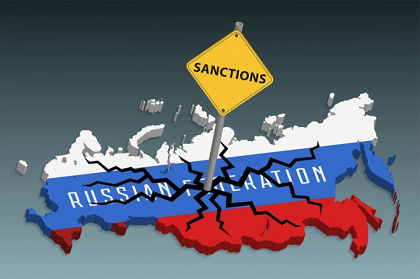
Detailing Western sanctions against Russia

The West is using the Ukraine crisis as a watershed moment to weaponize sanctions in a volatile global setting. This infographic shows the extent and scale of Western sanctions against Russia, both public and private, across different sectors, and in a coordinated manner.

G7s1 Courtesy: The Print
4 July 2022

What did the G7 achieve?

The shadow of the Ukrainian war was visible at the G7 summit. Anti-Russian formations were expected, but the extensive reference to China drew attention. The leaders did their part by extensively discussing challenges relating to climate, energy, environment, health, and food security. It is now for the G7 governments to deliver, to be taken seriously.

Narendra-Modi-Silicon-Valley-684x420 Courtesy: Twitter: Digital India Archives
19 May 2022

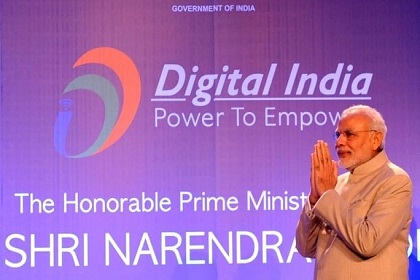
Digital public goods for the Indo-Pacific

With mass digitisation, India has proved that technology is not just for the educated, privileged, and wealthy. The country's open and secure digital public platforms can be significant for the Indo-Pacific, the world's most data-rich region. The Indian model is applicable because it is open-source, interoperable, auditable, and enshrines individual rights, ownership, and empowerment.

G20 Rome summit, marching ahead Courtesy: G20
4 November 2021

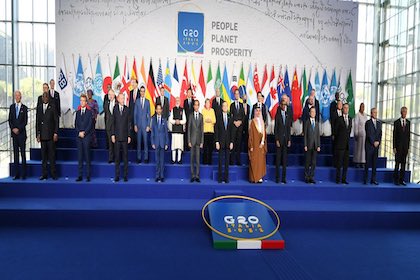
G20 Rome summit, marching ahead

The Oct 30-31 G20 Leaders’ Summit in Rome took several important steps to accelerate economic recovery and health security. In the absence of several Eurasian leaders, India played a significant role especially on climate and energy. The G20 will now acquire greater salience in India's foreign policy, as it readies to lead the grouping in 2023.

BigTech Report (1) Courtesy: Gateway House
1 July 2021

Regulating Big Tech: A Balancing Act

Big Tech is powerful and its profits are growing - by 105% over the last year. It dominates economies. This raises concerns about data protection and privacy, anti-trust, fintech and the specific role of intermediaries. India is leading the way on fintech, but is behind several countries and institutions on digital rules. It is important to establish laws and rules to govern technology – whether domestic or through multilateral bodies – with the aim to strike the right balance between innovation and regulation.

Chai Courtesy: Wikimedia Commons
26 October 2020

India must back Developing World in Space20

The Space20 is the newest sub-forum of the G20 initiated by Saudi Arabia, with the support of the United Nations Office of Outer Space Affairs. India, on its way to the G20 presidency in 2022, should set a comprehensive Space20 agenda for the democratization of outer space, whereby it can share its space growth story with the developing world and achieve its goal to become a global knowledge epicenter.