

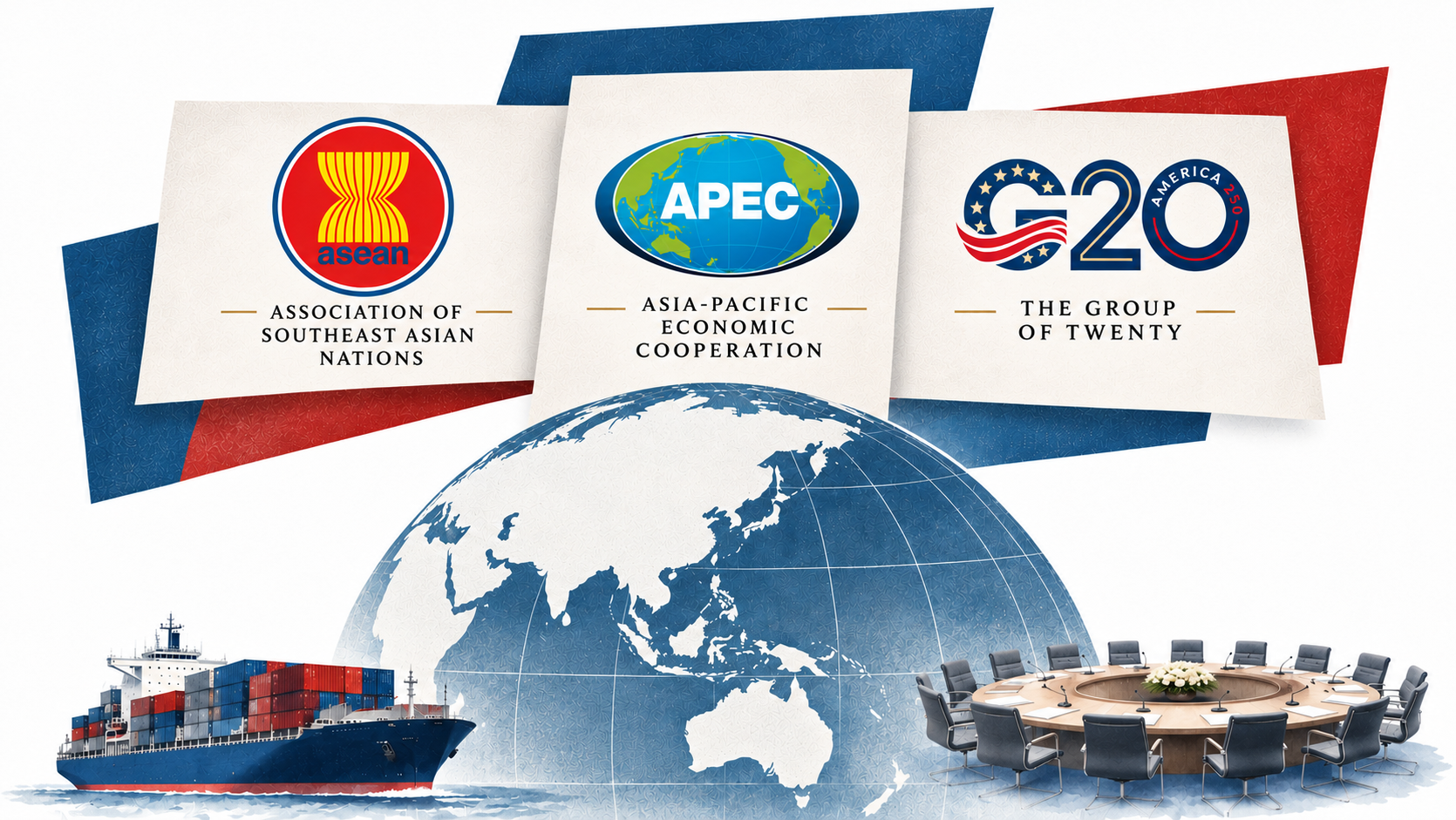
By a peculiar coincidence, the next four weeks – from November 16 to December 15 – will witness summits of the leaders of three major plurilaterals: ASEAN (the Association of South East Asian Nations) in Manila, hosted by Philippine President Ferdinand R. Marcos; APEC (the Asia-Pacific Economic Cooperation) in Shenzhen, hosted by Chinese President Xi Jinping; and the G20 (Group of 20) in Miami, hosted by U.S. President Donald Trump.
These summits, together with other related conferences and high-level meetings on their sidelines, such as the Quad summit, bilaterals between the U.S. and Chinese leaders, and a trilateral summit involving them and Russian President Vladimir Putin, will keep governments and analysts busy during the coming month. How the outcome of these summits moulds the world in 2027 will be worth careful studying.
ASEAN, set up in 1967, holds its 49th summit under the theme ‘Navigating Our Future, Together’. It is driven by member states’ collective will to steer the grouping cohesively through the complex current regional and global landscape. Considered a relatively successful grouping, it remains committed to upholding its unity, centrality, and solidarity, and to strengthening the key pillars of cooperation in political-security, economic, and socio-cultural domains. Under the Philippine presidency, a special focus has been placed on 19 Priority Economic Deliverables (PEDs), including accelerating digital transformation, integrating the MSME agenda, and advancing innovation through emerging technologies.
The Manila Summit will be a useful window into ASEAN’s dynamic relations with an array of external partners, working through various mechanisms such as ASEAN Plus One, ASEAN Regional Forum, and East Asia Summit (EAS). The last-mentioned platform brings together ASEAN’s key partners, including the US, China, Russia, India, and others. The Association’s footprint continues to expand; it has now set up sectoral dialogue partnerships with countries as distant as Brazil, Morocco, Norway, Pakistan, Saudi Arabia, and Türkiye.
Three other points to note. One, the process to admit Timor-Leste as the 11th member of ASEAN is well underway. The Manila summit will unveil the Association’s updated flag and emblem. Two, the ASEAN Outlook on the Indo-Pacific (AOIP) continues to draw increasing support from its partner countries, even as it presses them to undertake concrete projects and activities under its four priority pillars: maritime cooperation, connectivity, UN SDGs, and economic cooperation. A progress review may become available after the summit. The Manila extravaganza, running from November 16–18, will, therefore, draw regional and global attention. Third, the specific issue of wider concern is the contentious relationship between China and the Philippines on various maritime issues. It further enhances the urgency for ASEAN and China to finalise the Code of Conduct that has been under negotiations for over a decade.
The APEC summit, by contrast, will be a short affair running from November 18-19, with China as the chair and host. Launched in 1989, it is an intergovernmental forum of 21 Pacific Rim countries, ranging from Singapore and Brunei to Chile and Mexico. It has kept its sustained focus on trade facilitation and economic growth among its member economies. The Free Trade Area of the Asia Pacific (FTAAP) remains its overarching vision, yet to be achieved.
The Shenzhen summit dialogue topic is ‘Building a Sustainable Tomorrow: Connect, Innovate, Prosper’. Chinese officials have expressed serious concern over rising protectionism and anti-globalisation trends, stressing the need for APEC to strengthen its instincts for promoting growth and prosperity, energising practical cooperation, and advancing AI and the digital economy.
Two key features of the APEC conference stand out. First, India is not a member, and its membership application remains pending, but New Delhi will need to watch the outcome of the deliberations closely, as they are likely to impact the broad environment in which India has to deepen its economic relationship with the region. Second, a trilateral summit involving presidents Trump, Putin, and Xi Jinping will take place on the sidelines to discuss diverse global issues such as nuclear arms control, the war in Ukraine, and the Iran conflict. The meeting will contrast with another trio of Putin, Xi Jinping and Prime Minister Narendra Modi, which appeared together in a single frame at the BRICS summit in Delhi in September, but which passed up the opportunity of having a formal Russia-India-China (RIC) meeting.
Further out is the G20 summit in Miami on December 14-15, which will take place against the backdrop of Washington’s deliberate narrowing of the agenda of what has long been regarded as the premier forum for global economic governance. The U.S. decision to expel South Africa from the G20 and instead invite Poland has not been well received by the other G20 nations, but there has been no collective pushback. Unlike previous summits, this one has not involved the diverse range of stakeholders, such as civil society forums like women, youth and science. The only subgroups meeting this year are think tanks and businesses.
The U.S. side has made it clear that its presidency’s focus is on the three pillars of economic prosperity, affordable and secure energy supply chains, and advancements in innovation and technology, especially AI. It is ironic that the first two goals are jeopardised by US actions themselves, such as the war against Iran. The third goal is framed by the sharpening rivalry between the U.S. and China.
However, preparations have proceeded well among officials and ministers. The meeting of finance ministers and central bank governors, held in Asheville, North Carolina, on September 1, examined measures to address global imbalances, advance financial literacy and education, improve the global sovereign debt architecture, and promote financial sector innovation and regulatory reorganisation. The meeting produced the Chair’s statement, but China did not agree to several of its sections.
At their October 30-31 meeting in Atlanta, Georgia, the G20 foreign ministers contributed to summit preparations. They could not agree on a communique, nor could they stand together for the traditional ‘family photo’, as several ministers objected to the presence of the Russian foreign minister. In his Chair’s statement,[1] the host – U.S. Secretary of State Marco Rubio – covered a number of familiar G20 concerns: strengthening multilateralism, helping attain food and energy security, and promoting action to meet the challenges of climate action and biodiversity on the basis of the Paris Agreement and even the principle of common but differentiated responsibilities. China and Russia struck a discordant note, refusing to agree to paragraphs 3 (on supply chains and market access) and 4 (on terrorism and geopolitical conflict), which were taken from the G20 Bali Leaders’ Declaration.
In this backdrop, prudence demands keeping expectations low about what the Miami summit might achieve. G20 experts have already begun shifting their attention to the likely approach of the next two presidencies – of the UK and the Republic of Korea – and perhaps a return to some of the previous G20 priorities.
Prime Minister Modi will be in Manila to participate in the India-ASEAN summit and the East Asia Summit. His mission, no doubt, will be to project India’s perspectives while strengthening the region’s impulse for greater cooperation in the future. He will also take part in the Quad summit, in keeping with India’s vision reflected in the Indo-Pacific Oceans Initiative (IPOI). Finally, despite challenges, his role at the Miami summit should help the G20 rediscover the moorings that drove India’s 2022-23 presidency.
Rajiv Bhatia is the Distinguished Fellow for Foreign Policy Studies and a former diplomat who served in Jakarta as DCM and in Yangon as Ambassador.
This article was exclusively written for Gateway House: Indian Council on Global Relations. You can read more exclusive content here.
For permission to republish, please contact outreach@gatewayhouse.in.
Support our work here.
© Copyright 2026 Gateway House: Indian Council on Global Relations. All rights reserved. Any unauthorised copying or reproduction is strictly prohibited.
References:
[1] Ministry of External Affairs, Government of India. ‘G20 Foreign Ministers’ Meeting: Chair’s Summary & Outcome Document’. Accessed 16 November 2026. https://www.mea.gov.in/bilateral-documents?dtl/36320/G20_Foreign_Ministers_Meeting_Chairs_Summary_Outcome_Document.