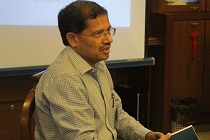
Rajiv Bhatia_Image Courtesy: Gateway House
12 November 2020

India-SCO: New Platform, Common Ground

India will host the 19th meeting of the Council of Heads of Government on 30 November 2020. This will be the first meeting of the grouping’s second highest organ, hosted by India. The significance of the event lies in the timing – India’s relations with two fellow memberstates, China and Pakistan, are at an exceptionally low ebb; yet the clear message from the SCO Secretariat and other member-states is: India’s presence in the SCO is highly beneficial to the latter and should be fully leveraged to strengthen it as an important and upcoming intergovernmental organisation. This necessitates a fresh appraisal of options for India.
shutterstock_1091235845 Courtesy: Shutterstock
15 October 2020

UN: Necessary but reformed

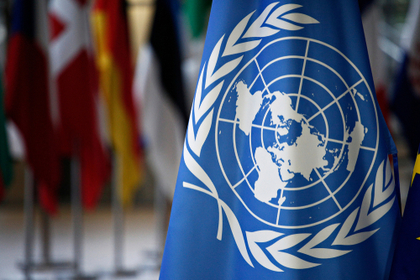
The UN turned 75 this year but instead of grand celebrations, the world witnessed an empty UNGA with world leaders addressing it via video screening because of the pandemic. The UN is under unprecedented stress and being shown up for its inability to tackle the challenges of today like the pandemics, climate change, terrorism or global peace and security. The institution's key governing structures, especially the UN Security Council, are inadequate and demand reform. India must now use gritty resolve to ensure its place in these governing structures.

ibc-center-oil-gaz-4-696x392 Courtesy: ibctrain.com
2 April 2019

India & the influential SCO Energy Club

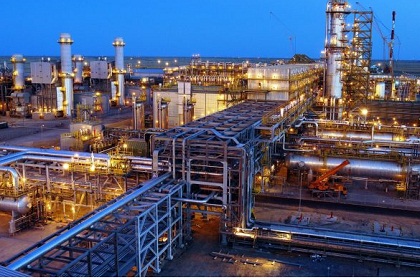
The main objective of the Shanghai Cooperation Organisation’s (SCO) Energy Club, when Russia formed it, was to market its member states’ substantial oil and natural gas reserves. This map shows some of the important natural gas pipelines, originating from Russia and its neighbouring countries that are not members of the SCO. What can India do to secure supplies from these abundant but currently inaccessible natural gas reserves?

2-8-18 CableMap-02 - Copy Courtesy: Gateway House
2 August 2018

Version 2: Mapping China’s global telecom empire

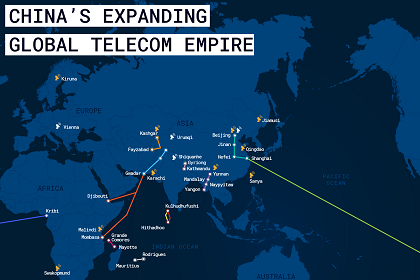
This version of the Gateway House Map on China’s Expanding Global Telecom Empire identifies some more telecommunication assets -- optic-fibre and satellite ground stations -- that Beijing is working on in South and Central America, Africa, Myanmar, the Indian Ocean Region and mainland China besides the existing ones, such as the Pakistan East Africa Cable Express (PEACE). It shows the direction China’s investment is taking, its diplomatic overtures and the larger geopolitical implications of its growing telecom empire

2015_Summit_of_the_Shanghai_Cooperation_Organization_03 Courtesy: Wikipedia
29 April 2016

India in the SCO: win-win

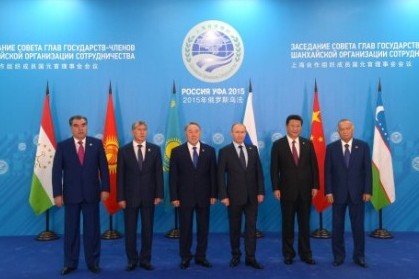
India’s forthcoming membership in the Shanghai Cooperation Organization (SCO) will benefit the SCO, Central Asia, Russia, China, as well as India itself. While India will be able to promote its own security, strategic, trade, economic, and energy interests in Central Asia, the SCO will benefit from India's rapid growing economy and its experience in counter-terrorism.

Global Stability Map Courtesy: Gateway House
1 August 2012

Global Stability Map 2012

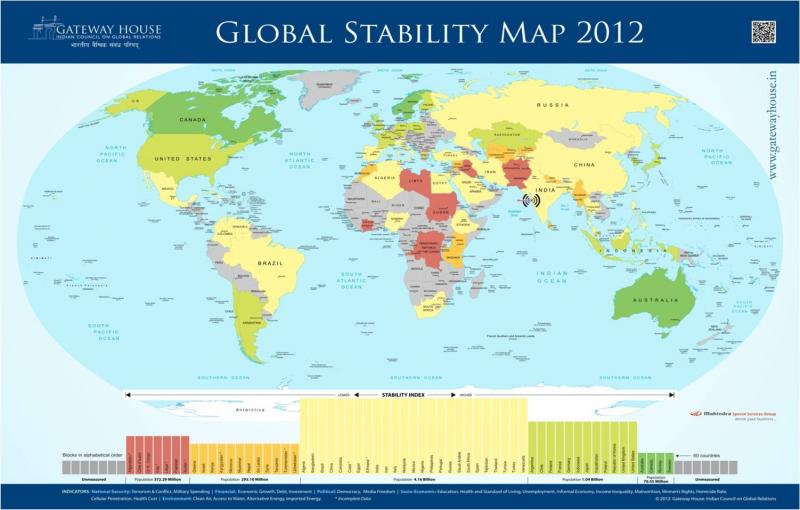
Gateway House prepared a Global Stability Map, using 20 differing indicators, to analyze the stability of 60 countries around the world. Using criteria that are important to the emerging economies of the world, the map provides an Indian perspective of the world today.

debnath shaw Courtesy: Gateway House
5 July 2012

“Russia still dominates Central Asia”

Though some countries like Russia gained a strong foothold in Central Asia and the Caucasus post-1991, India has been a late-comer. Gateway House interviews former Ambassador to Azerbaijan Debnath Shaw to discuss India’s energy interests in the region, the Shanghai Cooperation Organization and the TAPI pipeline.

India and Russia: a new Central Asian engagement Courtesy: PMO
8 February 2012

India and Russia: a new Central Asian engagement

India will do well to expand its positive and trust-laden cooperation with Russia in commerce, technology, and education, into a broader regional one, and establish a more meaningful presence in Central Asia. This will also assist in the future acquisition of energy resources in the region.