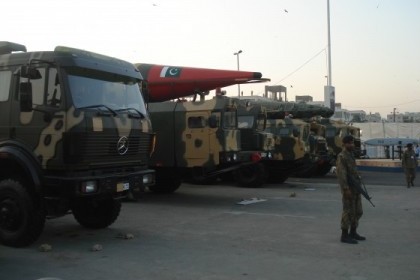
Military_truck_carrying_IRBMs_of_Pakistani_Army Courtesy: Wikipedia
3 September 2015

U.S.-Pakistan: A new nuke normal

A report by the Carnegie Endowment and the Stimson Center attempts to recognise Pakistan’s nuclear programme as ‘normal’ and India’s as not. However, with dangerous new additions to Islamabad’s arsenal, a throwback to simplistic US rationalisations still won’t bring Pakistan into the non-proliferation mainstream.
Mortar_attack_on_Shigal_Tarna_garrison,_Kunar_Province,_87 Courtesy: Erwin Franzen/Wikimedia
14 August 2015

Pakistan’s House of Cards

The August attack in Kabul and the now public disclosure of the death of Taliban leader Mullah Omar has caused Afghan President Ashraf Ghani to shift in outlook towards Pakistan. The "Pakistan-led" peace process is now tumbling like a house of cards backed implicitly by the United States.

People of Nagaland Courtesy: Homen Biswas/Wikimedia
13 August 2015

India: the East has Peace

As India celebrates its Independence Day, security situation on eastern borders is gradually moving towards stability with experiments in peace making focused on resolving insurgencies and border management. These experiments coupled with the sub-regional economic initiatives potentially put eastern region on the path of prosperity.

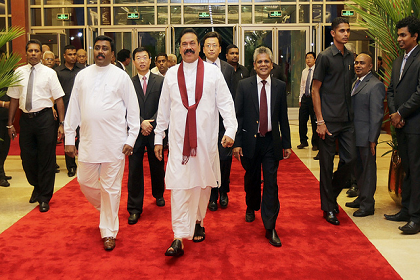
rajapaksa Courtesy: Sudath Silva/Flickr
12 August 2015

Will Rajapaksa return?

After losing power in January, Mahinda Rajapaksa, former president of Sri Lanka, is trying to re-enter politics by contesting for the prime minister’s seat in the elections on August 17. If he wins, it could destabilise Sri Lanka’s politics and impact relations with India, which had been hit under Rajapaksa’s rule. The future scenario will become clearer by next week.

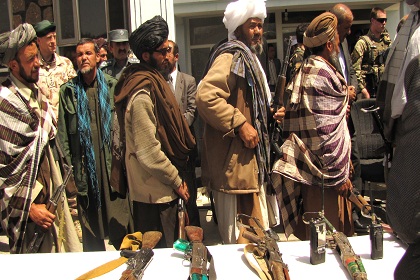
Former_Taliban_fighters_return_arms Courtesy: Wikipedia
23 July 2015

No peace in Kabul without Delhi

The recent meeting between the Taliban and the Afghan governments– brokered China– holds promise to bring peace to Afghanistan. However, the absence of India at the table notable. Given India's investments in Afghanistan and geopolitical importance, China must seek to bring India to the table, otherwise peace will remain elusive

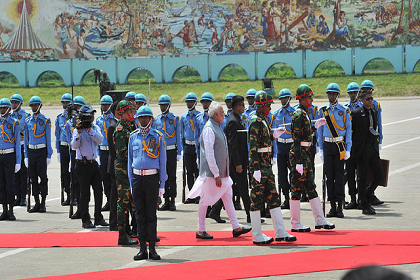
Modi walking Courtesy: Ministry of External Affair, Flickr
11 June 2015

Bangladesh and beyond

Prime Minister Narendra Modi’s completion of the South Asia circuit demonstrates the importance of the neighbourhood in his government’s foreign policy. The improved perception of India in the neighbourhood, especially in Bangladesh and Sri Lanka, is a positive, but the neighbours must recognise that India’s federal structure makes decision-making slower and more difficult on issues that affect neighbouring Indian states like West Bengal and Tamil Nadu.

Sharif-Xi jinping Courtesy:
14 May 2015

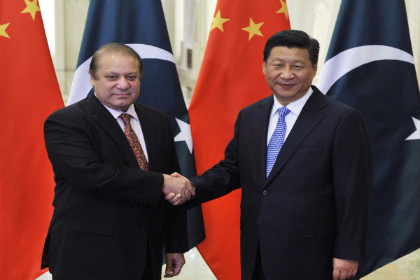
OBOR and India’s security concerns

While China will seek India’s cooperation on its ambitious ‘One Belt, One Road’ project during Prime Minister Modi’s visit this week, Indian policy makers must soon articulate a definite stand on this transnational corridor by bridging the country’s security concerns and the benefits of such an engagement with China.

17111184050_a38f69f6cb_z Courtesy: MEA/Flickr
29 April 2015

Ghani and India: circles of separation

Afghan president Ashraf Ghani visited India from April 27-29. Ghani accords a very different priority to India than his predecessors – both the timing and the outcome of his visit reflected this. He is choosing to play to Pakistan, by keeping India out of Afghanistan's security sector