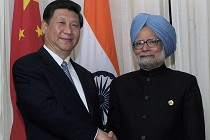
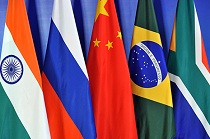
Indian foreign policy has not yet addressed the ramifications of Chinese economic dominance in BRICS. Nor have we matched China’s engagement within the group to ensure that the BRICS vision of a new international order for emerging economies actually works in their favour.
At the 5th BRICS Summit that begins in South Africa today, the heads of state of Brazil, Russia, India, China and South Africa are expected to ratify the creation of the BRICS Bank. After discussion and study for over a year by the respective governments, the bank will be launched with seed money estimated at between $50 billion to $100 billion, and most likely an equal share of voting rights for the management of the bank. What remains
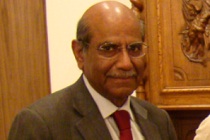
The establishment of a BRICS Development Bank will be among the prime topics of discussion at the BRICS Summit on March 26. Gateway House’s Akshay Mathur interviews former Indian Ambassador and Foreign Secretary, Shyam Saran, on the prospects and viability of alternate financial architectures.
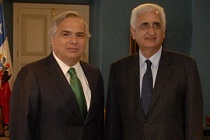
Indian Foreign Minister Salman Khurshid’s February 5 visit to Chile and Argentina is emblematic of the new era in Indo-Latin America relations. What does this increased engagement mean for India and Chile, two rapidly growing economies of the Global South?
The year 2012 has been a busy one for foreign policy: from escalating disputes in the South China Sea to alternate financial instruments from the emerging world. India’s foreign policy too has its shown strengths and weaknesses. We present our top foreign policy Hotspots, Sweet spots and Blind spots for 2012.
Ambassador Jorge Heine's latest book, La Nueva India, gives a comprehensive overview of India after the economic liberalisation of 1991, and explores how Latin America can learn from India's experiences.
There’s been much talk about the “the rise of the rest,” with Brazil, Russia, India, and China leading the charge. However, few countries can sustain unusually fast growth for a decade, and even fewer, for more than that. As the boom years begin to end, the international order won’t change as much as expected.
All the major economic forces in the world have come together in Africa in a new version of the Great Game. The competition for the continent’s resources will ultimately harm Africa unless Africa uses this opportunity to its advantage and to address its own serious problems.
As India looks to diversify its sources for energy imports and grapples with food security issues, it is looking more towards Latin America. Gateway House interviews Ambassador Deepak Bhojwani to discuss India’s prospects with this increasingly significant region.
CELAC (Community of Latin American and Caribbean States) chose India as its first dialogue partner, expressing its intent to expand trade and diversify. Given the increased political will from both sides, can CELAC be the driver for India-Latin America relations or will bilateral ties maintain the status quo?