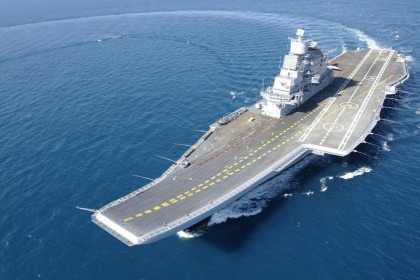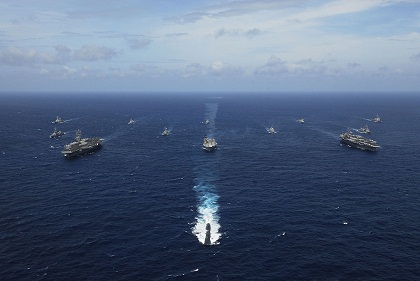
1200px-Malabar_07-2_exercise Courtesy: Wikipedia
14 February 2017

A democratic quadrilateral in Asia?

A strategic coming together of the U.S., Japan, Australia, and India was close to fruition some years ago, impelled initially by the tsunami of 2004. The spirit of the enterprise remains alive even now, and there are many merits in India joining the quad, but such an arrangement can skew existing Asian equations, jeopardising the Act East policy

28455374735_17cf79553a_b Courtesy: Flickr
31 January 2017

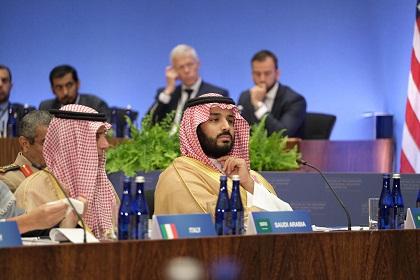
Saudi prince: not quite a game changer?

Prince Salman’s accession to the throne after the death of Saudi King Abdullah on 23 January 2015 has been a game changer, both domestically and in West Asian politics. Within days, he sidelined rivals within the House of Saud, and took on Iran with a confrontational policy. But two years later, the results of his new strategy disappoint

NATO Courtesy: NATO/Flickr
21 July 2016

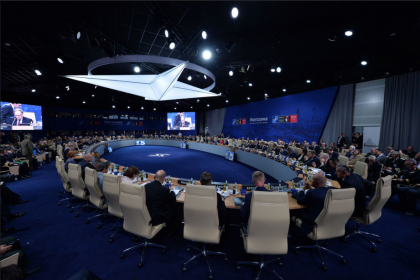
Brexit, NATO, EU: emerging dichotomies

In the aftermath of Brexit, the recently concluded NATO Summit highlighted the emerging asymmetry between NATO and the EU on their respective policy positions towards Russia. Has the expansion of NATO and the EU to absorb Eastern Europe, and the consequent large migration flows, been responsible for the visible cracks within the Europe?

1023-modi-cameron-mea Courtesy: MEA / Flickr
30 June 2016

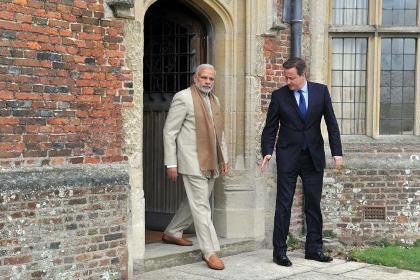
The dislocations of Brexit: can India gain?

The result of the Brexit referendum is nothing less than a body blow to Bretton Woods organisations, International Monetary Fund-North Atlantic Treaty Organisation (NATO)-World Bank, that originated at the end of the Second World War. The possibility of an Asian century becomes more feasible, if India can be nimble enough to make the most of the opportunity which has presented itself in Europe.

070822-A-6849A-667 -- Scouts from 2nd Battalion, 503rd Infantry Regiment (Airborne), pull overwatch during Operation Destined Strike while 2nd Platoon, Able Company searches a village below the Chowkay Valley in Kunar Province, Afghanistan Aug. 22. Courtesy: Wikipedia
5 February 2016

Obama needs to rethink, urgently

A resurgent Taliban has turned a hopeful declaration by the Obama administration into a premature one. The levels of U.S. troops stationed in Afghanistan, currently at 9,800, are expected to increase as a result. But with more than half a trillion dollars spent trying to stabilize the problem, perhaps it’s time to rethink the Af-Pak region.

Modi Obama Wiki Courtesy: Wikipedia
21 October 2015

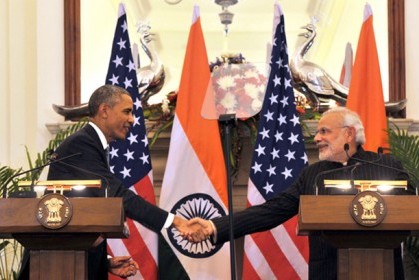
Building on India-U.S. meeting points

Modi’s second visit to the U.S. in September indicates a growing partnership in such areas as business, technology, and climate change. Though gaps too remain—for example, India is not part of the TPP and its bid for a UNSC seat is on hold—for now, it is time to consolidate bilateral meeting points, and India can start by simplifying its trade policy and tariff structure

U.S. Mission / Eric Bridiers Courtesy: Wikipedia
8 October 2015

UNSC and sanctions: a balanced role

The sanctions against Iran impacted the country’s oil, banking, aviation, and other sectors, and had a major humanitarian impact. But neither is armed attack a more suitable method in most instances to address allegedly recalcitrant states. What then is the middle ground? And can the UNSC assume a more proactive role in this context?

UN-Sicherheitsrat_-_UN_Security_Council_-_New_York_City_-_2014_01_06 Courtesy: Wikipedia
24 September 2015

The UN at 70: reform or retire?

On 14 September, a UN General Assembly resolution called for reform of the Security Council (SC). But when the world is in turmoil and alternative multilateral institutions are emerging, this may be a case of too little being done too late. It is imperative now for the SC to include India, Brazil, Germany, and Japan and adapt to a rapidly evolving world.